Southeastern's MSN Family Nurse Practitioner program, from first course to Family Health III
Southeastern Louisiana University's MSN Family Nurse Practitioner concentration is 42 credit hours over five semesters in the 2026-27 catalog, taught online through a four-university consortium. The clinical half is three Family Health courses totaling 750 practicum hours, all in Louisiana, each with a preceptor you propose and course faculty approve. This guide covers the plan, the admission gates and how we line up those preceptors for you.
Get FNP preceptors lined up early
Tell us your start term and where in Louisiana you live, and your placement advisor maps all three Family Health courses.
How the program is built
The FNP concentration belongs to the Intercollegiate Consortium for a Master of Science in Nursing, which Southeastern runs with McNeese State, Nicholls State and the University of Louisiana at Lafayette. You pick a home school that keeps your records and awards the master's. Choose Southeastern and you graduate from Southeastern, while some of your courses are taught by faculty at the other three schools. The consortium guide explains the home-school rules.
Theory courses are delivered online, and Southeastern says most courses, core courses above all, run fully online. Admission opens three times a year: the MSN admissions page gives November 15 for spring, May 16 for summer and July 15 for fall. Full-time study in the catalog means 7 to 10 credit hours each semester and part-time means 6; by Southeastern's own account, part-time is what most of its MSN students choose. Whatever your pace, you have six years from your first course to finish.
Admission and the gates before your first clinical
Entry requires an unencumbered Louisiana RN license and a cumulative undergraduate GPA of at least 2.7, per the 2026-27 catalog. Once enrolled, you complete background checks, drug and alcohol screening and the program's health requirements at your own expense, and CPR certification has to stay current through every practicum course.
A second gate stands in front of NURS 6820. Before any clinical or practicum course, the catalog wants proof of a year working as an RN in a setting that fits the FNP specialty. Under the consortium's student handbook, your Louisiana license must also stay unencumbered from admission to graduation, and the graduate coordinator must hear from you right away about any change.
Costs arrive in pieces. Beyond tuition, the catalog lists a professional fee charged each semester of coursework, fees for proctored online testing and a laboratory fee on each Family Health course. Because the catalog entries leave the amounts out, get today's numbers from the Graduate Nursing Office before you build a budget.
The five-semester plan
The catalog places the advanced sciences first and stacks the clinical courses at the end. Here is the 2026-27 plan as printed, using the focused scholarly project rather than the thesis.
| Semester | Courses | Clinical hours |
|---|---|---|
| 1 | NURS 6000 Theoretical Foundations of Advanced Nursing; NURS 6050 Applied Statistics; NURS 6180 Pathophysiology for Advanced Practice | None |
| 2 | NURS 6020 Generating Evidence; NURS 6070 Health Assessment and Diagnostic Reasoning; NURS 6170 Pharmacotherapeutics | NURS 6070 lab, 4 hours a week |
| 3 | NURS 6090 Population Based Primary Care; NURS 6820 Family Health I | 200 |
| 4 | NURS 6830 Family Health II; NURS 6810 Business, Leadership, and Health Policy; NURS 6950 Focused Scholarly Project or NURS 6990 Thesis | 275 |
| 5 | NURS 6840 Family Health III | 275 |
Picking the thesis adds three credit hours, for 45 in total. For FNP students, NURS 6810 opens only after NURS 6820 is complete, so a late start in Family Health I can delay semester four too.
Three Family Health courses, 750 hours
Every Family Health course combines three hours of didactic work with a semester's worth of precepted practice, and each one centers on a different population. Family Health I asks for 200 hours with children and child-bearing women, Family Health II 275 hours with adults, and Family Health III 275 hours with adults and older adults. That makes three preceptor searches, not one.
The catalog adds the three to 750, yet Southeastern's majors page for the concentration still shows 600 clinical hours. The catalog is the newer and more detailed document, so plan for 750 and raise any mismatch with your advisor. The FNP hours guide breaks the total down further.
Our own arithmetic, not a Southeastern figure: a fall or spring semester runs about 16 weeks, so 200 hours works out to roughly 12 or 13 hours a week and 275 hours to about 17, before holidays or a late start. If a clinical course lands in a summer semester, which ran June 3 to August 3 in 2026, the same hours squeeze into about nine weeks. None of these totals can include time your employer is paying you for.
Every clinical hour happens in Louisiana
Southeastern's MSN page is direct about it: clinical hours are completed in Louisiana, so living near Mississippi or Texas does not open a clinic across the line. Louisiana's nursing board layers on its own conditions. Every preceptor must hold a Louisiana RN or APRN license that is active and carries no encumbrance, the larger share of your hours belongs with an APRN certified for the family population, and one preceptor may supervise no more than two graduate APRN students in a given clinical experience.
Physicians can carry part of the load. Southeastern's graduate page names both advanced practice nurses and physicians as preceptors, and the board allows a mix of clinicians. For an FNP student, a family nurse practitioner is the natural core, with a pediatrician or an obstetric practice covering a specific gap once course faculty agree. The Louisiana-only clinicals page covers the rule and its edge cases.
Choosing preceptors for the FNP courses
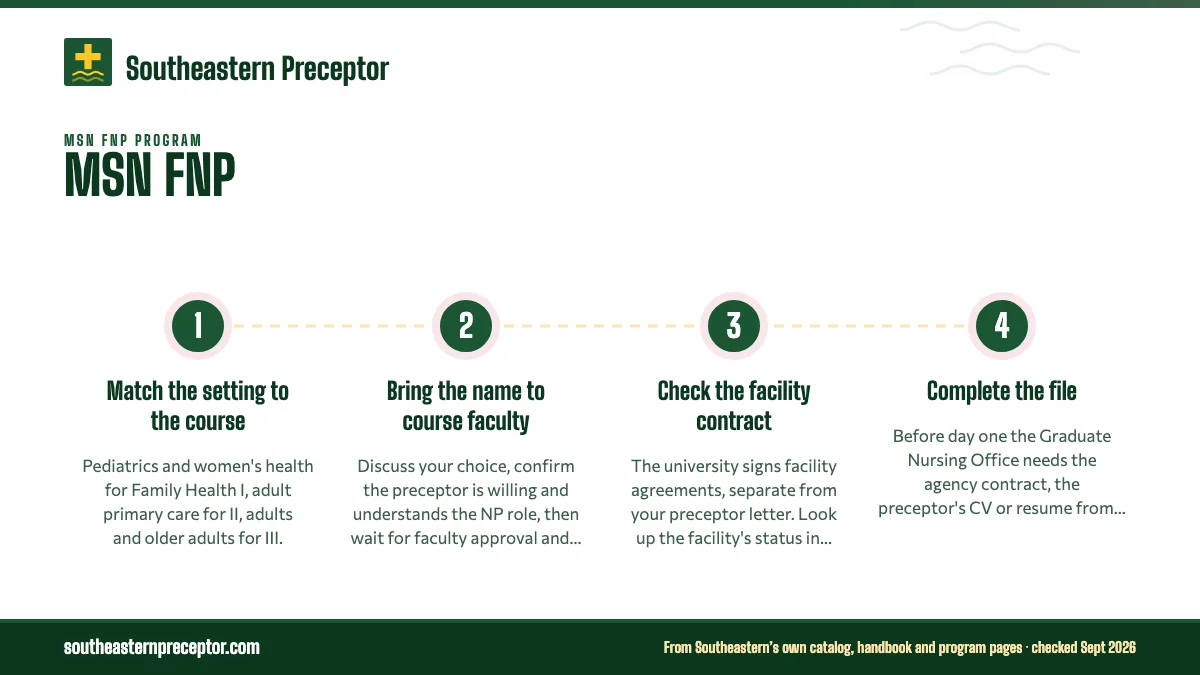
Southeastern's graduate students choose their own preceptors in collaboration with course faculty, who approve each one, and the graduate coordinator reviews every choice before an hour counts. The consortium also keeps a list of past and current preceptors it can recommend. Choosing your preceptor has the exact wording. Each Family Health course moves through the same four steps.
- Match the setting to the coursePediatrics and women's health for Family Health I, adult primary care for II, adults and older adults for III.
- Bring the name to course facultyDiscuss your choice, confirm the preceptor is willing and understands the NP role, then wait for faculty approval and the graduate coordinator's review.
- Check the facility contractThe university signs facility agreements, separate from your preceptor letter. Look up the facility's status in the clinical tracking system; if no agreement exists, securing one can run from several weeks to a few months.
- Complete the fileBefore day one the Graduate Nursing Office needs the agency contract, the preceptor's CV or resume from the last two years, a letter of agreement signed by you, faculty and preceptor, and your health and training records.
Large Louisiana systems add their own terms. Ochsner Health accepts graduate nursing requests only from schools through its InPlace platform and asks students not to contact its clinicians. LCMC Health says it runs no preceptor matching and needs an affiliation agreement first. North Oaks in Hammond takes requests through a web form, but an archived copy of its student page says it offers no pediatric rotations.
Start with Family Health I. Its pediatric and child-bearing women's hours are usually the hardest to place near Hammond: the hometown hospital lists no pediatric rotations, and the state's children's hospitals sit outside the Northshore, in Baton Rouge, New Orleans, Lafayette and Shreveport.
What we do for Southeastern FNP students
We plan all three Family Health courses at once instead of one semester at a time. Your placement advisor looks for a pediatric and women's health setting for NURS 6820 and adult and older-adult practices for NURS 6830 and NURS 6840, in the part of Louisiana where you live and work, with preceptors who hold Louisiana licenses and family population certification.
Before anything reaches your course faculty, we check the fit: the preceptor's license and certification, whether the facility already has a contract with Southeastern or what the university will need to start one, and a schedule that sits outside your paid hours. You get the preceptor's CV, the facility details and a clear summary for the faculty conversation, so faculty review and the contract paperwork can run side by side.
Then we stay on call. If a preceptor leaves mid-semester, the placement desk starts on a replacement right away and checks it against the same course rules. Tell us your start term on the request form and we begin with Family Health I.
Questions Southeastern students ask
Is Southeastern's MSN FNP program fully online?
The coursework is online and the MSN pages list no required campus visit. Your 750 clinical hours happen in person with Louisiana preceptors, and course faculty make a site visit to each student. NURS 6070 also carries four lab hours a week, and Southeastern's pages do not say where those take place, so ask your advisor before you register.
Which certification exams can Southeastern FNP graduates take?
Southeastern says FNP graduates meet the educational requirements for either the American Nurses Credentialing Center or the American Association of Nurse Practitioners family nurse practitioner exam. Louisiana then requires national certification before it grants an APRN license. Southeastern publishes no pass-rate figures for its NP graduates, so weigh any number you see elsewhere with care.
Can I enroll in the FNP program if I live in Mississippi?
Southeastern publishes no rule on where MSN students must live, but it does require an unencumbered Louisiana RN license and clinical hours completed in Louisiana. A resident near the state line could meet both by driving to Louisiana preceptors. Talk to the graduate coordinator before applying, since Southeastern warns that moving states during a program can affect whether you continue.
What grade do I need in the Family Health courses?
A B or better in every course to progress. A grade below B means probation and a repeat within two regular semesters, and a D or F means dismissal. A poor final clinical evaluation, whether it comes from the preceptor or from faculty, becomes an F under the consortium handbook, which is one more reason a well-matched preceptor matters.
How does the MSN FNP differ from Southeastern's BSN to DNP FNP?
Both use the same three Family Health courses and the same 750 clinical hours. The BSN to DNP adds doctoral courses and a residency for 70 credit hours over nine semesters in the catalog, and its plan notes that students may finish with the MSN along the way. The master's is the shorter route to FNP certification eligibility.
Related pages
Last checked 2026-09-27
We check these pages against Southeastern's own catalog, program pages and consortium handbook, and Louisiana rules. Your course faculty, the graduate coordinator and your advisor have the final word.
- Southeastern catalog 2026-27: Nursing, MSN, Family Nurse Practitioner Concentration
- Southeastern: MSN program page
- Southeastern: MSN Family Nurse Practitioner majors page
- ICMSN student handbook (Southeastern-hosted copy; preceptor steps unchanged in the October 2025 revision)
- Louisiana Administrative Code 46:XLVII.3543, preceptorships
Southeastern asks you to choose your preceptor. We find one near you.
Tell us your Southeastern track, where in Louisiana you live and when your next clinical course starts. We find Louisiana-licensed preceptors who fit the course, confirm whether the facility is already under contract with the university, and hand you what your course faculty need to approve it before the semester.
- Pediatric and women's health preceptors for
NURS 6820, adult and older-adult primary care forNURS 6830andNURS 6840 - Psychiatric preceptors for
NURS 6910toNURS 6930, with the child and older-adult focus each course sets - Across Louisiana, from the Northshore to Shreveport
Start your placement plan
Program, city and start date is all we need to begin.