Southeastern's post-master's Family Nurse Practitioner certificate
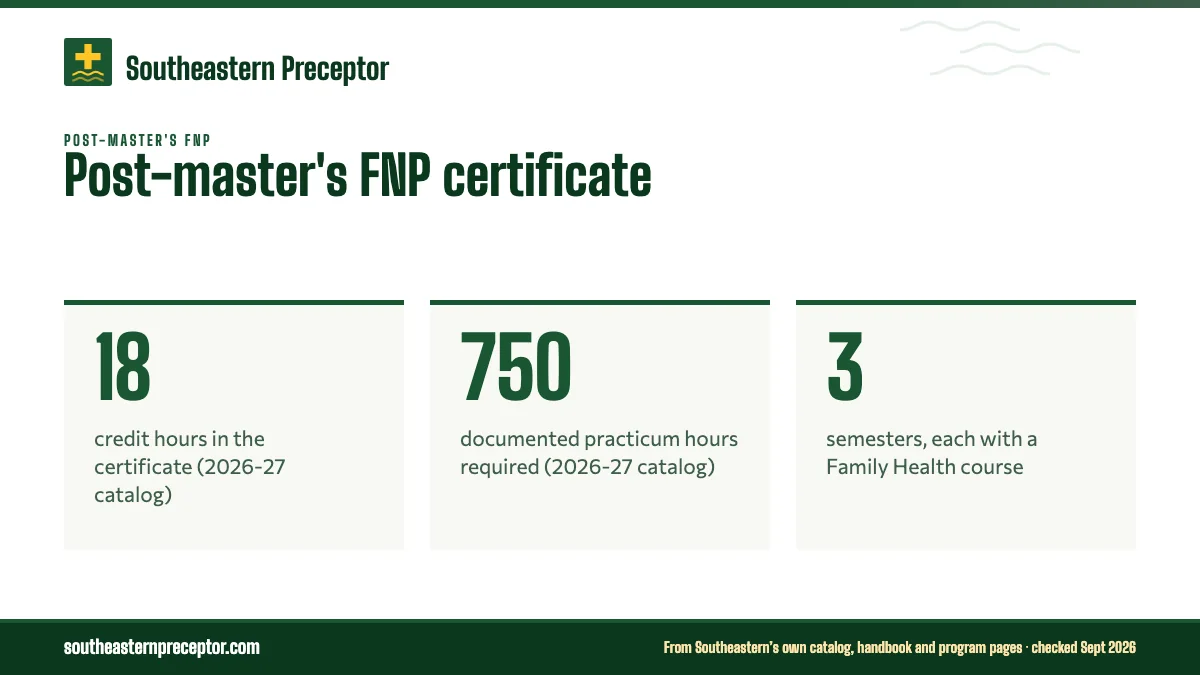
Southeastern Louisiana University's post-master's FNP certificate packs 18 credit hours into three semesters, and every one of them is a clinical semester. You take Family Health I, II and III plus the NP policy course for 750 documented practicum hours, starting in spring or fall. With no didactic runway, you need a preceptor ready for the first week, and that is the part we handle.
Have a preceptor ready for semester one
Tell us when you plan to start and where in Louisiana you practice, and your placement advisor begins with Family Health I.
Where the certificate is listed
The FNP certificate is easy to miss. Southeastern's 2026-27 catalog describes it in full, a majors listing shows it as online with 18 semester hours, and the School of Nursing names a post-MSN FNP certificate among its fully online programs. The School of Nursing's post-master's section, however, only describes the PMHNP certificate, so the catalog is your main written source for this one.
The catalog calls the program accelerated, notes that it carries full approval from the Louisiana State Board of Nursing, and admits students in spring and fall. Its model is simple: didactic courses online, and practicum courses that combine online work with clinical time beside a preceptor who is an approved advanced practice clinician, with graduate faculty guiding the work. Southeastern offers its post-master's certificates in affiliation with the consortium that runs the MSN.
Who it serves reads two ways. Southeastern's graduate programs page frames the certificates as a way for adult nurse practitioners to care for patients across the lifespan, while the catalog entry admits applicants holding a master's in nursing from a nationally accredited program.
Admission and the gap analysis
You need a Louisiana RN license without encumbrance and a GPA of 3.0 or higher across all graduate work, per the catalog; applicants already practicing as nurse practitioners also show a Louisiana APRN license, per the post-master's admission page. Screenings for background, drugs and alcohol, plus the health requirements, come after admission and at your cost.
The step that sets your timeline is the gap analysis. The graduate coordinator reviews your transcript for advanced health assessment, advanced pharmacotherapeutics and advanced pathophysiology to judge whether they covered the full lifespan, and may ask for course syllabi. Anything missing becomes a requisite you finish before the certificate begins, which moves your first clinical semester later.
Southeastern's post-master's admission page also mentions an onsite orientation for certificate students, to be scheduled. Because that part of the site describes only the PMHNP certificate, ask the Graduate Nursing Office whether the orientation applies to FNP students as well.
Three semesters, three clinical courses
Unlike the MSN, the certificate has no theory semesters in front of the clinicals. The catalog plan goes straight into the Family Health sequence:
| Semester | Course | Credits | Practicum hours |
|---|---|---|---|
| I | NURS 6820 Advanced Practice Nursing: Family Health I | 5 | 200 |
| II | NURS 6830 Advanced Practice Nursing: Family Health II | 5 | 275 |
| III | NURS 6840 Advanced Practice Nursing: Family Health III | 5 | 275 |
| III | NURS 6810 Business, Leadership, and Health Policy for Nurse Practitioners | 3 | None |
These are the same courses MSN students take, with the same populations: children and child-bearing women in Family Health I, adults in Family Health II, and adults and older adults in Family Health III. The catalog numbers the semesters I to III without naming calendar terms, so confirm with the graduate coordinator which terms your three courses fall in, especially if one of them lands in summer.
What 750 hours in a year means
The catalog asks for 750 documented practicum hours, and the certificate's majors listing gives no competing hour figure. Our arithmetic, not Southeastern's: spread across three consecutive 16-week semesters, that averages close to 16 hours a week for roughly a year, with Family Health I lighter than the two courses after it and no semester off in between.
For a working nurse practitioner, that is the hard part. Hours count only when they fall outside paid work, so if you already see patients at a clinic, clinical days have to come from time off or unpaid time there. Three preceptors in a row, each approved before its semester, leave little room for a search that starts late. The FNP hours guide lays the totals out course by course.
Start the Family Health I search when you apply, not when you are admitted. Semester I is a clinical semester from its first week, and a new facility contract alone can take weeks to months.
Preceptors, Louisiana and the approval steps
The catalog entry for this certificate carries no Louisiana-only sentence of its own, unlike the PMHNP certificate's page. Still, it uses the MSN's clinical courses, which Southeastern's MSN page keeps in Louisiana, it requires a Louisiana RN license, and Louisiana's board requires preceptors with an active Louisiana license. Plan on Louisiana and confirm with the graduate coordinator; the Louisiana-only clinicals page has the details.
Approval runs as it does for MSN students. You propose a preceptor to course faculty, who approve, and the graduate coordinator reviews; the university must have an agreement in place with the facility, and the Graduate Nursing Office needs the preceptor's recent CV and a three-way letter of agreement carrying your signature, your faculty member's and the preceptor's before your first hour. Most of your hours should be with a nurse practitioner certified in the family population, with other clinicians used where faculty agree. Choosing your preceptor quotes the consortium's rules.
If you already practice as a nurse practitioner, colleagues who could precept are a head start. Pediatric and women's health hours for Family Health I are the usual gap, and North Oaks in Hammond, according to an archived copy of its student clinical request page, is not taking pediatric rotations.
What we do for certificate students
Certificate students have the shortest gap between admission and the first clinical hour, so we begin the search as you apply. Your placement advisor finds a Louisiana setting that sees children and child-bearing women for NURS 6820, then practices seeing adults for NURS 6830 and adults plus older adults for NURS 6840, and sequences all three so each is ready before its semester opens.
Every preceptor is checked against the course, Louisiana's licensing rule and your paid schedule, and we check the facility's agreement status with the university or collect what a new agreement needs. You get a faculty-ready packet: the preceptor's CV and a short case for the placement. If someone drops out mid-course, the placement desk replaces them. Send your start term through the request form.
Questions Southeastern students ask
Can a nurse educator with an MSN take the FNP certificate?
The catalog entry admits applicants holding a master's in nursing from a nationally accredited graduate program without limiting it to nurse practitioners, though Southeastern's graduate page describes the certificates as a path for adult nurse practitioners. A master's without NP coursework is more likely to trigger requisite courses in the gap analysis, so ask the graduate coordinator before you apply.
Can I keep a full-time job during the FNP certificate?
Only if your schedule leaves room. The consortium handbook counts practicum hours solely when they fall outside paid work, and each semester needs 200 or 275 of them. Map clinical days onto your work calendar before the semester begins, and tell course faculty early if a rotating shift pattern makes steady clinical days hard to hold.
What does the FNP certificate cost beyond tuition?
Each Family Health course carries a laboratory fee in the catalog, and certificate students also pay for background checks, drug and alcohol screening and the clinical tracking subscription. None of these amounts is printed in the catalog entries, so ask the Graduate Nursing Office for current figures, and budget for travel to clinical sites across three straight semesters.
Do certificate students pay for a clinical tracking system?
Yes. The consortium handbook makes NP practicum students pay for the tracking system named by their home school and keep that subscription active for as long as they take practicum courses. You log patient contact hours there and post your approved schedule. Southeastern does not publish the current system's name or price for these courses, so course faculty will point you to it.
Can I start the FNP certificate in summer?
No. The catalog admits certificate students in spring and fall only, unlike the MSN, which also takes summer admits. Since semester I is Family Health I, your admission term is usually the term your first 200 hours begin, unless the gap analysis adds a requisite course first, so run your preceptor search alongside your application.
Related pages
Last checked 2026-09-27
We check these pages against Southeastern's own catalog, program pages and consortium handbook, and Louisiana rules. Your course faculty, the graduate coordinator and your advisor have the final word.
Southeastern asks you to choose your preceptor. We find one near you.
Tell us your Southeastern track, where in Louisiana you live and when your next clinical course starts. We find Louisiana-licensed preceptors who fit the course, confirm whether the facility is already under contract with the university, and hand you what your course faculty need to approve it before the semester.
- Pediatric and women's health preceptors for
NURS 6820, adult and older-adult primary care forNURS 6830andNURS 6840 - Psychiatric preceptors for
NURS 6910toNURS 6930, with the child and older-adult focus each course sets - Across Louisiana, from the Northshore to Shreveport
Start your placement plan
Program, city and start date is all we need to begin.