Southeastern's MSN Psychiatric Mental Health NP program and its four clinical steps
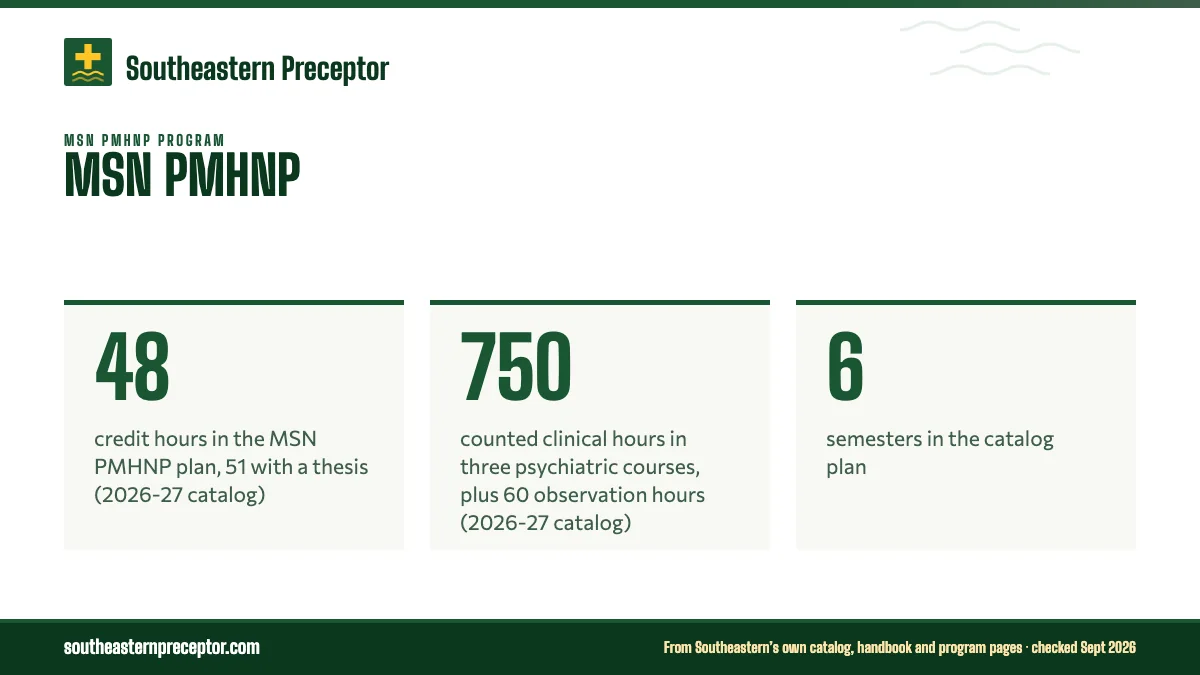
Southeastern Louisiana University's MSN in psychiatric mental health runs 48 credit hours over six semesters in the 2026-27 catalog, online through the four-school consortium. Its clinical side opens with 60 hours of psychotherapy observation, then moves through three Psychiatric/Mental Health courses worth 750 counted hours, all with Louisiana preceptors that course faculty approve. Psychiatric preceptors are scarce across the state, so the search deserves an early start.
Find your psychiatric preceptors early
Share your start term and home parish, and your placement advisor plans the observation course and all three psychiatric clinicals.
The program at a glance
The catalog files this track as the Psychiatric/Mental Health Curriculum within the MSN's nurse practitioner concentration, one of only two NP populations Southeastern teaches; family practice is the other. It is taught through the Intercollegiate Consortium for a Master of Science in Nursing, whose other members are McNeese, Nicholls and UL Lafayette, and students who name Southeastern as their home school keep their records and graduate there. The consortium guide shows how the shared courses work.
The entry bar is the same as for the other MSN tracks: an unencumbered Louisiana RN license and an undergraduate GPA of 2.7 or higher, then screenings and health requirements after enrollment, paid by you. A further requirement applies before the first practicum course: twelve months as an RN in a setting the catalog deems appropriate to the specialty. The graduate coordinator can confirm which psychiatric or behavioral settings qualify.
Southeastern admits MSN students in spring, summer and fall. The psychiatric courses, though, are pinned to particular terms in the plan, and that calendar decides when you need each preceptor.
Six semesters, term by term
The first two semesters cover shared science and research courses plus NURS 6080, the diagnostic and psychopharmacology course that opens the psychiatric content. From semester three on, the catalog marks each psychiatric course for a single term.
| Semester | Courses | Clinical hours |
|---|---|---|
| 1 | NURS 6000 Theoretical Foundations; NURS 6050 Applied Statistics; NURS 6170 Pharmacotherapeutics | None |
| 2 | NURS 6020 Generating Evidence; NURS 6070 Health Assessment and Diagnostic Reasoning; NURS 6080 Diagnostic Considerations and Psychopharmacology | NURS 6070 lab, 4 hours a week |
| 3 | NURS 6090 Population Based Primary Care; NURS 6180 Pathophysiology; NURS 6900 Psychotherapy (fall only) | 60 observation |
| 4 | NURS 6910 Psychiatric/Mental Health I (spring only) | 200 |
| 5 | NURS 6920 Psychiatric/Mental Health II (fall only); NURS 6810 Business, Leadership, and Health Policy; NURS 6950 or NURS 6990 | 275 |
| 6 | NURS 6930 Psychiatric/Mental Health III (spring only) | 275 |
Swapping the focused scholarly project for a thesis brings the total to 51 credit hours. The term labels come from the MSN plan, but the course descriptions list NURS 6900 for both fall and spring, and the BSN to DNP plan schedules the same courses in other terms, so confirm your own sequence with your advisor. Our reading of the MSN plan: from the observation course to Psychiatric/Mental Health III is about two academic years of alternating fall and spring clinicals.
Observation first, then three clinical courses
NURS 6900, the psychotherapy course, asks for 60 hours of observation, and you take it alongside or after NURS 6080. Those hours sit outside the 750 the catalog counts; include them and your total time in practice settings reaches 810, by our arithmetic.
Psychiatric/Mental Health I is 200 hours built around initial diagnostic assessment, basic individual and family psychotherapy, differential diagnosis and risk analysis for common disorders. Psychiatric/Mental Health II is 275 hours across the lifespan with emphasis on children and adolescents, and Psychiatric/Mental Health III is 275 hours centered on older adults, their families and community.
Southeastern's majors page for the concentration lists 600 clinical hours, while the 2026-27 catalog and the three course descriptions both reach 750. Plan for the catalog. The PMHNP hours guide tracks the totals course by course.
The child and adolescent emphasis in Psychiatric/Mental Health II is the placement students most often leave too late. Line up a preceptor who sees children and teenagers a full semester ahead, since that preceptor still needs faculty approval and a facility contract before the fall term opens.
Who can precept a PMHNP student in Louisiana
Southeastern's MSN page keeps every clinical hour inside Louisiana, and state rules add two conditions. Each preceptor must be licensed in Louisiana as an RN or APRN, with the license active and unencumbered. The bulk of your hours must be precepted by an APRN holding psychiatric mental health certification, and other clinicians can cover the remainder.
Psychiatrists can fill part of that remainder, since the state's definition of a graduate preceptor includes physicians alongside APRNs and dentists. One more condition comes from the consortium's faculty handbook: a behavioral health professional who precepts must hold an independent license and cannot be practicing under supervision. Whether such a clinician suits a given course is for course faculty to decide. The Louisiana-only clinicals page walks through the state rule.
One practical difference from other clinicals: the consortium handbook excuses the usual white lab coat in psychiatric settings where it does not fit, though your consortium name tag stays on at every practicum.
Finding psychiatric preceptors across Louisiana
Need runs high on the patient side. HRSA's shortage data show whole-parish mental health shortage areas around Hammond, with high-needs designations in Tangipahoa, St. Helena and Washington and a geographic designation in Livingston. A shortage designation means too few mental health clinicians for the population, which also means fewer potential preceptors for each student looking.
Hospitals are one route. Federal hospital data list several psychiatric hospitals on the Northshore, including Universal Behavioral Health Hospital in Hammond, Northlake Behavioral Health System in Mandeville, Oceans Behavioral Hospital of Kentwood, Beacon Behavioral Hospital in Lacombe and Greenbrier Behavioral Health in Covington, and the state runs Eastern Louisiana Mental Health System in Jackson. None of them posts a PMHNP student process on its website that we could find, so each begins with a conversation and a contract.
Outpatient psychiatric practices, community mental health clinics and community health centers are the other route, and they can suit the lifespan emphases well. The big systems follow their own rules: Ochsner Health takes graduate nursing requests only from schools through InPlace and tells students to route every request through their school rather than approach its providers, and LCMC Health requires an affiliation agreement and runs no preceptor matching. The Northshore guide maps the home region.
What we do for Southeastern PMHNP students
We map the four psychiatric courses together: a psychotherapy setting where you can observe for NURS 6900, then preceptors for adult diagnostic work in NURS 6910, children and adolescents in NURS 6920 and older adults in NURS 6930, each timed to the term your plan sets. Your placement advisor searches your part of Louisiana first and widens only as far as you are willing to drive.
Each candidate is vetted before you raise the name with course faculty: a Louisiana license, psychiatric mental health certification for the preceptors carrying most of your hours, room to take a student, and the facility's contract status with the university. You receive the preceptor's CV, the site details and a short brief for the faculty conversation.
If a preceptor steps away mid-semester, the placement desk replaces them against the same checks, so your hours keep moving. Begin with the request form.
Questions Southeastern students ask
Can I start the PMHNP concentration in any semester?
Southeastern admits MSN students in spring, summer and fall, but the MSN plan ties NURS 6900 to fall, NURS 6910 to spring, NURS 6920 to fall and NURS 6930 to spring. Your start term decides when you reach that sequence, so ask your advisor to map your exact terms before you approach any preceptor.
Can a psychiatrist be my only preceptor for the PMHNP hours?
Not for all 750 hours. Louisiana's board requires most graduate APRN clinical time to be with an APRN whose certification matches the student's population, here psychiatric mental health, though physicians may precept a share. A psychiatrist can be a strong second preceptor in a course, provided course faculty approve and the site has a contract with the university.
Do I have to write a thesis in the PMHNP program?
No. The fifth semester offers NURS 6950 Focused Scholarly Project or NURS 6990 Thesis. The scholarly project keeps the program at 48 credit hours, and the thesis raises it to 51. Your clinical hours and psychiatric courses stay exactly the same whichever you choose.
Is the MSN the only way to become a PMHNP through Southeastern?
No. A nurse practitioner already certified in another population can take the post-master's PMHNP certificate, and a nurse with a BSN can choose the BSN to DNP with a PMHNP concentration, 76 credit hours in the catalog. Post-master's DNP students can add the certificate too. All of these routes share the psychiatric clinical courses, with a shorter final course for certificate students.
Can I count hours at the behavioral hospital where I work?
Only hours you are not paid for. The consortium handbook lets you use a preceptor at your own employer, but clinical time has to be kept apart from your job and fall outside the hours you are paid for. A staff nurse at a behavioral hospital can ask an NP there to precept on days off, after the site's university agreement and faculty approval are settled.
Related pages
Last checked 2026-09-27
We check these pages against Southeastern's own catalog, program pages and consortium handbook, and Louisiana rules. Your course faculty, the graduate coordinator and your advisor have the final word.
Southeastern asks you to choose your preceptor. We find one near you.
Tell us your Southeastern track, where in Louisiana you live and when your next clinical course starts. We find Louisiana-licensed preceptors who fit the course, confirm whether the facility is already under contract with the university, and hand you what your course faculty need to approve it before the semester.
- Pediatric and women's health preceptors for
NURS 6820, adult and older-adult primary care forNURS 6830andNURS 6840 - Psychiatric preceptors for
NURS 6910toNURS 6930, with the child and older-adult focus each course sets - Across Louisiana, from the Northshore to Shreveport
Start your placement plan
Program, city and start date is all we need to begin.