How we find your Southeastern preceptor, course by course
Southeastern Louisiana University asks its graduate nursing students to choose their own preceptors, and course faculty approve each one. Our placement desk takes on the search: we read your next clinical course, find a Louisiana-licensed preceptor near you whose patients fit it, learn where the facility stands on a university contract, and assemble what your faculty need to decide.
Get your placement plan
Tell us your Southeastern program and where you live. A placement advisor replies with preceptor and site options in your community that fit your Southeastern course.
Who does what: our part and Southeastern's
Every placement at Southeastern ends with decisions that belong to the university. Your course faculty member approves the preceptor, the graduate coordinator reviews that approval before your first clinical day, and the university signs the contract with the facility. Those decisions stay exactly where they are.
What moves to us is the legwork before those decisions. The consortium handbook has the student pick a practice area, settle on a preceptor, confirm that preceptor's willingness and bring the proposal to course faculty. We run that search with the course objectives in hand, so the name you bring forward already fits. Faculty keep collaborating with you, and the consortium can still point you to preceptors it knows; choosing your preceptor quotes Southeastern's own wording.
Our steps, from your first message to your first clinical day
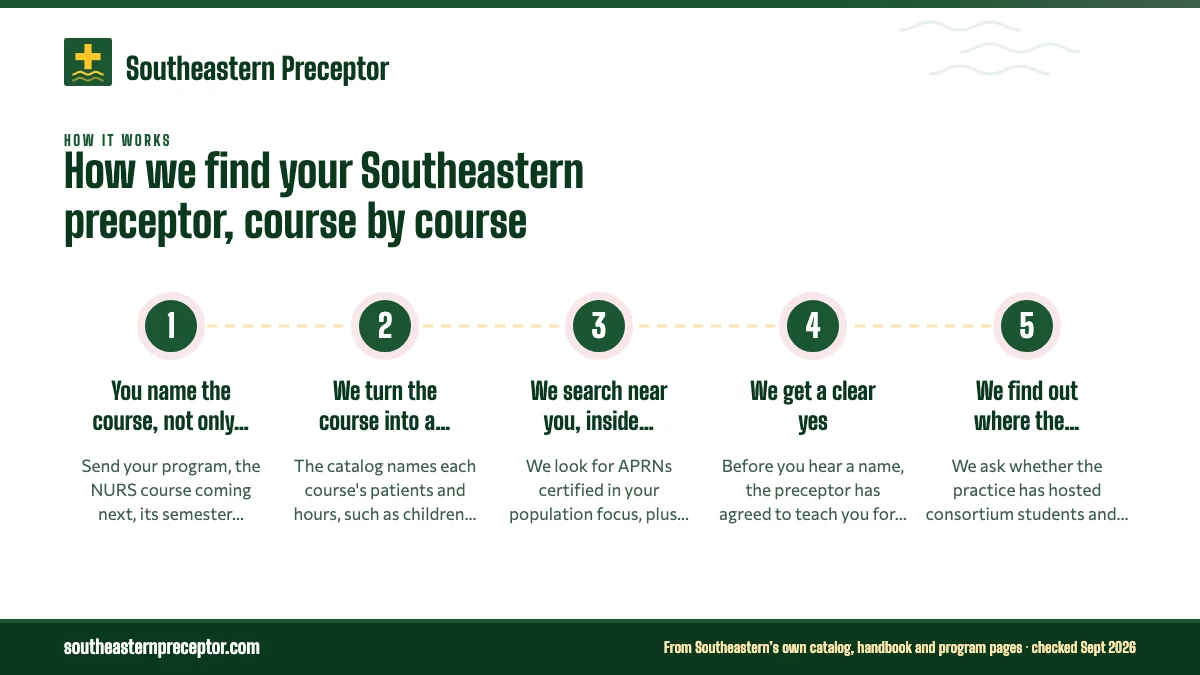
We repeat these steps for every clinical course, because the patients and the hour count change each semester.
- You name the course, not only the trackSend your program, the
NURScourse coming next, its semester, your parish and your work pattern.NURS 6910andNURS 6920call for very different searches. - We turn the course into a search profileThe catalog names each course's patients and hours, such as children and child-bearing women over 200 hours in
NURS 6820. That sets the specialty, practice type and patient volume we need. - We search near you, inside LouisianaWe look for APRNs certified in your population focus, plus physicians where a mix suits the course, within a drive you can keep up, and confirm each Louisiana license.
- We get a clear yesBefore you hear a name, the preceptor has agreed to teach you for the whole course, understands the NP student role and has described the patient encounters on offer.
- We find out where the facility standsWe ask whether the practice has hosted consortium students and flag any site that may need a new university contract, so you can check it in the tracking system early.
- We build your faculty briefYou get the preceptor's current CV or profile, license and certification, the practice's patient mix and a proposed weekly schedule, ready for course faculty and the letter of agreement.
- We list the site's onboarding itemsWe set any extra facility requirements beside Southeastern's health, CPR, drug screening and background items, so your file is whole before day one.
- We stay on call all semesterIf a preceptor steps away, your placement advisor starts a replacement search at once.
What each clinical course asks us to find
Southeastern's catalog describes each clinical course by its hours and the patients it centers on. Here is how we turn those descriptions into the preceptor we go looking for.
| Course | Hours | Patients the catalog names | Preceptor we look for |
|---|---|---|---|
NURS 6820 Family Health I | 200 | Pediatrics and child-bearing women | Family, pediatric or women's health practice seeing many children and pregnant patients |
NURS 6830 Family Health II | 275 | Adults | FNP or adult primary care clinician with a busy adult caseload |
NURS 6840 Family Health III | 275 | Adults and older adults | Family or internal medicine practice with many older adults |
NURS 6910 Psychiatric/Mental Health I | 200 | Common psychiatric disorders | PMHNP doing diagnostic intakes and therapy visits |
NURS 6920 Psychiatric/Mental Health II | 275 | Lifespan, emphasis on children and adolescents | PMHNP or psychiatric clinician with a young caseload |
NURS 6930 Psychiatric/Mental Health III | 275 | Lifespan, emphasis on older adults | PMHNP serving older patients in outpatient, inpatient or community care |
Certificate students in NURS 6970 (120 hours), Nursing Education students in NURS 6440 and NURS 6570, and DNP students choosing a residency mentor get the same approach. Clinical hours by program lists every total.
Louisiana rules we check before you hear a name
Louisiana's nursing board sets preceptor rules for every Southeastern NP student, and the consortium adds its own. We screen for both first, because a preceptor who misses either one costs you weeks.
- An active, unencumbered Louisiana RN or APRN license.
- An APRN certified in your population focus for most of your hours; a physician can carry part of a course.
- No more than two graduate APRN students with one preceptor at a time, so we ask who else they teach that term.
- The consortium's qualifications: a master's or doctorate, current licensure and certification, a suitable practice and at least a year of clinical experience.
- A practice in Louisiana, where Southeastern requires every MSN clinical hour and every PMHNP certificate practicum to happen.
Preceptor requirements and Louisiana-only clinicals explain each rule in full.
Planned around your job, never on its clock
Most Southeastern NP students keep working as nurses, and the consortium lets you choose a preceptor at your own employer. The condition is firm: clinical hours stay separate from your job duties and never fall on time your employer pays for.
So we plan the schedule first and the preceptor second. We ask for your shift pattern, look for preceptors whose clinic days land on your days off, and sketch a weekly plan that reaches the course total inside the semester. Clinicals where you work covers training within your own health system.
If a preceptor drops mid-semester
Preceptors change jobs, take leave or close practices, and a 275-hour course cannot sit idle for long. Tell your course faculty member first, from your university email account, since any new preceptor goes back through approval and review. Then tell us.
Your placement advisor starts with preceptors already screened for your course population and region, learns whether the new site is under contract, and prepares a fresh brief. Southeastern publishes no written policy for a mid-course preceptor loss, so faculty decide how the change is handled; we put a strong replacement in front of them quickly.
The earlier we start, the more choices you have. When we can, we begin a full semester before the course, while a new facility contract still has room to clear. If your course is only weeks away, no preceptor yet has the faster route.
Questions Southeastern students ask
Does Southeastern still approve a preceptor your team finds?
Yes, every time. Course faculty approve each preceptor and the graduate coordinator reviews that approval before any clinical hour, whoever found the name, and the university signs the facility contract. Our work is making sure the proposal that reaches faculty is complete and suited to the course.
How far ahead should I contact you about my next clinical course?
A full semester ahead is ideal, our advice rather than a Southeastern rule. Per the consortium handbook, a brand-new facility contract can take months to put in place, and some Louisiana health systems post request cutoffs months before a term. A later start still works; it simply narrows the choices.
Do you help DNP residency and Nursing Education students too?
Yes. For the DNP we look for a residency mentor and site that suit your DNP project; the 2018-19 DNP handbook asks for a facility agreement request for every residency site. For Nursing Education we look for precepted classroom, lab and clinical teaching settings that fit NURS 6440 and NURS 6570.
Can you find a preceptor near Hammond, Baton Rouge or New Orleans?
Yes, and elsewhere in Louisiana. Many Southeastern students live on the Northshore and will drive toward Baton Rouge or New Orleans for the right practice, so we search the whole range you can travel. The Northshore guide shows the systems, clinics and shortage areas closest to campus.
What should I send to start a search?
Your program, the NURS course coming next and its semester, your parish or city, how far you can drive, your usual work days, and any preceptors you have already approached with their answers. That lets your placement advisor skip repeat requests and begin with practices that fit. The request form asks for each item.
Related pages
Last checked 2026-09-27
We check these pages against Southeastern's own catalog, program pages and consortium handbook, and Louisiana rules. Your course faculty, the graduate coordinator and your advisor have the final word.
Southeastern asks you to choose your preceptor. We find one near you.
Tell us your Southeastern track, where in Louisiana you live and when your next clinical course starts. We find Louisiana-licensed preceptors who fit the course, confirm whether the facility is already under contract with the university, and hand you what your course faculty need to approve it before the semester.
- Pediatric and women's health preceptors for
NURS 6820, adult and older-adult primary care forNURS 6830andNURS 6840 - Psychiatric preceptors for
NURS 6910toNURS 6930, with the child and older-adult focus each course sets - Across Louisiana, from the Northshore to Shreveport
Start your placement plan
Program, city and start date is all we need to begin.