Doing Southeastern clinicals at the place you already work
Southeastern Louisiana University lets you choose a preceptor at the agency that employs you. The condition is firm: clinical hours stay apart from your job and happen on time you are not paid for. Used well, your own health system can be the quickest route to a preceptor, as long as the clinic, the patient population and the university contract all fit the course.
Get your placement plan
Tell us your Southeastern program and where you live. A placement advisor replies with preceptor and site options in your community that fit your Southeastern course.
The rule: your employer is allowed, paid time is not
The consortium's student handbook covers this inside its steps for setting up a clinical experience. You may pick a preceptor in an agency where you currently work, but your clinical hours must be separate from your job duties and completed during time you are not compensated for. Put simply, an hour your employer pays you for cannot also be an hour toward your program.
The DNP side says the same in its own words. The mentor letter of agreement in the 2018-19 DNP handbook bars practicum activity while you are being paid for work at the same time. Across the MSN, the post-master's certificates and the DNP, the line sits in one place.
The rule is about time and pay, not the building. A clinical day at your own hospital is fine; a clinical hour folded into a paid shift is not.
How the rule applies to common situations
Southeastern publishes no list of examples, so the table applies the handbook's wording to situations working students ask about. Where the answer turns on how your pay works, it says so.
| Situation | Counts toward clinical hours? | Why |
|---|---|---|
| Clinic day with an NP in your hospital's outpatient practice, on an unpaid day off | Yes, once approved | Separate from your job and not compensated |
| Seeing patients beside an NP during your paid shift | No | You are being paid for that time |
| Staying after a paid shift for clinic time, off the clock | Only if course faculty approve the setup | The clinical time itself must be unpaid and logged on its own |
| Clinical hours on a paid time-off day | Ask course faculty first | The handbook does not say whether paid leave counts as compensated time |
| Paid education or orientation hours from your employer | No | The time is compensated |
| Hours in your current NP job, for certificate students already practicing | No | Paid work, even in the new specialty |
Whatever the setup, log only unpaid time in the clinical tracking system. The consortium's honesty policy counts fabrication in clinical or practicum work as academic dishonesty, so a paid hour logged as clinical time becomes a conduct problem, not just an hour problem.
Why your own system is often the fastest route
Working inside a health system gives you what an outside student has to build from nothing. You know which clinics run well, which nurse practitioners like teaching and whom to ask. The consortium's FAQ observes that most of its students work locally with physicians and NPs where they are later offered positions, so a rotation in your own system can double as a long interview for the NP job you want there.
There are limits. Your current unit rarely matches the patients a clinical course centers on: a medical-surgical or ICU nurse will not find the children and child-bearing women NURS 6820 needs on their own floor. And employment does not create a contract. The university needs its own agreement with the facility, and the handbook warns that a new one can take weeks to months.
Some systems also route every student request through the school, staff or not. The section after next shows which ones say so.
Using your health system well, step by step
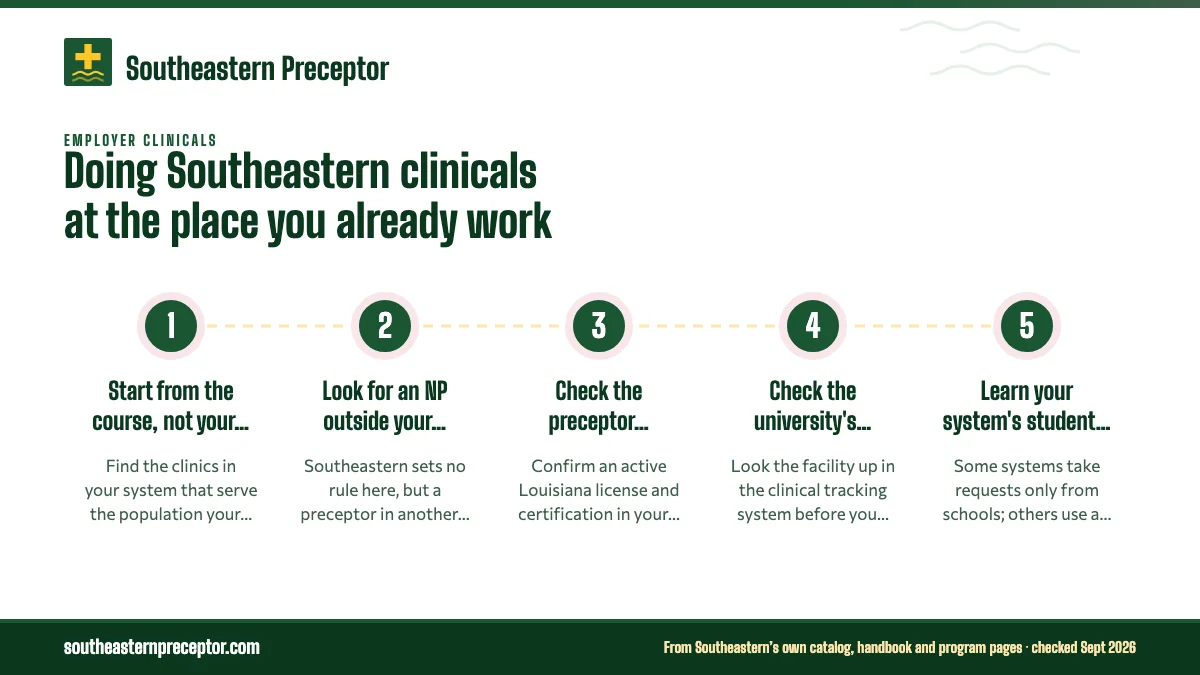
- Start from the course, not your unitFind the clinics in your system that serve the population your next course centers on: a pediatric or family clinic for
NURS 6820, adult primary care forNURS 6830, a behavioral health clinic for the Psychiatric/Mental Health courses. - Look for an NP outside your reporting lineSoutheastern sets no rule here, but a preceptor in another unit or clinic keeps your two roles apart and makes schedules and evaluations simpler.
- Check the preceptor against Louisiana's rulesConfirm an active Louisiana license and certification in your population focus, as preceptor requirements sets out.
- Check the university's agreement with that facilityLook the facility up in the clinical tracking system before you promise anyone a start date.
- Learn your system's student routeSome systems take requests only from schools; others use a web form. The next section lists what several Louisiana systems publish.
- Build the schedule around your shiftsPut clinical days on unpaid time, tell your manager if your employer expects notice, and take the plan to your course faculty for approval.
Louisiana systems that route or favor their own people
Several Louisiana health systems publish how graduate nursing students get in, and two details matter to employees: whether staff get priority, and whether students may approach preceptors directly. Each row reflects the system's own student page; archived copies are labeled.
| System | According to its student page | If you work there |
|---|---|---|
| Ochsner LSU Health (Shreveport and Monroe) | School faculty or coordinators enter requests in InPlace at least three months ahead; students should not call providers; it prioritizes its own employees and highly rated graduate programs | Your employee status helps, but Southeastern still files the request, and a preceptor's verbal yes is weighed rather than final |
| Ochsner Health (south Louisiana sites) | A school representative enters requests in InPlace Network; students are told not to contact providers and to pass preceptors of interest to their school coordinator | Give the NP's name to Southeastern rather than arranging it yourself |
| LCMC Health | Runs no preceptor matching; an affiliation agreement comes first, then students and schools ask each hospital's education office (archived copy) | Your contacts help once the agreement is confirmed |
| North Oaks Health System (Hammond) | Student clinical requests go through a web form; no pediatric rotations at present (archived copy) | Staff still file the form, and NURS 6820 pediatric hours belong elsewhere |
| St. Tammany Health System (Covington) | A nurse practitioner clinical request form, 7 to 10 business days to process (archived copy) | Apply early, even as staff |
Ochsner LSU Health is the only system in this research that writes an employee priority into its student page; the others describe one route for every student. Its posted request deadlines are May 1 for fall, October 1 for spring and February 1 for summer. The Louisiana region guides cover more systems by area.
Keeping two roles apart once you start
Once approved, your clinical schedule is posted in the clinical tracking system where your faculty member can see it. Keep a simple record of your paid shifts for the same weeks, so any question about overlap has a quick answer.
Coworkers will forget you are a student on clinical days. Wear the consortium name tag, which the handbook requires during practicum experiences, and let your unit know when you are on your student schedule. If your employer asks you to pick up a shift that collides with a planned clinical day, move the clinical day and tell your preceptor and faculty.
If your preceptor is also a colleague, talk early about evaluation. They complete an end-of-semester evaluation for your course faculty, and an honest one is what protects your grade.
How we help nurses who want to stay close to work
Southeastern's graduate page notes that most students enroll part-time, and plenty of them keep nursing through every clinical course. Our placement desk plans around that. We start with your employer: which of its clinics serve your course's population, whether the university already has an agreement with that facility, and whether the system takes requests from schools only.
Where your own system fits, we help you shape a proposal your course faculty can approve quickly. Where it does not, because the population is missing, a contract is months away or the system routes everything through its own platform, we find a Louisiana preceptor outside it, near your home or your shifts, with everything ready for the faculty conversation. Tell us your course and schedule, or compare approaches in your own search versus placement help.
Questions Southeastern students ask
Can my coworker be my preceptor at Southeastern?
Yes, if they meet the preceptor rules and your course faculty approve them. A coworker who is an APRN with an active Louisiana license and certification in your population focus can be proposed like anyone else. What cannot happen is precepting during your paid shift together, since clinical time has to be separate and unpaid. Someone outside your own unit usually makes that easier.
Can I get clinical hours on my day off at my own hospital?
Yes. An unpaid day off is the kind of time the consortium handbook has in mind, as long as the preceptor is approved and the university has a current agreement with the facility. Log the day in the clinical tracking system like any other clinical day, and keep your work schedule for the same week in case faculty ask.
I work for Ochsner. Can I just ask an Ochsner NP to precept me?
Ochsner Health's clinical education page tells students not to reach out to providers or staff and to send preceptors of interest to their school coordinator, who enters the request in InPlace Network. The page makes no exception for staff. Give the NP's name to Southeastern through your course faculty and let the request go in through that route.
Do I still need a contract if I already work at the facility?
Yes. The contract or letter of agreement is between the university and the facility, and your employment does not create one. Check the facility in the clinical tracking system; if no current agreement exists, approval has to start and can take weeks to months. Clinical contracts walks through it.
Does paid time off count as unpaid time for clinical hours?
Southeastern's handbooks do not say. The rule bars clinical hours during time you are compensated for, and paid leave sits in a gray area under that wording. Ask your course faculty before you build a clinical schedule on paid time off, and keep their reply from your university email with your clinical records.
Related pages
Last checked 2026-09-27
We check these pages against Southeastern's own catalog, program pages and consortium handbook, and Louisiana rules. Your course faculty, the graduate coordinator and your advisor have the final word.
Southeastern asks you to choose your preceptor. We find one near you.
Tell us your Southeastern track, where in Louisiana you live and when your next clinical course starts. We find Louisiana-licensed preceptors who fit the course, confirm whether the facility is already under contract with the university, and hand you what your course faculty need to approve it before the semester.
- Pediatric and women's health preceptors for
NURS 6820, adult and older-adult primary care forNURS 6830andNURS 6840 - Psychiatric preceptors for
NURS 6910toNURS 6930, with the child and older-adult focus each course sets - Across Louisiana, from the Northshore to Shreveport
Start your placement plan
Program, city and start date is all we need to begin.