Preceptor approval at Southeastern: course faculty sign-off and the graduate coordinator's review
At Southeastern Louisiana University, a preceptor counts only after two sign-offs: approval by your course faculty member and review by the graduate coordinator, both before the clinical experience begins. Faculty judge fit: the population the course needs, the preceptor's license, certification and experience, and a setting that can carry the hours. Below is what they weigh, what Southeastern leaves unpublished, and how to hand them a request that is easy to act on.
Get your placement plan
Tell us your Southeastern program and where you live. A placement advisor replies with preceptor and site options in your community that fit your Southeastern course.
Two sign-offs, both before the first hour
The consortium student handbook builds approval into the second step of arranging a precepted course. Once you have talked your candidate over with the faculty member assigned to the course and confirmed the preceptor is willing, course faculty approve that preceptor and the graduate coordinator reviews them. Both happen before any clinical or practicum time starts.
Faculty also read, revise where needed, and approve the letter of agreement that you, the preceptor and the faculty member sign. After that approval, your clinical schedule goes into the clinical tracking system.
The arrangement reflects state law as well as school policy. Louisiana's nursing education rules keep the selection and guidance of every graduate learning experience with nurse faculty, with preceptors contributing input on how the student performs. Approval is how faculty carry that responsibility.
What course faculty weigh
Approval turns on three questions: does this person fit the course, are they qualified, and can the setting deliver the hours.
- Population focus. The candidate's patients must match the course. Family Health I needs pediatric and women's health patients, Family Health II needs adults, Family Health III needs adults along with older patients, and PMHNP students need the youth or older-adult emphasis of the later courses. Louisiana's rules put most graduate clinical time with an NP whose certification matches your population.
- Credentials. The consortium's preceptor policy looks for graduate preparation (a master's or doctorate) relevant to precepting, an active license without restrictions, APRN certification matching the area and a minimum of a year in clinical practice. Every preceptor also needs an active, unencumbered Louisiana license.
- Setting. The practice must offer experiences suited to building your skills, with enough patient volume to fill 200 to 275 hours in a semester and a schedule that works for you both.
- Your side of it. Hours must fall outside paid work, and the facility needs a current contract with the university.
Two wrinkles are worth knowing. The consortium's faculty handbook calls a year of experience preferred where the student handbook says required, so a newer preceptor is a question for faculty rather than an automatic no. The faculty handbook also says a behavioral health clinician serving as preceptor has to hold an independent license, not one still under supervision, which matters for PMHNP students. Preceptor requirements covers each rule in full.
The file that travels with the approval
Approval is a decision, but it rests on paper. The handbook asks you to obtain the preceptor's vita or resume, or a completed professional profile, dated within two years. You also submit the student and preceptor letter of agreement to your course faculty member for review.
Separately, the facility needs its own current agreement with Southeastern. That one is signed at the institutional level, and clinical contracts explains how to check it.
Under the consortium's faculty handbook, coordinators answer for every preceptorship document: the affiliation agreement, the preceptor profile or vitae, and the appropriateness of the clinical site. Everything ends up in the Graduate Nursing Office, together with your health and compliance records, before you begin.
What Southeastern does not publish
Several parts of approval live inside the course rather than on the public web. Southeastern publishes no deadline for submitting a preceptor; the handbook mentions only a date your university designates. The MSN letter of agreement, the preceptor professional profile form, the preceptor evaluation form and any preceptor orientation material are not public either, and neither is a typical review time or what happens after a candidate is declined.
Each gap has a home. Course faculty and the Canvas course site hold the forms and course-level dates. The graduate coordinator can speak to program-wide timing. The Graduate Nursing Office confirms what is on file. Use your university email for these questions, since the handbook makes it the only channel for reaching faculty and preceptors.
The most common mistake is treating a preceptor's yes as the finish line. Willingness is only part of step two; the course faculty member's approval and the graduate coordinator's review are what make the hours count.
How to make approval quick
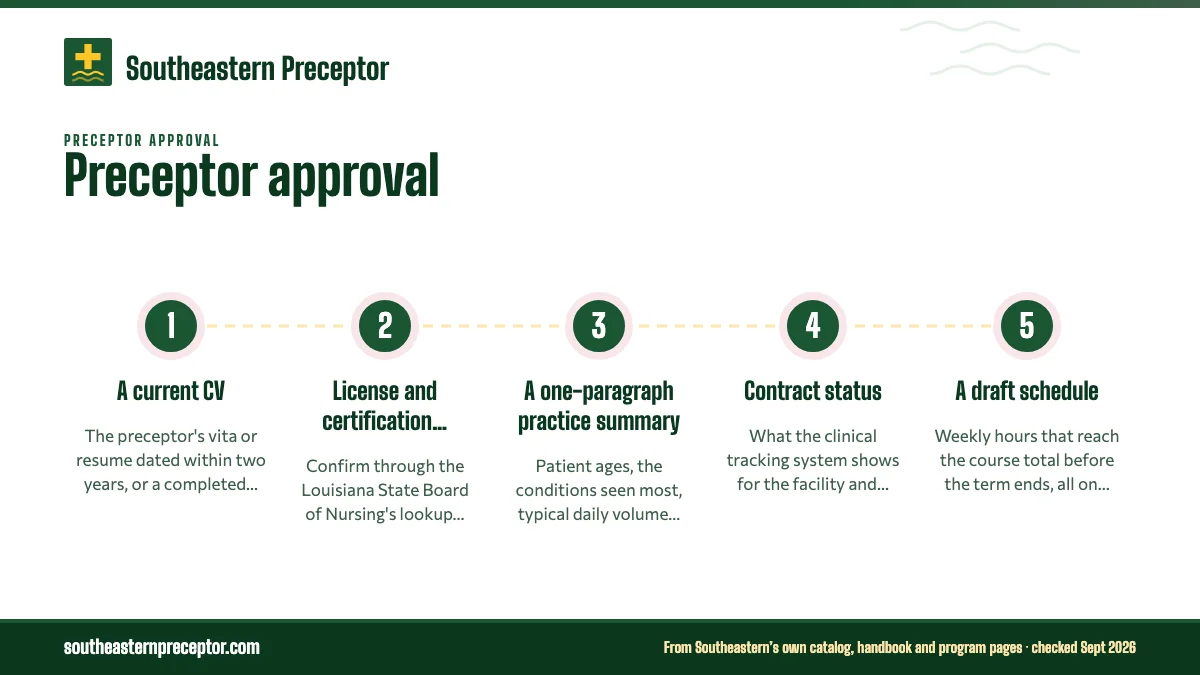
Faculty move faster when nothing is missing. Before the conversation, gather these five pieces.
- A current CVThe preceptor's vita or resume dated within two years, or a completed professional profile.
- License and certification proofConfirm through the Louisiana State Board of Nursing's lookup that the Louisiana license is active and unencumbered, and note the certification area.
- A one-paragraph practice summaryPatient ages, the conditions seen most, typical daily volume and the days the preceptor can host you, tied to the course's population.
- Contract statusWhat the clinical tracking system shows for the facility and, if nothing is on file, who at the facility signs agreements.
- A draft scheduleWeekly hours that reach the course total before the term ends, all on unpaid time.
With that in hand, faculty can spend the conversation on fit instead of chasing details, and any follow-up has a quick answer.
Approval is course by course
A preceptor approved for one course is not automatically right for the next. The FNP courses step from children and women's health, to adults, to older adults, and the PMHNP sequence shifts emphasis between children and adolescents and older adults. A family practice that sees every age might fit all three FNP courses; a pediatric office fits only the first.
Replacements go through the same approval. If a preceptor leaves partway through a course, tell your course faculty member at once, because the new candidate needs the same review and paperwork. The fit matters beyond paperwork, too: under the consortium handbook, a poor final clinical evaluation, whether it comes from the preceptor or from faculty, means an F for the course. Grades and time limits has the details.
How we prepare what faculty see
Our placement desk builds every match around Southeastern's approval standard. We check each candidate's Louisiana license and certification against your population focus, confirm the practice's patient mix fits your exact course, gather a current CV, and write the practice summary and draft schedule with you. When a candidate falls short on population or credentials, you hear it from us first, along with a stronger option, long before the name would reach faculty.
We also find out who at the facility signs agreements, so if the tracking system shows no contract, that detail is already in hand for faculty. The decision stays with course faculty and the coordinator's review; our part is sending it to them complete and fitted to the course. Start with how it works or request a placement.
Questions Southeastern students ask
Does the graduate coordinator approve preceptors, or only review them?
The consortium handbook uses two different verbs on purpose: the faculty member teaching the course grants approval, while the graduate coordinator conducts a review before clinical time starts. The faculty handbook adds that coordinators are responsible for the preceptorship documents, including the preceptor's profile or CV and the site's appropriateness, so treat the review as a real second check.
Can one preceptor take me and a classmate at the same time?
Louisiana limits each preceptor to no more than two graduate APRN students at once in a clinical experience, so a pair of students can share one. Each of you still needs your own approval and letter of agreement, and the practice has to produce enough patient encounters for both of you to reach your course hours.
How long does Southeastern take to approve a preceptor?
No review time is published. What is published is the facility side: a new contract can take several weeks to months. Submitting early, with a current CV, a license check and a practice summary already attached, is the most reliable way to keep approval from becoming the step that holds up your start.
What should I do if course faculty do not approve my preceptor?
Ask what did not fit: population, credentials, setting or hours. Southeastern publishes no policy for a declined candidate, so the reason tells you what the next candidate needs to show. If the course start is close, our guide for students without a preceptor covers what to do this week.
Does my preceptor need Southeastern training before I start?
Southeastern publishes no preceptor training or orientation material. The handbook has the preceptor orient you to the practice, agree on a schedule and stay in touch with your course faculty member, and faculty supply the evaluation materials. Under Louisiana's rules, faculty must touch base with you and your preceptor at least once a week while you are precepted.
Related pages
Last checked 2026-09-27
We check these pages against Southeastern's own catalog, program pages and consortium handbook, and Louisiana rules. Your course faculty, the graduate coordinator and your advisor have the final word.
Southeastern asks you to choose your preceptor. We find one near you.
Tell us your Southeastern track, where in Louisiana you live and when your next clinical course starts. We find Louisiana-licensed preceptors who fit the course, confirm whether the facility is already under contract with the university, and hand you what your course faculty need to approve it before the semester.
- Pediatric and women's health preceptors for
NURS 6820, adult and older-adult primary care forNURS 6830andNURS 6840 - Psychiatric preceptors for
NURS 6910toNURS 6930, with the child and older-adult focus each course sets - Across Louisiana, from the Northshore to Shreveport
Start your placement plan
Program, city and start date is all we need to begin.