Who does what in a Southeastern clinical course, and what to ask each role
A Southeastern Louisiana University clinical course involves more people than the syllabus lists: the course faculty member who approves your preceptor, the graduate coordinator who reviews that choice, the Graduate Nursing Office that holds your file, your home school inside the MSN consortium, and for DNP students a residency mentor and project committee. This guide names each role by title, says what it owns, and pairs it with the questions that belong there.
Get your placement plan
Tell us your Southeastern program and where you live. A placement advisor replies with preceptor and site options in your community that fit your Southeastern course.
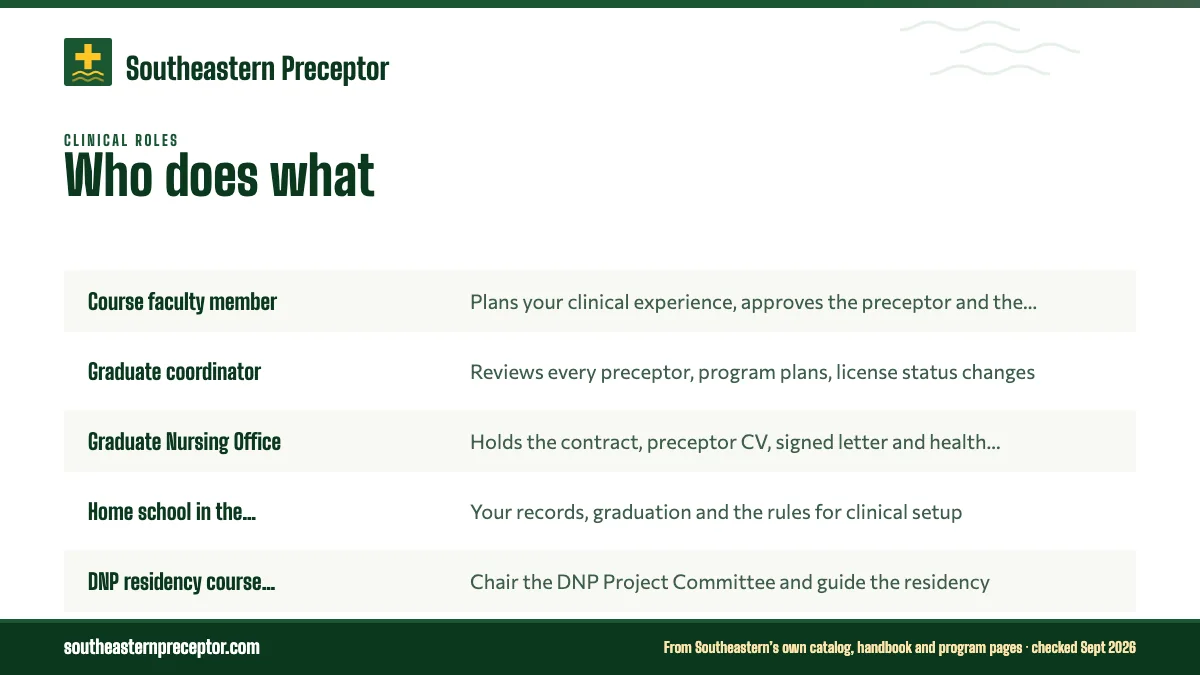
Every role on one page
Titles only here: people change, and the title is what carries the responsibility. A few titles also shift from page to page. The graduate coordinator appears as the Graduate Nursing Program Coordinator, the DNP Program Coordinator and, in 2026 news, the Interim Graduate Nursing Director.
| Role | What it owns | Bring it this question |
|---|---|---|
| Course faculty member | Plans your clinical experience, approves the preceptor and the letter of agreement, visits the site, grades | Does this preceptor and setting fit this course? |
| Graduate coordinator | Reviews every preceptor, program plans, license status changes | What is this term's date for naming a preceptor? |
| Graduate Nursing Office | Holds the contract, preceptor CV, signed letter and health records | Is my file complete for this term? |
| Home school in the consortium | Your records, graduation and the rules for clinical setup | Which requirements apply to me as a Southeastern student? |
| DNP residency course faculty | Chair the DNP Project Committee and guide the residency | Does this site and mentor suit my project? |
| Residency mentor | Access to the population, data or system your DNP project needs | Can you commit through all the residency courses? |
| Preceptor | Orientation, day-to-day teaching, the schedule, the end-of-term evaluation | What will a typical week with you look like? |
| Facility education office | The facility's student requests and its side of the contract | Who signs affiliation agreements here? |
Your course faculty member: the first call
The consortium handbook has you arrange every clinical semester with the course's assigned faculty member, so this person comes first. They help you settle the area of practice, talk through your preceptor, approve the preceptor and the letter of agreement, help route a new facility contract, conduct a site visit, and assign your grade with input from your preceptor. State rules also require faculty to check in with every preceptor and student weekly, at minimum, during the precepted experience.
Because four universities share the MSN, your course faculty member may teach from another consortium school. They are still the right first contact for anything about that course.
Worth asking your course faculty member
- Which practice settings and patient ages suit this course best?
- Does the consortium's preceptor list include anyone near me for this population?
- Is anything in my candidate's background likely to slow approval?
- When will the site visit happen, and what should my preceptor expect from it?
The graduate coordinator and the Graduate Nursing Office
The graduate coordinator reviews every preceptor after course faculty approve, and the faculty handbook puts coordinators in charge of the paperwork behind each preceptorship, from the affiliation agreement and the preceptor's profile or CV to whether the clinical site is appropriate. The coordinator also signs off on program plans, hears transfer credit appeals, and must be told at once of any change in your Louisiana RN license status.
The Graduate Nursing Office, in the Kinesiology and Health Studies Building on the Hammond campus, keeps the file. Before your first clinical hour it needs the current facility contract, a preceptor CV no more than two years old, the letter carrying all three signatures, and your health, OSHA and HIPAA records.
- Ask the coordinator: what is this term's date for naming a preceptor and site?
- Ask the office: is everything for my clinical course on file, and does anything expire mid-term?
Your home school inside the consortium
Southeastern's MSN is delivered by the Intercollegiate Consortium for a Master of Science in Nursing, shared with McNeese, Nicholls and UL Lafayette. Each student selects a home school, which keeps their records and from which they graduate, while courses and classmates come from all four. For Southeastern students, Southeastern is home.
Home status matters most at clinical time. The handbook tells students to follow their home institution's requirements when arranging nurse practitioner and nurse educator practicums, to use the tracking system their home institution designates, and to meet its health requirements. A course repeated after a grade of C or below has to be retaken at the home university if it offers the course. The consortium guide covers the rest.
Above the four schools sits the consortium's Coordinating Committee, made up of the four graduate coordinators, which runs the consortium day to day and owns the student handbook.
DNP roles: residency faculty, mentor and committee
Southeastern offers the DNP with UL Lafayette, and the residency courses NURS 8210 to NURS 8230, plus any NURS 8090 hours, happen at the home institution. The roles below are drawn from Southeastern's 2018-19 DNP handbook, still the latest it posts, so confirm current practice with your residency course faculty.
- Residency course faculty chair your DNP Project Committee and guide the residency courses.
- The residency mentor is chosen by you from beyond Southeastern, with faculty weighing in. The handbook wants a mentor holding a master's at minimum, or one in a position to get you into the population, data, agency or system behind your project.
- The mentor letter of agreement carries four signatures: yours, the mentor's, your faculty member's and the DNP Program Coordinator's. The mentor also supplies a current resume or CV.
- The committee form is signed by the DNP Program Coordinator and the Dean.
The DNP residency guide covers the hours and the project site in detail.
The preceptor and the facility
Your preceptor teaches you day to day. The handbook has them introduce you to the role and setting, make expectations clear, settle hours with you and keep faculty in the loop. The faculty handbook adds an end-of-term clinical evaluation from the preceptor and a prompt warning to faculty whenever performance is in doubt. At term's end you rate the preceptor and the site as well.
The facility has its own voice through its education office and whoever signs affiliation agreements. Some systems also set who may contact whom. Ochsner Health's clinical education page, for one, asks that preceptor interest go through the school coordinator rather than straight to its clinicians.
Worth asking your preceptor
- Which days and hours can you host a student this term?
- Which patient ages and visit types will I see most often?
- How would you like my course faculty member to reach you?
Where our placement desk fits
Every role above has a defined job. Choosing and proposing the preceptor sits with the student, with faculty support, and the searching behind that choice is the part we take on. Your placement advisor combs your part of Louisiana, vets each candidate against the course, Louisiana licensing and the facility's contract status, and hands you what the course faculty conversation needs. If a preceptor steps away mid-term, your advisor restarts the search straight away so faculty have a replacement to consider.
Course faculty still approve, the graduate coordinator still reviews, and the Graduate Nursing Office still holds the file; we make sure what reaches them is complete. Preceptors curious about the role can read the guide for preceptors, and students can start a request.
Questions Southeastern students ask
Who do I contact first when a preceptor problem comes up mid-semester?
Your course faculty member. Email them from your Southeastern account, the one channel the handbook allows for faculty and preceptor contact. Faculty are responsible for you in the clinical area and stay in regular touch with your preceptor, so they are best placed to judge whether the placement can continue or needs a replacement.
Is my graduate coordinator the same person as my advisor?
Not necessarily. Southeastern's catalog mentions both a graduate coordinator or director and a graduate faculty advisor, for example as people you may appeal to about transfer credit. The coordinator reviews preceptors and program plans for graduate nursing. Ask the Graduate Nursing Office who fills each role for your program and entry term.
Who signs the letter of agreement for my clinical course?
Three: the student, the preceptor and the faculty member teaching the course. You submit the completed letter to course faculty, who can review, revise and approve it before it is final. It is separate from the facility contract the university signs; preceptor approval explains how the two fit around the sign-offs.
What if my course is taught by faculty from another consortium school?
That faculty member is your course faculty for planning and approving the clinical experience in that course. Your home school's requirements still govern the setup, the tracking system and your health records, and the Graduate Nursing Office still needs your file complete. Ask early how the two sides connect for your specific course.
Who should I tell if my RN license status changes?
The graduate coordinator, immediately. An unencumbered Louisiana RN license is required for the whole MSN, per the consortium handbook, and failing to report encumbrances or disciplinary proceedings against it results in immediate dismissal from the university. RN license requirements covers the license rules in full.
Related pages
Last checked 2026-09-27
We check these pages against Southeastern's own catalog, program pages and consortium handbook, and Louisiana rules. Your course faculty, the graduate coordinator and your advisor have the final word.
Southeastern asks you to choose your preceptor. We find one near you.
Tell us your Southeastern track, where in Louisiana you live and when your next clinical course starts. We find Louisiana-licensed preceptors who fit the course, confirm whether the facility is already under contract with the university, and hand you what your course faculty need to approve it before the semester.
- Pediatric and women's health preceptors for
NURS 6820, adult and older-adult primary care forNURS 6830andNURS 6840 - Psychiatric preceptors for
NURS 6910toNURS 6930, with the child and older-adult focus each course sets - Across Louisiana, from the Northshore to Shreveport
Start your placement plan
Program, city and start date is all we need to begin.