Southeastern clinical hours, program by program
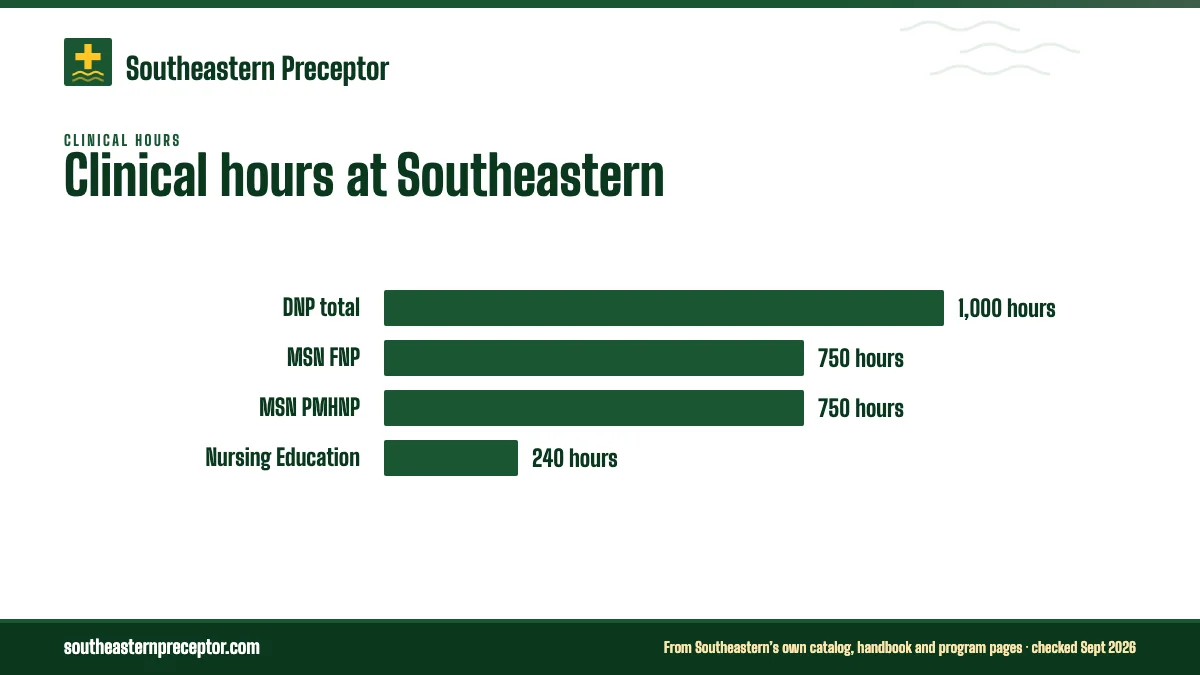
Southeastern Louisiana University's 2026-27 catalog sets 750 clinical hours for the MSN FNP and MSN PMHNP, 240 for Nursing Education, 750 or 510 for the post-master's certificates, and a residency that carries DNP students toward 1,000 post-baccalaureate hours. A few Southeastern pages print lower figures. Here is every number, where it comes from, and how hours get logged and approved.
Get your placement plan
Tell us your Southeastern program and where you live. A placement advisor replies with preceptor and site options in your community that fit your Southeastern course.
Pick your Southeastern program
Your clinical courses and hours, who can precept you, where, and when to start looking. From the 2026-27 Southeastern catalog, graduate handbooks and program pages.
- Who precepts
- Louisiana-licensed APRNs in family practice, with pediatric and women's health for Family Health I
- Where
- Primary care practices and clinics in your part of Louisiana, never on paid employer time
- Start looking
- The semester before each course, so faculty approval and the contract are done
- Who precepts
- Louisiana-licensed psychiatric NPs, with child and adolescent then older-adult focus
- Where
- Outpatient psychiatry, behavioral health clinics and inpatient units in Louisiana
- Start looking
- Before the observation course, then a semester ahead of each clinical course
- Who precepts
- The same preceptors as the matching MSN track
- Where
- In Louisiana for the PMHNP certificate, per its page; confirm the FNP certificate's rule with the graduate coordinator
- Start looking
- A semester ahead of the first clinical course
- Who precepts
- FNP or PMHNP preceptors for the clinical courses; a project mentor and site for the residency
- Where
- The facility where your DNP project runs
- Start looking
- Before Residency I, with IRB approval in view
Hours by Southeastern program
Start with the catalog. Southeastern's 2026-27 General Catalog is the newest document that prints clinical totals, and its course descriptions let you check each total one course at a time. The table sets the catalog figure beside any different number Southeastern prints elsewhere, and the planner on this page breaks each track into its courses, preceptors and timing.
| Program | Clinical courses | 2026-27 catalog | Other Southeastern figure |
|---|---|---|---|
| MSN Family Nurse Practitioner | NURS 6820, NURS 6830, NURS 6840 | 750 (200 + 275 + 275) | 600 on the majors page |
| MSN Psychiatric Mental Health NP | NURS 6900 (observation), NURS 6910, NURS 6920, NURS 6930 | 750 (200 + 275 + 275), plus 60 observation hours | 600 on the majors page |
| MSN Nursing Education | NURS 6440, NURS 6570 | 240 | 225 on the majors page |
| Post-master's FNP certificate | NURS 6820, NURS 6830, NURS 6840 | 750 practicum | None printed |
| Post-master's PMHNP certificate | NURS 6900, NURS 6910, NURS 6920, NURS 6970 | 510 | 595 by its course descriptions, plus 60 observation |
| BSN to DNP, FNP or PMHNP | The NP courses above, then NURS 8210 to NURS 8230 | 750 clinical and 540 residency | 450 by the residency course descriptions |
| BSN to DNP, Nurse Executive Leadership | NURS 6540, NURS 6550, NURS 6590, NURS 8090, residencies | No total printed | Weekly practicum hours in each course |
| Post-master's DNP | NURS 8210 to NURS 8230, NURS 8090 as needed | No total printed | 450 residency by course, toward 1,000 overall |
When Southeastern's own pages disagree
Three mismatches touch most graduate students. The majors pages give 600 clinical hours for the FNP and PMHNP concentrations where the catalog gives 750, and 225 for Nursing Education where the catalog gives 240. The catalog carries a date, 2026-27, and its course descriptions add up to its own totals, so we build every placement around the catalog figure and treat the lower one as a question to ask, never a target.
The PMHNP certificate is harder to read. Its catalog total of 510 falls short of its own course hours, which reach 595 before the observation course, and its program page describes 120 to 240 hours in each practicum course. On the doctoral side, the BSN to DNP entries print 540 residency hours while Residency I, II and III add to 450. By our arithmetic, the 90 practicum hours the catalog lists for NURS 8030 Project Planning would close that gap, but Southeastern does not say that is how it counts. PMHNP hours and DNP residency hours go further.
Until your course faculty or the graduate coordinator says otherwise in writing, plan around the larger figure.
The NP ladder: 200 hours, then 275 and 275
Both nurse practitioner tracks climb the same way: one clinical course a semester, each the prerequisite for the next, with the hours stepping up after the first. FNP students log 200 hours in NURS 6820 Family Health I with children and child-bearing women, then 275 in NURS 6830 with adults and 275 in NURS 6840 with adults and older adults. FNP 750 hours turns that into a weekly load.
PMHNP students add a first rung. NURS 6900 Psychotherapy carries 60 practicum hours of observation, which sit outside the 750 the catalog counts. Then come 200 hours in NURS 6910, 275 in NURS 6920 with its emphasis on children and adolescents, and 275 in NURS 6930 with its emphasis on older adults. Certificate students take NURS 6970, a 120-hour course, in place of NURS 6930.
Nursing Education, the certificates and the DNP
Nursing Education hours are set by the week. NURS 6440 Advanced Clinical Practicum in Nursing Practice carries four practicum hours a week and NURS 6570 Nursing Education Practicum twelve, in precepted classroom, lab and clinical settings. Over a 15-week semester that is 60 and 180 hours by our count, matching the catalog's 240. Nursing Education practicums covers the preceptor side.
The FNP certificate runs the same three Family Health courses, 750 documented practicum hours over three semesters. The PMHNP certificate takes four semesters, ends with NURS 6970 and carries the 510 versus 595 question above; its program page places every practicum experience in Louisiana.
Doctoral students take NURS 8210 Residency I (90 residency hours), NURS 8220 Residency II (180) and NURS 8230 Residency III (180), built around the DNP project. The goal, in the words of NURS 8090 Advanced Directed Studies, is 1,000 total residency hours including post-baccalaureate work; that course adds 135 hours per enrollment and can be repeated twice. Post-master's applicants verify their MSN practicum hours when they apply, so the gap depends on what you bring.
How hours are logged and approved
An hour counts only when the paperwork behind it is complete. The consortium student handbook, which governs Southeastern's MSN clinical courses, sets the order.
- The file comes first.No clinical hour begins until the Graduate Nursing Office holds four things: the facility's current contract with the university, your preceptor's CV or resume from the past two years, a three-way letter of agreement signed by you, the preceptor and your faculty member, and your health, OSHA and HIPAA paperwork.
- Faculty approve the preceptor.Each preceptor needs your course faculty's approval and a review by the graduate coordinator before the first clinical day. Preceptor approval explains the sequence.
- Your schedule goes online.Once your faculty member approves the letter of agreement, you post the clinical schedule in the clinical tracking system and keep it current.
- Every patient contact is logged.NP students record all patient contact hours in the tracking system their home school designates and keep the subscription through every practicum course. The consortium's 2022 evaluation plan names Typhon; Southeastern's current MSN pages name no system, so check your course in Canvas.
- Preceptor and faculty evaluate.Your preceptor completes an evaluation at the end of the semester and your faculty member assigns the grade. An unsatisfactory final evaluation from either one means an F in the course.
The consortium counts fabricated clinical or practicum records as academic dishonesty and says it has zero tolerance for it.
Paid time at your job never counts
You may pick a preceptor at the agency that employs you, but the clinical hours have to sit outside your job duties and outside any time you are paid for. A shift worked as an employee does not turn into clinical time because an NP is on the unit, and the 2018-19 DNP handbook applies the same rule to residency work. Clinicals where you work shows how to use your own employer within the rule.
Hours logged while your employer is paying you do not count toward any Southeastern clinical total, even with an approved preceptor at your own workplace. Build your clinical days around your paid shifts, not inside them.
Getting every hour in on time
Logging 275 hours in a semester takes a preceptor who can host you most weeks, at a facility whose contract with the university is settled before day one. We plan the search a semester ahead, while a new contract still has time to clear.
Your placement advisor starts from the course's hours and population, finds Louisiana-licensed preceptors near you who can carry that load, checks the facility's contract status and assembles the preceptor details your course faculty review. When a preceptor drops mid-semester, we go straight to a replacement so your log keeps moving. How it works shows the steps, and the form below starts a search.
Questions Southeastern students ask
Do the NURS 6070 lab hours count toward Southeastern's clinical hours?
The catalog lists NURS 6070 Health Assessment and Diagnostic Reasoning with four laboratory hours a week, but the program totals of 750 and 240 match the practicum courses alone, so by our reading the lab hours sit outside them. Southeastern does not publish where those lab hours take place; your course faculty can confirm how they run in your semester.
Can I bank extra clinical hours for my next course?
For the MSN, Southeastern publishes no rule that carries surplus hours from one clinical course into the next, and each course states its own hours per semester. The only carry-forward rule we found sits in the 2018-19 DNP handbook, which let 20 practicum hours be carried into a future residency course. Ask your course faculty before planning around it.
What happens if I finish the semester short of my clinical hours?
An Incomplete is only for circumstances beyond your control, and Southeastern turns it into an F if it is still open at the end of the next semester, summers included. In a clinical course that makes a stalled preceptor search expensive. Behind on clinical hours sets out what to do.
Do graduate clinical hours count for prescriptive authority in Louisiana?
Possibly. Louisiana asks new prescribers for 500 hours of clinical practice in their role and population within two years before applying, and its rule allows clinical practice from a graduate program that met certification eligibility to count toward that figure. The Louisiana State Board of Nursing decides what it accepts, so keep complete records from every course.
Do DNP residency hours have to be completed in Louisiana?
Southeastern does not say. The MSN and PMHNP certificate pages put every clinical hour in Louisiana, but the DNP pages only say practicum hours take place in various facilities. The catalog does require a Louisiana RN license for the FNP and PMHNP doctoral tracks, so confirm with the DNP program coordinator before you plan a residency site elsewhere.
Related pages
Last checked 2026-09-27
We check these pages against Southeastern's own catalog, program pages and consortium handbook, and Louisiana rules. Your course faculty, the graduate coordinator and your advisor have the final word.
- Southeastern 2026-27 catalog: MSN, Family Nurse Practitioner concentration
- Southeastern majors page: MSN, Family Nurse Practitioner concentration
- Southeastern 2026-27 catalog: Psychiatric Mental Health NP, post-master's certificate
- Southeastern 2026-27 catalog: BSN to DNP, FNP concentration
- ICMSN student handbook, Southeastern-hosted copy (precepted learning experiences)
Southeastern asks you to choose your preceptor. We find one near you.
Tell us your Southeastern track, where in Louisiana you live and when your next clinical course starts. We find Louisiana-licensed preceptors who fit the course, confirm whether the facility is already under contract with the university, and hand you what your course faculty need to approve it before the semester.
- Pediatric and women's health preceptors for
NURS 6820, adult and older-adult primary care forNURS 6830andNURS 6840 - Psychiatric preceptors for
NURS 6910toNURS 6930, with the child and older-adult focus each course sets - Across Louisiana, from the Northshore to Shreveport
Start your placement plan
Program, city and start date is all we need to begin.