Your own preceptor search or a placement service: a fair look for Southeastern students
Both routes end in the same place at Southeastern Louisiana University: a preceptor your course faculty approve, reviewed by the graduate coordinator, at a facility under a university contract. What differs is who spends the hours finding that preceptor, how early the search starts and how quickly a replacement appears when a lead falls through.
Get your placement plan
Tell us your Southeastern program and where you live. A placement advisor replies with preceptor and site options in your community that fit your Southeastern course.
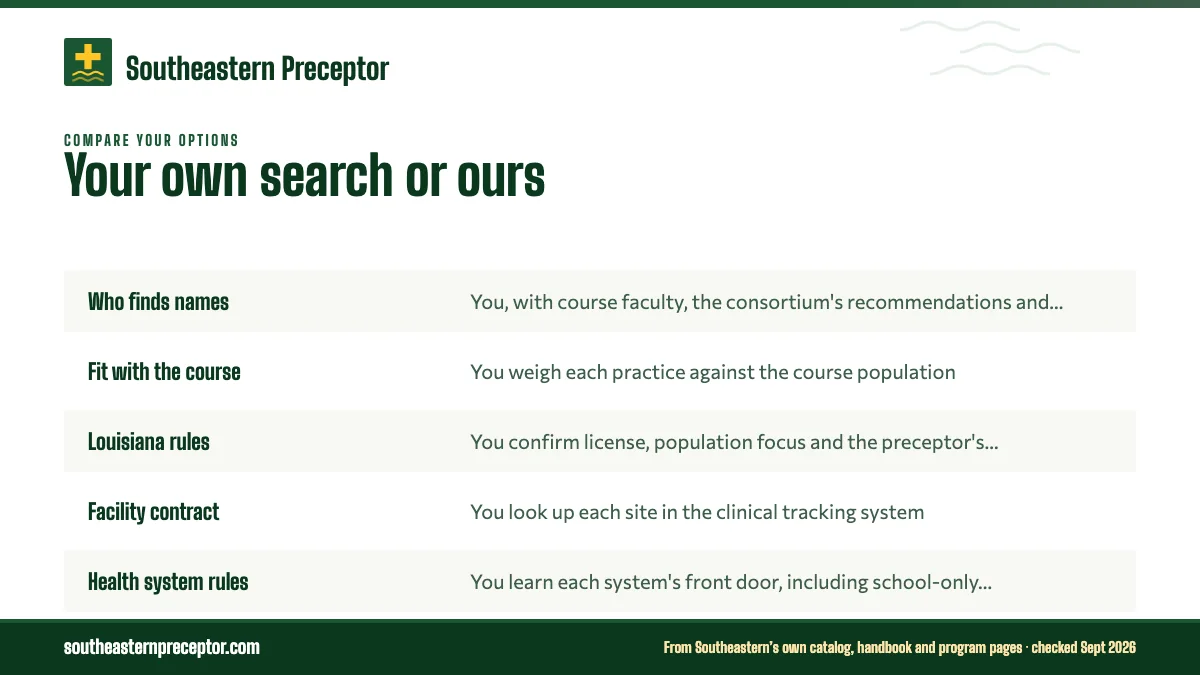
Same finish line, different path
Nothing about Southeastern's approval changes with the route you pick. Whoever finds the preceptor, course faculty approve the choice, the graduate coordinator reviews it, the university holds the facility contract and the preceptor needs a Louisiana license. Southeastern's published pages and the consortium handbook say nothing for or against placement services, so the same rules apply to both paths.
The practical differences are your time, your reach into Louisiana practices you do not already know, and the speed of a replacement when a preceptor withdraws. Plenty of Southeastern students find preceptors themselves; the consortium observes that most of its students train close to home with physicians and NPs, and many are later hired where they trained. Others would rather spend those weeks on coursework and shifts.
Side by side
Here is how the two routes compare for a single clinical course.
| Your own search | With our placement desk | |
|---|---|---|
| Who finds names | You, with course faculty, the consortium's recommendations and your own network | We search your part of Louisiana; your own leads and faculty suggestions still count |
| Fit with the course | You weigh each practice against the course population | Each practice is screened against the course's patients and hours first |
| Louisiana rules | You confirm license, population focus and the preceptor's student load | Checked before a name reaches you |
| Facility contract | You look up each site in the clinical tracking system | We flag sites likely to need a new contract early; you confirm status in the tracking system |
| Health system rules | You learn each system's front door, including school-only routes | We know which systems take requests only through your school and plan around them |
| Scarce populations | Pediatric, women's health and child psychiatric searches run longest | Those searches start first and widen by region as needed |
| Preceptor drops mid-term | You restart the search while the course runs | Your placement advisor starts a replacement at once |
| What it costs you | Your time, across all three courses | A service fee; see cost |
| Approval | Course faculty approve; the graduate coordinator reviews | Exactly the same |
What you already have on your side
A solo search at Southeastern is never truly solo. The MSN page calls clinical practicum experiences faculty facilitated, the consortium's faculty handbook lists helping students identify potential preceptors among faculty duties, and the consortium keeps names of preceptors, past and present, from across south Louisiana to suggest to students. Ask for those names early.
Your working life helps too. Nurses often know an NP down the hall or a physician who has taught students before, and the consortium lets you train with your own employer as long as the hours fall outside paid time. The university also tries to keep contracts current with facilities it uses often, so a site with a Southeastern history may move faster. The consortium guide explains the list and your home school's role.
Where a solo search gets harder in Louisiana
Three clinical courses mean three searches, each for a different population, and each course packs 200 or 275 hours into one semester. The adult practice that suits NURS 6830 may see too few children for NURS 6820. Several Louisiana realities add friction:
- Per its clinical education page, Ochsner Health accepts graduate nursing rotation requests solely from schools, entered in InPlace Network, wants students to send every preceptor idea through their school coordinator rather than to its clinicians, and sets cutoffs of June 15, November 15 and March 15 for fall, spring and summer.
- LCMC Health leaves matching to students and schools: an archived version of its learner page rules out a matching program and asks for a school affiliation agreement before anything else.
- Hammond's own North Oaks listed no pediatric rotations on the archived request page we reviewed, and the state's children's hospitals cluster in the big cities, from New Orleans and Baton Rouge to Lafayette and Shreveport.
- Few psychiatric clinicians focus on children and teens, the emphasis of
NURS 6920, and HRSA marks Tangipahoa and the neighboring Livingston, St. Helena and Washington parishes as mental health shortage areas. - Contracts move slowly: the consortium handbook budgets weeks to months for a new one, and Ochsner puts a new affiliation agreement at four months or more. Clinical contracts explains the wait.
When your own search is the right call
Searching yourself is often the sensible route. It fits best when:
- A qualified APRN you already know has agreed to take you for the whole course.
- The practice already shows a current contract with the university in the clinical tracking system.
- Your next clinical course is two or more semesters away.
- The course centers on adults, like
NURS 6830, and you live in a metro area with many primary care practices. - Course faculty or the consortium have suggested a preceptor who fits your schedule.
In those cases, a direct conversation with course faculty may be all you need. Choosing your preceptor sets out Southeastern's official steps.
When handing it to us makes sense, fully or in part
Our placement desk earns its place when time is short or the population is hard to reach: a NURS 6820 search that needs pediatrics and women's health, a NURS 6920 search for a young psychiatric caseload, a rural parish with few practices, rotating shifts that clash with most clinic days, or a preceptor who withdrew mid-term. We search Louisiana practices matched to the course, confirm license and population focus, learn the facility's contract picture and hand you a brief ready for course faculty.
Many students mix the routes. You might keep the adult preceptor you found for NURS 6830 and NURS 6840 and ask us only for the NURS 6820 search, or bring us the consortium's suggestions to check for fit and availability. Your placement advisor then searches only for the gaps. How it works walks through each step, and the request form has room for leads you have already tried.
Questions Southeastern students ask
Can a Southeastern student use a preceptor placement service?
Southeastern's published pages and the consortium handbook neither permit nor forbid placement services. What they require applies to any preceptor, however found: approval by course faculty, a review by the graduate coordinator, a facility contract on the university's side, a Louisiana-licensed preceptor and hours outside paid work time. Be open with course faculty about how you found your preceptor.
Does the consortium's preceptor list mean I can skip the search?
It is a strong place to start and worth asking for. A recommended preceptor still has to fit your course population, your schedule and your part of Louisiana, and may already be teaching other students. Louisiana's two-student ceiling for graduate APRN preceptors also means well-known names fill early in the term.
Can a placement service get me a rotation at Ochsner?
At Ochsner Health, a rotation request has to come from your school through InPlace Network, and students are asked to leave provider outreach to the school. An Ochsner site therefore runs through Southeastern. We respect that route: raise any Ochsner idea with course faculty early, while our search centers on practices that accept requests directly.
Will a placement service make Southeastern's approval faster?
Approval timing belongs to course faculty and the graduate coordinator. What a good search changes is what they receive: a preceptor already checked against the course and Louisiana's rules, a current CV and a workable schedule. A complete proposal on the first pass avoids the back-and-forth that can cost a student weeks.
Is outside help worth it for only one clinical course?
For many students, yes. The slowest search is usually a single course, most often NURS 6820 with its pediatric and women's health focus or NURS 6920 with its young psychiatric caseload. You can run your own search for the other courses and bring us only the hard one. Cost explains what shapes the fee.
Related pages
Last checked 2026-09-27
We check these pages against Southeastern's own catalog, program pages and consortium handbook, and Louisiana rules. Your course faculty, the graduate coordinator and your advisor have the final word.
Southeastern asks you to choose your preceptor. We find one near you.
Tell us your Southeastern track, where in Louisiana you live and when your next clinical course starts. We find Louisiana-licensed preceptors who fit the course, confirm whether the facility is already under contract with the university, and hand you what your course faculty need to approve it before the semester.
- Pediatric and women's health preceptors for
NURS 6820, adult and older-adult primary care forNURS 6830andNURS 6840 - Psychiatric preceptors for
NURS 6910toNURS 6930, with the child and older-adult focus each course sets - Across Louisiana, from the Northshore to Shreveport
Start your placement plan
Program, city and start date is all we need to begin.