Choosing a preceptor placement service as a Southeastern student: a checklist
A placement service helps a Southeastern Louisiana University student only if its work holds up in Southeastern's own process: course faculty approval, graduate coordinator review, a university contract with the facility and Louisiana's preceptor rules. Use this checklist to judge any service, ours included.
Get your placement plan
Tell us your Southeastern program and where you live. A placement advisor replies with preceptor and site options in your community that fit your Southeastern course.
Start from Southeastern's rules
Southeastern's pages and the consortium handbook make no mention of placement services, for or against. They do set the standard every preceptor must meet, however the name was found, and that standard is the best yardstick for a service.
Course faculty approve each preceptor and the graduate coordinator reviews the approval before your first clinical hour. The facility must be covered by a current university contract or letter of agreement. The preceptor needs an active Louisiana license, and the bulk of your hours belong with an APRN certified for your population. MSN and PMHNP certificate hours happen in Louisiana, and no hour counts on paid employer time. A service built around those rules saves you weeks; the placement process sets out the full route.
The checklist
A service worth your trust meets every point below.
- Louisiana-licensed preceptors only, each with an active, unencumbered Louisiana RN or APRN license checked before you see the name.
- A population-matched APRN as the main preceptor, with physicians only where a mix suits the course.
- Fit with the exact
NURScourse: the practice matches its patients and hours, whether that means young families forNURS 6820or older adults forNURS 6930. - Awareness of facility contracts: the service asks whether a site is under university contract and flags a new one early, since the handbook says it can take weeks to months.
- Respect for health system rules, including Ochsner Health's school-only requests and its request that students not contact its providers.
- A weekly schedule that fits your days off and reaches the course total inside the semester.
- A faculty-ready file: a CV or professional profile dated within two years, proof of license and certification, and a description of the practice's patients.
- A replacement plan in writing for a preceptor who withdraws before or during the course.
- Clear written terms on what you receive, what the fee covers and what happens if course faculty decline a preceptor.
- Honest language about approval: Southeastern's course faculty and graduate coordinator decide, so no promise of approval or a start date.
Questions to ask before you commit
Put these to any service and expect specific answers, not reassurance.
- Where is this preceptor licensed, and in which population focus are they certified?
- Which of my
NURScourses is this preceptor right for, and why? - How many graduate APRN students will this preceptor have during my course?
- Has the practice hosted consortium students before, and might it need a new university contract?
- What weekly schedule does the preceptor propose, and does it stay clear of my paid shifts?
- What happens if course faculty decline this preceptor, or if the preceptor withdraws in week six?
- Which of these answers appear in your written terms?
Specific answers are a good sign. A service that knows Southeastern's courses can answer most of these in the first conversation, and preceptor requirements lets you check the replies against the rules.
Signs a service does not fit Southeastern
Some offers sound helpful but clash with Southeastern's or Louisiana's rules. Any one of these can cost you a semester.
- Preceptors in another state for an MSN or PMHNP certificate student.
- Talk of approval, a start date or a particular hospital as certain.
- Suggestions to count hours during paid shifts, or to log hours not worked.
- Encouragement to contact providers at a system that routes graduate requests through schools.
- A preceptor already supervising two graduate APRN students in the same clinical experience, Louisiana's limit.
- Replacement terms that stay vague until something goes wrong.
- A preceptor proposed with no word on which
NURScourse they suit. - No questions about your work schedule, even though paid shifts never count as clinical time.
How our placement desk meets each point
We built our process around Southeastern's steps, so each checklist item maps to something we do for every course.
| What to look for | How we meet it |
|---|---|
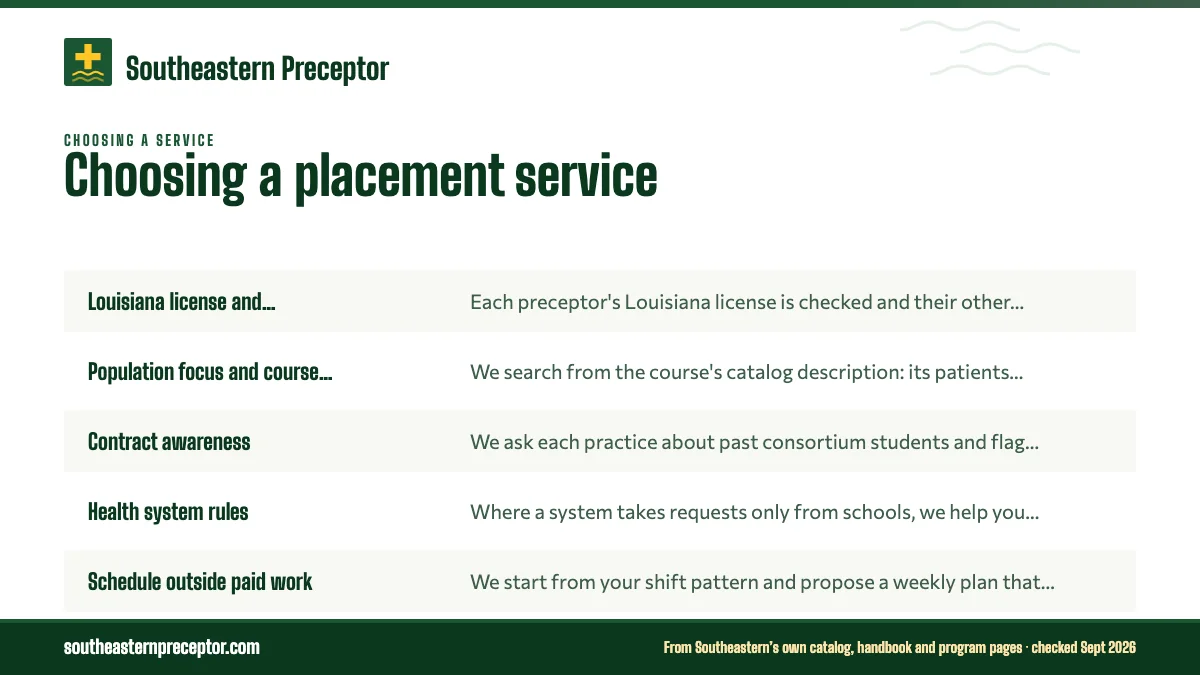
| Louisiana license and student load | Each preceptor's Louisiana license is checked and their other graduate students for the term confirmed before you hear the name |
| Population focus and course fit | We search from the course's catalog description: its patients, its hours and its place in your track |
| Contract awareness | We ask each practice about past consortium students and flag sites likely to need a new university contract, so you can confirm in the tracking system early |
| Health system rules | Where a system takes requests only from schools, we help you raise it with course faculty and focus our own search on practices that accept direct requests |
| Schedule outside paid work | We start from your shift pattern and propose a weekly plan that reaches the course total on your days off |
| Faculty-ready file | You receive the preceptor's CV or profile, license and certification details, patient mix and schedule in one brief |
| Replacement plan | If a preceptor withdraws, your placement advisor starts a new search at once, beginning with preceptors already screened for your course |
| Clear terms, honest language | Our terms are in writing before you commit, and approval stays with course faculty and the graduate coordinator |
Your part stays the same
A service changes who searches, not what Southeastern expects of you. You still discuss the preceptor with course faculty, sign the letter of agreement, complete compliance, keep your schedule current in the clinical tracking system and log honest hours. Keep every message with faculty and your preceptor in your university email account, as the consortium handbook requires. We make each of those steps lighter by handing you a complete, course-matched proposal early.
How it works shows our steps, your own search or ours compares the two routes, cost explains what shapes the fee, and the request form starts a search.
Questions Southeastern students ask
Does Southeastern recommend any preceptor placement services?
Southeastern's pages and the consortium handbook name no placement service and take no position on them. The consortium does say it can recommend preceptors it has worked with across south Louisiana, which is worth asking about. Any preceptor a service finds still goes through the same faculty approval, graduate coordinator review and facility contract.
Can a placement service promise that my preceptor will be approved?
No honest service can. Approval of each Southeastern preceptor sits with course faculty, with the graduate coordinator reviewing, and Louisiana's board rule keeps the selection of student experiences with nursing faculty. What a service can do is improve the odds of a first-pass yes: a preceptor matched to the course, licensed in Louisiana and presented with a complete file.
How do I check a preceptor's Louisiana license myself?
Use the Louisiana State Board of Nursing's online license lookup, which Southeastern's DNP admissions page links. Confirm the license is active and unencumbered, as the board requires of every preceptor, and that the APRN certification matches your population focus. A good service shares these details up front so you can verify them before the faculty conversation.
What should a placement service's written terms cover?
What you receive for each course, how many preceptor options you will see, what happens if course faculty decline a preceptor, what happens if a preceptor withdraws before or during the course, and how your information is handled. Ask for all of it in writing before you commit, and read it beside Southeastern's rules.
Should a placement service contact Ochsner providers for me?
Ochsner Health's clinical education page routes graduate nursing requests through a school representative in InPlace Network and wants any provider outreach left to the school. A service calling those providers on your behalf would sidestep that rule. Take an Ochsner idea to course faculty, and let a service work with practices that accept direct requests.
Related pages
Last checked 2026-09-27
We check these pages against Southeastern's own catalog, program pages and consortium handbook, and Louisiana rules. Your course faculty, the graduate coordinator and your advisor have the final word.
Southeastern asks you to choose your preceptor. We find one near you.
Tell us your Southeastern track, where in Louisiana you live and when your next clinical course starts. We find Louisiana-licensed preceptors who fit the course, confirm whether the facility is already under contract with the university, and hand you what your course faculty need to approve it before the semester.
- Pediatric and women's health preceptors for
NURS 6820, adult and older-adult primary care forNURS 6830andNURS 6840 - Psychiatric preceptors for
NURS 6910toNURS 6930, with the child and older-adult focus each course sets - Across Louisiana, from the Northshore to Shreveport
Start your placement plan
Program, city and start date is all we need to begin.