The Southeastern clinical placement process, from practice area to first counted hour
At Southeastern Louisiana University, a graduate clinical course begins long before its first day. You pick a practice area that suits the course, choose a preceptor, talk the choice through with your course faculty member, confirm the preceptor is willing, check the facility's contract, clear approval and review, finish compliance, and only then start hours. Each step below stays short and points to the guide that owns it.
Get your placement plan
Tell us your Southeastern program and where you live. A placement advisor replies with preceptor and site options in your community that fit your Southeastern course.
The route in one view
Southeastern delivers its MSN inside the Intercollegiate Consortium for a Master of Science in Nursing, and the consortium's student handbook sets out how a precepted course gets arranged. It first points you to your home school's own requirements, then lays out a fixed order that you repeat alongside each course's assigned faculty member, every semester you have clinical or practicum work.
The same order carries into the post-master's certificates and the BSN to DNP, because their nurse practitioner courses are the same NURS 6820 to NURS 6840 and NURS 6910 to NURS 6930. The DNP residency adds its own paperwork, covered further down. Bachelor's students are on a different footing altogether: Southeastern itself sets up BSN clinical placements, all inside a radius of roughly 60 miles from campus.
The eight steps, in order
Treat these as a relay. Each step hands something to the next one, and jumping ahead usually means circling back.
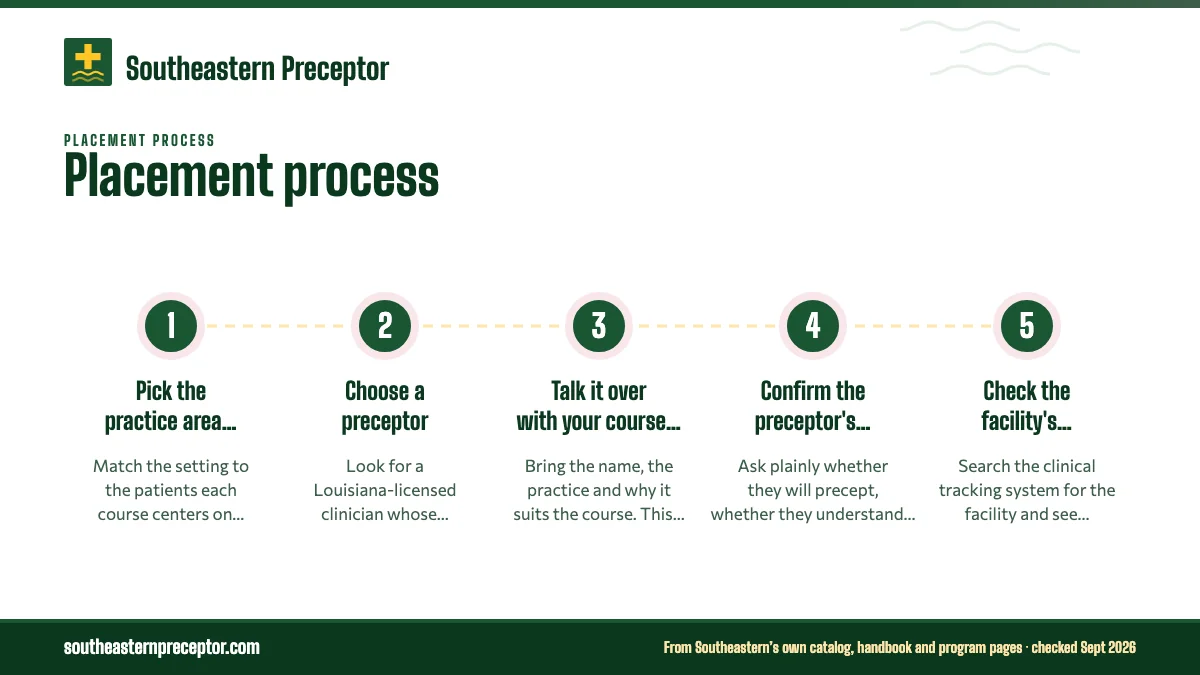
- Pick the practice area that fits the courseMatch the setting to the patients each course centers on: pediatrics and women's health for
NURS 6820, adults forNURS 6830, adults plus older patients forNURS 6840. PMHNP students need children and teens forNURS 6920, then older patients forNURS 6930. - Choose a preceptorLook for a Louisiana-licensed clinician whose patients fit, ideally a nurse practitioner certified in your focus. Choosing your preceptor gives Southeastern's own wording.
- Talk it over with your course faculty memberBring the name, the practice and why it suits the course. This conversation is where a weak fit gets caught early.
- Confirm the preceptor's willingnessAsk plainly whether they will precept, whether they understand the nurse practitioner student role, and what patient encounters the practice can offer over a full course.
- Check the facility's contractSearch the clinical tracking system for the facility and see whether a current university contract or letter of agreement exists. If there is none, a new one must be started; clinical contracts explains the wait.
- Faculty approval and graduate coordinator reviewYour course faculty member signs off, the graduate coordinator takes a second look, and the three-way letter of agreement is signed. Preceptor approval has the detail.
- Compliance on fileHealth requirements, CPR, drug screening, background check, and OSHA and HIPAA records must be current first. See compliance requirements.
- Begin hours, on unpaid timeSet a schedule with your preceptor, post it in the tracking system and log as you go. Time your employer pays for never counts, even at your own workplace; clinicals where you work shows how to separate the two.
What has to be on file before hour one
The consortium handbook is firm on this point: no clinical practicum experience begins until four items sit in the Graduate Nursing Office. Missing any one of them moves your start date, however ready the preceptor is.
- A completed, current contract between the university and the facility.
- The preceptor's CV or resume, no older than two years, or a filled-in professional profile.
- The three-way letter of agreement, carrying your signature, the preceptor's and your course faculty member's.
- Current proof of your clinical health requirements and your OSHA and HIPAA compliance, plus anything else your home university asks for.
After faculty approve the letter of agreement, your clinical schedule goes into the tracking system and stays updated through the term. Your course faculty member also conducts a site visit while you are there.
The step students most often misjudge is the facility contract. It moves on the facility's legal timeline, not yours, so the lookup in step five belongs in the semester before the course, not in its first week.
How early to start
Southeastern publishes no overall timeline and no preceptor submission deadline. The handbook only says to tell course faculty your preceptor and agency by the date your university designates, so check the current date with course faculty or the graduate coordinator once you register.
Two published lead times argue for an early start. By the handbook's own estimate, securing a brand-new agency contract can run from a few weeks to several months. Some Louisiana health systems keep their own calendars as well: Ochsner Health's clinical education page says only a school representative may submit a graduate nursing request, and it posts cutoffs in mid-June, mid-November and mid-March for the fall, spring and summer terms.
Our own rule of thumb, not a Southeastern figure: start the preceptor search a full semester ahead of the clinical course, so the contract, approval and compliance steps have room to finish.
Where the route bends by program
MSN FNP and PMHNP students, and post-master's certificate students, follow the steps as written, and every clinical hour has to be completed in Louisiana; the Louisiana-only guide covers what that means for students near a state line. PMHNP students also complete 60 observation hours in NURS 6900 before the three clinical courses.
MSN Nursing Education students use the same handbook section, which covers nurse educator practicums as well as nurse practitioner ones. Their NURS 6440 and NURS 6570 hours are teaching hours, and NURS 6570 places you in precepted classroom, lab and clinical settings, so the practice area in step one is an educational one.
DNP students add the residency. Southeastern's 2018-19 DNP handbook, the newest one it links, has the student pick a residency mentor, someone outside Southeastern, with guidance from faculty, and submit a facility agreement request for every residency site, even one thought to be under contract already. The residency courses, NURS 8210 through NURS 8230, must be completed at the home institution.
Why Southeastern students hand us the search
Three clinical courses of 200 to 275 hours each, every one needing a Louisiana preceptor in the right population and a facility under contract, is a heavy lift for a working nurse. Our placement desk carries steps one through five for you.
We search your part of Louisiana for a preceptor whose patients match the exact course, confirm the Louisiana license and certification, get a clear yes on willingness and schedule, and find out early whether the facility may need a new contract. You receive a short brief for the faculty conversation: the preceptor's current CV, the practice's patient mix and a proposed weekly schedule. If a preceptor withdraws mid-term, your placement advisor starts on a replacement at once.
Course faculty still approve and the graduate coordinator still reviews; our job is making sure what reaches them is complete and built for that course. Read how it works or send your course and region through the placement request form.
Questions Southeastern students ask
How long does the Southeastern placement process take from start to finish?
Southeastern publishes no total. The piece most likely to drag is a new facility contract, which can run from weeks into months by the handbook's reckoning, and approval and compliance come after it. Starting the search a semester ahead, our suggestion rather than a Southeastern rule, leaves room for a contract to be drawn up without delaying your course.
Can I log clinical hours while my preceptor's approval is pending?
No. The handbook bars any clinical practicum experience until course faculty have approved the preceptor and the graduate coordinator has reviewed them, and until the whole file (contract, CV, signed letter, health records) is in place. Time spent before that point sits outside the approved experience, so wait until faculty confirm you are cleared.
Do I go through these steps again for each clinical course?
Yes. The handbook frames the process per semester of clinical work, planned with that course's assigned faculty member. Even a preceptor you keep deserves a fresh look, because the population changes from NURS 6820 to NURS 6830 to NURS 6840, and from NURS 6910 to the youth and older-adult emphases of NURS 6920 and NURS 6930.
Is the placement process different for BSN to DNP students?
For the nurse practitioner courses it is identical, since BSN to DNP students take the consortium's Family Health or Psychiatric/Mental Health courses. The residency is the extra layer: a mentor chosen with faculty input, a facility agreement request for each residency site, and residency hours taken at the home institution, per the 2018-19 DNP handbook and the current catalog.
What happens if my preceptor backs out partway through a semester?
Southeastern and the consortium publish no written policy for that case, so tell your course faculty member right away from your university email account. A replacement goes through the same approval and contract checks. If you work with us, your placement advisor begins the replacement search as soon as you tell us, starting with preceptors already vetted for your course.
Related pages
Last checked 2026-09-27
We check these pages against Southeastern's own catalog, program pages and consortium handbook, and Louisiana rules. Your course faculty, the graduate coordinator and your advisor have the final word.
Southeastern asks you to choose your preceptor. We find one near you.
Tell us your Southeastern track, where in Louisiana you live and when your next clinical course starts. We find Louisiana-licensed preceptors who fit the course, confirm whether the facility is already under contract with the university, and hand you what your course faculty need to approve it before the semester.
- Pediatric and women's health preceptors for
NURS 6820, adult and older-adult primary care forNURS 6830andNURS 6840 - Psychiatric preceptors for
NURS 6910toNURS 6930, with the child and older-adult focus each course sets - Across Louisiana, from the Northshore to Shreveport
Start your placement plan
Program, city and start date is all we need to begin.