Precepting a Southeastern FNP or PMHNP student: what it involves
A Southeastern Louisiana University nurse practitioner student who asks you to precept wants one clinical course: a semester of 200 or 275 hours with the patients that course names. You need an active Louisiana license and, for most hours, APRN certification in the student's population focus. Course faculty approve you, your facility needs a current agreement with the university, and you evaluate the student at the semester's end.
Open to precepting a Southeastern student?
Choose the preceptor option under Program and tell us your specialty, practice location and the semesters that suit you.
One course, one semester, one patient group
Southeastern's graduate NP students pick their own preceptors and take that choice to the faculty member teaching the course. Their master's program runs through the Intercollegiate Consortium for a Master of Science in Nursing, a four-university partnership, so the handbook they follow is the consortium's.
Each request covers one course, and every course names the patients it centers on, so a practice that suits one can be wrong for the next.
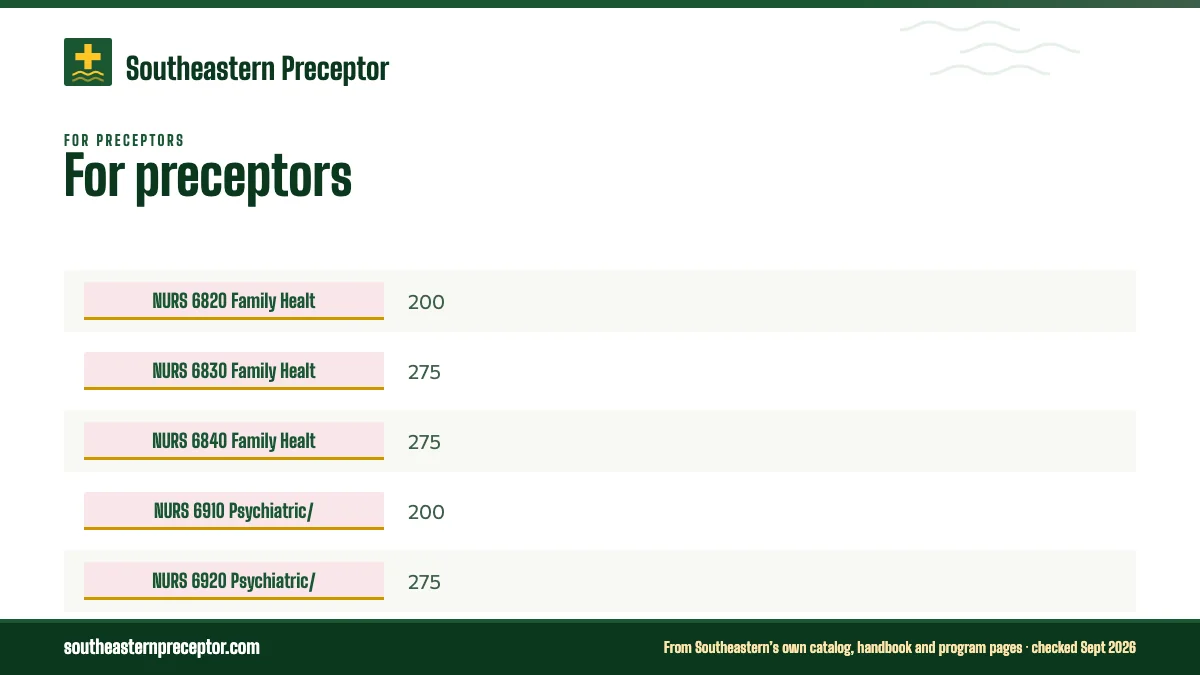
| Course | Practicum hours | Patients and focus |
|---|---|---|
NURS 6820 Family Health I | 200 | Children and child-bearing women |
NURS 6830 Family Health II | 275 | Adults |
NURS 6840 Family Health III | 275 | Adults and older adults |
NURS 6910 Psychiatric/Mental Health I | 200 | Diagnostic assessment, basic psychotherapy, common disorders |
NURS 6920 Psychiatric/Mental Health II | 275 | Lifespan care, emphasis on children and adolescents |
NURS 6930 Psychiatric/Mental Health III | 275 | Lifespan care, emphasis on older adults |
Post-master's PMHNP certificate students replace the third psychiatric course with NURS 6970, which carries 120 hours. On our own math (Southeastern prints no weekly figure), a 275-hour course in fall or spring works out to roughly two full clinic days a week, and the nine-week summer semester asks for more. Totals by program are in clinical hours.
Who may precept under Louisiana and consortium rules
Louisiana's Board of Nursing sets the floor: whoever precepts needs a current Louisiana RN or APRN license with no encumbrance, and most of the student's clinical time belongs with an APRN certified in the student's population focus: a family nurse practitioner for an FNP student, a psychiatric-mental health NP for a PMHNP student.
Physicians and dentists also fit the board's definition of a graduate preceptor, and programs may blend clinicians, so a physician may take a share of a course while the APRN carries most of it. Louisiana caps the load at two graduate APRN students per preceptor in a given rotation.
What the consortium handbooks add
- A master's or doctorate relevant to the preceptor role
- A current license in your discipline with no encumbrance, plus APRN certification in the right area
- At least a year in clinical practice (the faculty handbook calls it preferred)
- For behavioral health clinicians, an independent license rather than one held under supervision
Citations for each rule are on preceptor requirements.
Approval, and the agreement with your facility
Each preceptor needs approval from Southeastern's course faculty and a review by the graduate coordinator, both before any clinical time begins. Faculty also review, may revise, and then approve a student-preceptor letter of agreement carrying three signatures: yours, the student's and the faculty member's.
Your facility needs its own agreement as well, a contract or letter of agreement made at the university level and signed on behalf of your organization and of the College of Nursing. Louisiana requires these agreements to state each side's rights and responsibilities, liability insurance coverage included, and to contain a termination clause. The consortium handbook warns that a new one may take several weeks to months.
On file in the Graduate Nursing Office before day one
- Your CV, resume or completed professional profile, no older than two years
- The signed three-way letter of agreement
- A current agreement between the university and your facility
- The student's health, OSHA and HIPAA documentation
Clinical contracts explains how students check a facility's status.
Your part during the semester, and the faculty's
The consortium handbook keeps a preceptor's duties short: orient the student to the role and your setting, make expectations plain, agree on a schedule together, and keep the course faculty member informed. The student arranges any agency orientation your organization requires and enters the agreed schedule into the clinical tracking system, where every patient contact hour is logged.
Louisiana requires a faculty member to be available to you throughout and to confer with you and the student at least once a week, consortium faculty visit each student's site, and faculty remain responsible for APRN students whether supervision is direct or indirect. Messages will come from the student's Southeastern account, the only channel the handbook allows between students, faculty and preceptors.
Evaluations, and why yours counts
Under the consortium handbooks, evaluation flows three ways. You give input on the student's clinical performance through the term and complete the clinical evaluation form at the semester's end, using materials the faculty member supplies. The student rates you and the site every semester, and course faculty weigh your input when they assign the grade.
When performance becomes a worry, the faculty handbook asks preceptors to tell faculty immediately rather than save it for the final form. Southeastern keeps its MSN evaluation form inside the course, so ask the faculty member for a copy at the start.
A preceptor's final evaluation can decide the course. The consortium student handbook turns an unsatisfactory final evaluation, from the preceptor or the faculty member, into an F, and under Southeastern's catalog a D or F in any graduate course leads to dismissal.
What the student brings to your site
Your student arrives screened. The catalog requires background checks, drug and alcohol screening and program health requirements at the student's expense, along with current CPR. Before any clinical course the student needs twelve months as an RN in a field matching the specialty, and must hold an unencumbered Louisiana RN license throughout, reporting any change to the graduate coordinator at once.
Your organization may add its own requirements, including a criminal background check, which the student completes and pays for. After an exposure to blood or other potentially infectious material at your site, follow-up care and its cost belong to the student.
If the student works for your organization, clinical hours must stay separate from the job and fall on unpaid time; see clinicals where you work.
Louisiana practice, and how our placement desk approaches you
Louisiana NPs who make medical diagnoses and manage treatment practice under a collaborative practice agreement with a physician, which is why AANP classes Louisiana as a reduced practice state. The student learns inside your practice under your guidance and signs no such agreement; Louisiana NP practice has the detail.
When our placement desk contacts you for a Southeastern student, we arrive with the specifics: the course, its hours and population, the semester dates and where the student lives. We ask whether you already have graduate students that term, collect your CV and the name of your facility's signer, and prepare the student for the faculty conversation. If you are willing to precept, use the form on this page.
Questions Southeastern students ask
Who signs the agreement between my practice and Southeastern?
The person with signing authority for your facility signs the contract or letter of agreement, together with a designee of Southeastern's College of Nursing. In a small independent practice that is often the owner; in a larger organization, ask your administration. You personally sign the separate three-way letter of agreement with the student and the course faculty member.
Can a colleague in my practice cover some of the student's hours?
Often, yes. Louisiana lets programs use a mix of clinicians, provided most of the student's time stays with an APRN holding certification in the student's population. Because course faculty approve every preceptor, tell the student early so your colleague goes through approval as well instead of stepping in unannounced.
Can I precept two Southeastern students at once?
Louisiana allows up to two graduate APRN students with one preceptor in a given clinical experience, and that limit counts students from any school. Each student needs a separate approval and letter of agreement, and your patient volume must let both reach their hours.
What should I do if the student is struggling?
Contact the course faculty member right away. The consortium faculty handbook asks preceptors to notify faculty immediately when unsatisfactory performance is in question, and Louisiana already requires faculty to confer with you weekly. Raising it early gives the student time to improve before your final evaluation, which weighs heavily on the grade.
Related pages
Last checked 2026-09-27
We check these pages against Southeastern's own catalog, program pages and consortium handbook, and Louisiana rules. Your course faculty, the graduate coordinator and your advisor have the final word.
Southeastern asks you to choose your preceptor. We find one near you.
Tell us your Southeastern track, where in Louisiana you live and when your next clinical course starts. We find Louisiana-licensed preceptors who fit the course, confirm whether the facility is already under contract with the university, and hand you what your course faculty need to approve it before the semester.
- Pediatric and women's health preceptors for
NURS 6820, adult and older-adult primary care forNURS 6830andNURS 6840 - Psychiatric preceptors for
NURS 6910toNURS 6930, with the child and older-adult focus each course sets - Across Louisiana, from the Northshore to Shreveport
Start your placement plan
Program, city and start date is all we need to begin.