How nurse practitioners practice in Louisiana, and what it means for who precepts you
Louisiana licenses nurse practitioners through its Board of Nursing and requires any NP who diagnoses and manages medical conditions to hold a collaborative practice agreement with a physician, the reason AANP files Louisiana under reduced practice. For a Southeastern Louisiana University student that shapes two things: the practice you step into after certification, and the working setup of nearly every NP who precepts you.
Get your placement plan
Tell us your Southeastern program and where you live. A placement advisor replies with preceptor and site options in your community that fit your Southeastern course.
Reduced practice, briefly
On AANP's state map, updated in May 2026, Louisiana sits in the reduced practice category. By AANP's definition, a reduced practice state either requires a regulated collaborative agreement with another provider for the length of an NP's career or limits the setting of at least one element of NP practice. Its October 2025 Louisiana fact sheet makes that concrete: Louisiana law obliges NPs to maintain a regulated, physician-based collaborative agreement covering at least one piece of their practice.
Licensure sits with the nursing board alone. AANP describes NP licensure in Louisiana as regulated exclusively by the Board of Nursing, on the basis of an RN license, graduate NP education and national certification. The government sources in our research show no enacted change to the collaboration requirement between 2024 and 2026, and AANP's 2026 map still lists Louisiana as reduced practice.
Inside a collaborative practice agreement
The Board's rule is specific about who needs an agreement and what it must hold. An APRN who engages in medical diagnosis and management must have one; APRNs whose work stays within the nursing practice described in R.S. 37:913(3)(a) do not. At minimum the agreement spells out:
- How the collaborating physician or dentist is available for consultation, referral or both
- How the collaborative practice is managed, including the clinical practice guidelines the APRN follows
- How patients' needs are covered when the APRN, the physician or both are away
Call it collaboration under an agreement, which is how the Board's rule and AANP both frame it. As a student you sign nothing here. The agreement belongs to your preceptor and the collaborating physician, and the terms of your own role come from your faculty, the practice and the three-way agreement you sign for the course.
Prescriptive authority, step by step
Prescribing is its own authorization on top of the APRN license, and it rests on the agreement: under the Board's rule, an APRN's prescriptive authority is switched to inactive status whenever no collaborative practice agreement with a physician is in effect.
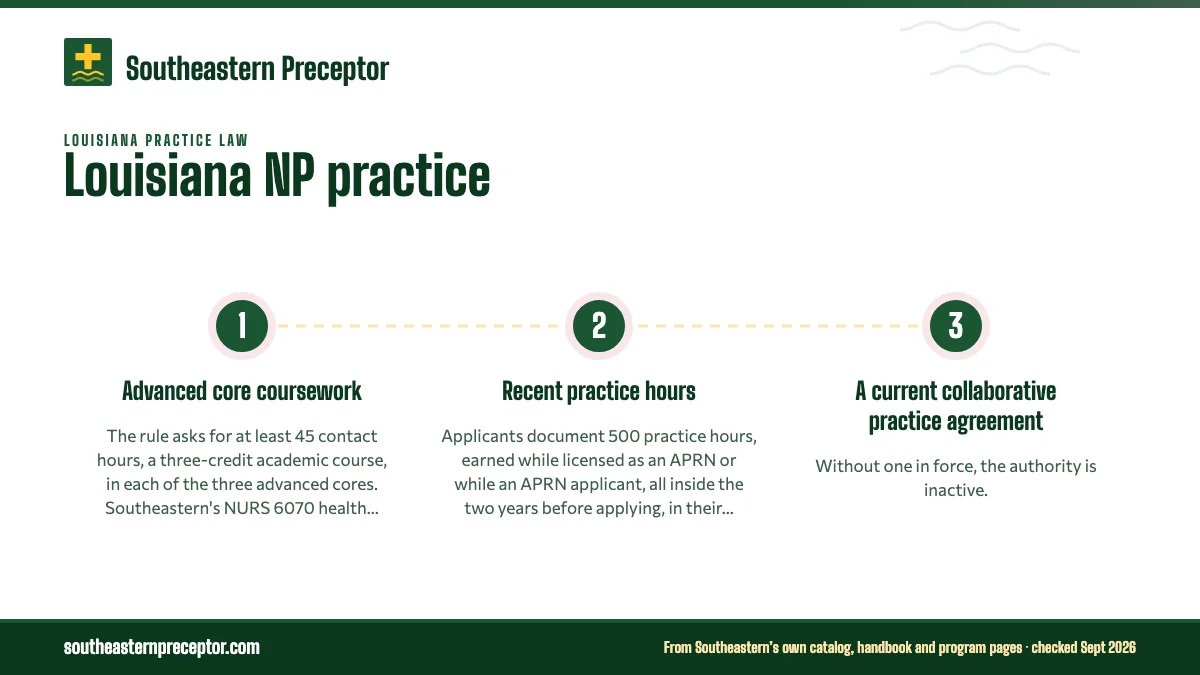
- Advanced core courseworkThe rule asks for at least 45 contact hours, a three-credit academic course, in each of the three advanced cores. Southeastern's
NURS 6070health assessment,NURS 6170pharmacotherapeutics andNURS 6180pathophysiology each carry three credits. - Recent practice hoursApplicants document 500 practice hours, earned while licensed as an APRN or while an APRN applicant, all inside the two years before applying, in their role and population focus. Graduate program clinical practice that met certification eligibility and prepared the applicant for the role may be accepted toward that total.
- A current collaborative practice agreementWithout one in force, the authority is inactive.
Controlled substances carry extra limits. An APRN with controlled substance authority may not use those drugs to treat chronic or intractable pain, obesity, or themselves, a spouse, a child or another family member, and AANP notes that Louisiana NPs are not currently authorized to prescribe Schedule II drugs for chronic pain or obesity. AANP also lists DNR orders and death certificates as outside NP signing authority in Louisiana, while recognizing NPs as primary care providers.
Continuing education for prescribers is one detail to verify at the source. AANP's fact sheet says NPs with prescriptive authority owe yearly continuing education in pharmacotherapeutics, and other summaries give a different hour count, so take the current figure from the Louisiana State Board of Nursing rather than a secondhand source.
What the practice model means for your preceptor
An NP preceptor who diagnoses and prescribes works under a collaborative practice agreement, so the practice you train in is shaped by one: the NP's scope, the guidelines the practice follows and its referral routes all trace back to it. When you meet a prospective preceptor, it is fair to ask how the NP and the collaborating physician share patients, because that decides much of what you will see.
Louisiana's education rules then say who may precept an advanced practice student: an APRN, a physician or a dentist. More than half of your time belongs with an APRN whose certification matches your population, and other clinicians may fill in around that. In a collaborative practice that opens a useful option: the NP carries the larger share of your hours while the collaborating physician, once course faculty approve, teaches the rest.
PMHNP students face one more filter: the consortium's faculty handbook accepts a behavioral health professional as a preceptor only if that person is independently licensed rather than working under supervision. The full checklist is in preceptor requirements, and the Board's rules explains the share of hours and faculty oversight.
From your last clinical course to practice
After your final clinical course the order runs: national certification in your population, an APRN license from the Louisiana State Board of Nursing, then prescriptive authority once a collaborative practice agreement is in place. The Board's licensure rule looks for a finished graduate or post-graduate program and current certification, and applicants who wait longer than two years after finishing face added scrutiny. Southeastern's DNP page notes that you must be certified to qualify for APRN licensure in Louisiana. Certification exams covers the boards.
The field you join is sizable. In its 2023 data, the Health Works Commission of the Louisiana Board of Regents found 9,670 licensed APRNs, with 82 percent living in Louisiana and 79 percent of those certified nurse practitioners, and it cited 246 open certified nurse practitioner positions. The consortium's FAQ adds that most of its students train close to home with physicians and NPs and are eventually offered positions there, so a well-chosen preceptor can matter well beyond one course.
How the placement desk applies Louisiana's practice rules
Each preceptor we propose is checked against the way Louisiana NPs actually practice. Your placement advisor confirms the NP's Louisiana APRN license and national certification in your population, asks how the collaborating physician fits into the practice and whether that physician could teach part of your hours, and plans the schedule so an APRN carries most of your time. For PMHNP students we confirm that any other clinician involved is independently licensed.
The outcome is a preceptor your course faculty can approve on first review, in a practice where the collaborative setup supports teaching rather than squeezing it. Your advisor remains reachable all term and finds a replacement if the arrangement changes. How it works walks through our process, and the request form starts it.
Questions Southeastern students ask
Can a nurse practitioner practice independently in Louisiana?
Not for medical diagnosis and management. The Board's rule requires an APRN who diagnoses and manages patients to hold a collaborative practice agreement, and prescriptive authority goes inactive without one. That requirement is why AANP rates Louisiana a reduced practice state on its 2026 map.
Can Southeastern clinical hours help me qualify to prescribe in Louisiana?
Yes, potentially. The Board wants proof of 500 recent practice hours in your role and population before it grants prescriptive authority, and its rule lets it accept graduate clinical practice that met certification eligibility toward that figure. The Board rules on each application, so keep complete, accurate records of every clinical course.
Can a physician be my preceptor instead of an NP?
For part of your hours. Louisiana's definition of a graduate preceptor includes physicians along with APRNs and dentists, yet the larger share of your clinical time still has to be spent alongside an APRN holding certification in your population. Southeastern's course faculty approve every preceptor, so agree on the split with them before the semester starts.
Can Louisiana NPs prescribe controlled substances?
With controlled substance authority, yes, within limits. The Board's rule bars using those drugs to treat chronic or intractable pain, obesity, or the prescriber and their family, and AANP notes Louisiana NPs may not prescribe Schedule II drugs for chronic pain or obesity. Any prescribing also depends on a current collaborative practice agreement.
Does Louisiana's reduced practice rating change where I can do clinicals?
No. Where you train is governed by Southeastern's Louisiana-only rule for MSN and certificate hours and by the Board's education rules on preceptors. The practice rating describes licensed NPs after graduation, although it does shape how your preceptor's practice is organized day to day.
Related pages
Last checked 2026-09-27
We check these pages against Southeastern's own catalog, program pages and consortium handbook, and Louisiana rules. Your course faculty, the graduate coordinator and your advisor have the final word.
Southeastern asks you to choose your preceptor. We find one near you.
Tell us your Southeastern track, where in Louisiana you live and when your next clinical course starts. We find Louisiana-licensed preceptors who fit the course, confirm whether the facility is already under contract with the university, and hand you what your course faculty need to approve it before the semester.
- Pediatric and women's health preceptors for
NURS 6820, adult and older-adult primary care forNURS 6830andNURS 6840 - Psychiatric preceptors for
NURS 6910toNURS 6930, with the child and older-adult focus each course sets - Across Louisiana, from the Northshore to Shreveport
Start your placement plan
Program, city and start date is all we need to begin.