NP certification after Southeastern: the FNP and PMHNP exams and the Louisiana APRN license
Southeastern Louisiana University's FNP graduates meet the educational requirements for either the ANCC or the AANP family nurse practitioner exam, and the catalog lists Psychiatric/Mental Health Nurse Practitioner as the other NP role its master's prepares students to certify in. In Louisiana, national certification comes before the APRN license. Southeastern publishes no pass rates, so this guide covers eligibility, sequence and how your last clinical courses feed the exam.
Get your placement plan
Tell us your Southeastern program and where you live. A placement advisor replies with preceptor and site options in your community that fit your Southeastern course.
Which exams Southeastern graduates sit for
Southeastern's DNP page states that MSN FNP graduates meet the educational requirements for either of two national family nurse practitioner exams: the one from the American Nurses Credentialing Center (ANCC) and the one offered through the American Association of Nurse Practitioners (AANP), which its certification board, AANPCB, administers. For psychiatric-mental health graduates, ANCC offers a PMHNP certification exam.
Each board's own handbook is the authority on eligibility, fees, application steps and test timing, and boards revise those handbooks, so read the current version on the AANPCB site or the ANCC site before you apply.
| Southeastern program | Certification population | Certifying board |
|---|---|---|
| MSN FNP, post-master's FNP certificate, BSN to DNP FNP | Family nurse practitioner | ANCC or AANPCB |
| MSN PMHNP, post-master's PMHNP certificate, BSN to DNP PMHNP | Psychiatric-mental health nurse practitioner | ANCC |
Southeastern's MSN page adds a caution worth reading twice: some certification exams require clinical experience beyond what the master's program includes. Check your chosen board's hour and population requirements early, while your remaining clinical courses can still be shaped around them. BSN to DNP students in the FNP and PMHNP concentrations may finish with the MSN once its requirements are met, a point the catalog marks in each plan; ask your advisor how that affects when you can apply to test.
Louisiana licensure comes after certification
In Louisiana, the Board of Nursing alone licenses nurse practitioners. AANP's Louisiana fact sheet lists three requirements: a registered nurse license, graduate preparation in an NP role and national certification. Board rule LAC 46:XLVII.4507 calls for completion of at least a graduate or post-graduate program plus current certification in the advanced practice role and population, and Southeastern's DNP page puts it plainly: certification is required to be eligible for APRN licensure in Louisiana.
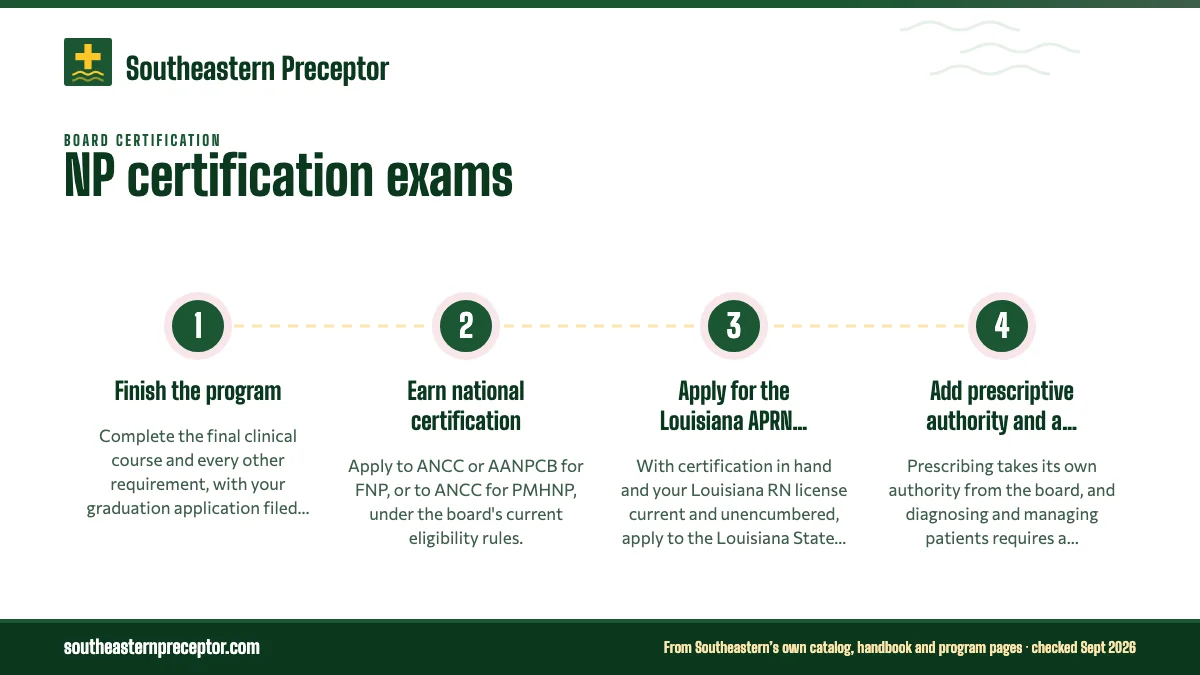
The same rule adds an extra review when more than two years pass between finishing the program and applying for the license, so plan to certify and apply well inside that window. The board's own site carries the current application steps. In order, the path looks like this:
- Finish the programComplete the final clinical course and every other requirement, with your graduation application filed on the calendar's dates.
- Earn national certificationApply to ANCC or AANPCB for FNP, or to ANCC for PMHNP, under the board's current eligibility rules.
- Apply for the Louisiana APRN licenseWith certification in hand and your Louisiana RN license current and unencumbered, apply to the Louisiana State Board of Nursing.
- Add prescriptive authority and a collaborative practice agreementPrescribing takes its own authority from the board, and diagnosing and managing patients requires a collaborative practice agreement with a collaborating physician.
Prescriptive authority and your program hours
Louisiana's prescriptive authority rule asks for 500 hours of clinical practice as a licensed APRN or APRN applicant, within the two years right before you apply, in your role and population. The same rule allows clinical practice from the graduate program to be accepted when it met certification eligibility and prepared you for the role. Documented well, your Southeastern clinical hours may count toward that first prescribing application.
The rule also looks for 45 contact hours, the equivalent of a 3-credit course, in each of three advanced core areas. Southeastern's NURS 6070 Health Assessment and Diagnostic Reasoning, NURS 6170 Pharmacotherapeutics and NURS 6180 Pathophysiology carry 3 credits each.
Prescriptive authority is designated inactive when an APRN has no current collaborative practice agreement with a physician, so the arrangement is part of your first job search. NP preceptors who diagnose and prescribe already work under these agreements, which makes them a good source of practical answers. Louisiana NP practice explains the agreement in detail.
How the last clinical courses build toward the exam
The consortium's FAQ says it wants students to get a variety of clinical experiences so they succeed on the certification exam. Southeastern's course sequence spreads that variety across populations, and each course requires the one before it:
| Track | Course | Hours | Population focus |
|---|---|---|---|
| FNP | NURS 6820 Family Health I | 200 | Pediatrics and child-bearing women |
| FNP | NURS 6830 Family Health II | 275 | Adults |
| FNP | NURS 6840 Family Health III | 275 | Adults and older adults |
| PMHNP | NURS 6900 Psychotherapy | 60 observation | Psychotherapy foundations |
| PMHNP | NURS 6910 Psychiatric/Mental Health I | 200 | Initial diagnostic assessment, common disorders |
| PMHNP | NURS 6920 Psychiatric/Mental Health II | 275 | Lifespan, emphasis on children and adolescents |
| PMHNP | NURS 6930 Psychiatric/Mental Health III | 275 | Lifespan, emphasis on older adults |
Post-master's PMHNP certificate students finish with NURS 6970 (120 hours) in place of NURS 6930. The catalog totals that certificate at 510 clinical hours while its courses add to 595, and the majors pages still print 600 hours for the MSN tracks against the catalog's 750. Settle your own documented total with the graduate coordinator before you apply to test, since boards and Louisiana's prescriptive rule both look at program hours. The FNP hours guide and PMHNP hours guide break the totals down.
A final-semester checklist
The last clinical semester is when exam preparation, licensure planning and the final 275 hours all land together. These steps keep the paperwork side from slipping:
- Keep your clinical tracking records complete and consistent with your preceptors' signed evaluations; they are the proof of your program hours.
- File the graduation application on time; the dates are on the academic calendar.
- Read your chosen board's current eligibility rules and confirm your hours and populations meet them, including any clinical experience beyond the program.
- Keep your Louisiana RN license unencumbered; the consortium handbook requires it throughout the program and asks you to report any change to the graduate coordinator right away.
- Ask preceptors how collaborative practice agreements work in their practice, since you will arrange your own after licensure.
- Have the preceptor for your final course confirmed a semester ahead, so the last 275 hours can begin in the first week of the term.
No published pass rates, and what you can control
Southeastern does not publish certification pass rates for its FNP or PMHNP graduates, and the consortium's evaluation plan shows only the benchmarks it tracks first-attempt results against. Accreditation covers what Southeastern does publish about its programs. Any Southeastern NP pass rate you see without a Southeastern source should be treated as unverified.
What you can shape is the quality and fit of your clinical hours. Your placement advisor finds Louisiana preceptors whose practices match each course's population, so the pediatric and women's health hours of Family Health I, the older adults of Family Health III, or the children and adolescents of Psychiatric/Mental Health II happen in the semester they are meant to. That is the variety the consortium ties to exam success. Start with how it works or the form below.
Questions Southeastern students ask
Should I take the ANCC or the AANPCB exam for FNP?
Southeastern names both as options for its FNP graduates and states no preference on the pages we read. Compare the two boards' current handbooks, including their content outlines, formats and renewal rules, and ask course faculty which suits your practice plans. Before you choose, confirm with the Louisiana State Board of Nursing that the certification you pick meets its licensure rule.
Can I take the certification exam before I graduate from Southeastern?
The certification boards set that rule, not Southeastern, so check the current handbook of the board you choose for when you may apply and what proof of program completion it asks for. Southeastern's statement is that students who successfully graduate meet the educational requirements, so plan around your graduation term and file the graduation application on time.
Can a new Louisiana NP prescribe right away?
Not automatically. Prescriptive authority is a separate board authority that asks for 500 hours of practice as an APRN or APRN applicant within two years before applying, though qualifying clinical practice from your graduate program may be accepted. You also need a collaborative practice agreement with a physician, or prescriptive authority is designated inactive.
What happens if I wait more than two years to apply for my APRN license?
Louisiana's APRN licensure rule adds extra review when more than two years pass between finishing the graduate or post-graduate program and applying. That review is an added step, so certify and apply promptly after graduation, and check the board's current requirements early if a gap cannot be avoided.
Do post-master's certificate students take the same exam as MSN graduates?
The post-master's certificates prepare nurses who already hold a master's in nursing for FNP or PMHNP practice, so they aim at the same population certification as MSN graduates. Because the PMHNP certificate's catalog total of 510 hours does not match its courses' 595, confirm your documented hours with the graduate coordinator before applying.
Related pages
Last checked 2026-09-27
We check these pages against Southeastern's own catalog, program pages and consortium handbook, and Louisiana rules. Your course faculty, the graduate coordinator and your advisor have the final word.
- Southeastern: Doctor of Nursing Practice (FNP exam eligibility, certification for APRN licensure)
- Southeastern: MSN, about the program (certification caution)
- Louisiana Administrative Code 46:XLVII.4507 (APRN licensure)
- Louisiana Administrative Code 46:XLVII.4513 (prescriptive authority, collaborative practice)
- AANP: Louisiana state practice fact sheet
Southeastern asks you to choose your preceptor. We find one near you.
Tell us your Southeastern track, where in Louisiana you live and when your next clinical course starts. We find Louisiana-licensed preceptors who fit the course, confirm whether the facility is already under contract with the university, and hand you what your course faculty need to approve it before the semester.
- Pediatric and women's health preceptors for
NURS 6820, adult and older-adult primary care forNURS 6830andNURS 6840 - Psychiatric preceptors for
NURS 6910toNURS 6930, with the child and older-adult focus each course sets - Across Louisiana, from the Northshore to Shreveport
Start your placement plan
Program, city and start date is all we need to begin.