Clinical contracts at Southeastern: the facility agreement behind every placement
Every Southeastern Louisiana University clinical placement rests on a written agreement, a contract or letter of agreement, linking the university with the facility. It is signed at the university level, it is separate from the agreement you, your preceptor and your course faculty member sign, and setting up a new one is measured in weeks or months. Here is how to check a facility, what slows a contract down, which Louisiana health systems set their own terms, and why a backup site protects your semester.
Get your placement plan
Tell us your Southeastern program and where you live. A placement advisor replies with preceptor and site options in your community that fit your Southeastern course.
Two agreements, two jobs
Students often blur these together, but the consortium handbook separates them on purpose. The facility contract is instituted at the university level and covers the site. The letter of agreement you sign with your preceptor and course faculty member is its own document, written for one course.
| Detail | Facility contract or letter of agreement | Student and preceptor letter of agreement |
|---|---|---|
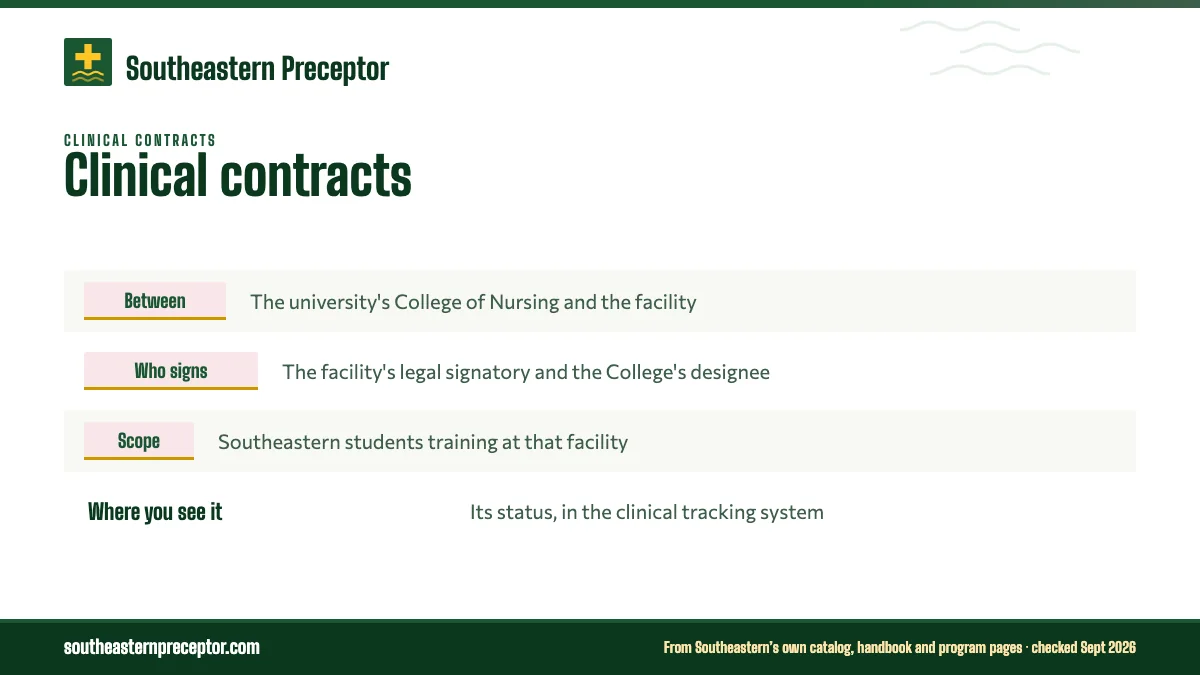
| Between | The university's College of Nursing and the facility | You, your preceptor and your course faculty member |
| Who signs | The facility's legal signatory and the College's designee | All three of you |
| Scope | Southeastern students training at that facility | One student, one preceptor, one course |
| Where you see it | Its status, in the clinical tracking system | Your course faculty member reviews and approves it |
Louisiana's nursing education rules require the agreement between a nursing program and an agency to be written, to state each side's rights and responsibilities including liability insurance, and to carry a termination clause. That is why facilities send these through legal or administrative offices rather than leaving them to a clinic manager.
Checking a facility in the clinical tracking system
The handbook's third step tells you to log in to the clinical tracking system and look up any facility you are considering: whether Southeastern already has a contract or letter of agreement on record there, and where that agreement stands. If nothing current is on file, the approval process for a new one begins.
The handbook is candid that gaps happen. The university works to keep contracts current with agencies students use often, yet a current contract may still be missing, including at a site classmates used before.
Southeastern does not publicly name the system MSN students use today. The consortium's 2022 evaluation plan refers to Typhon for clinical hours, while Southeastern's 2018-19 DNP handbook uses the same name for residency logs. The list of contracted agencies is visible only to enrolled students inside that system; clinical tracking and background checks covers the subscription side.
Lead time: weeks to months
The handbook's own estimate is that a new agency contract can take several weeks to months to secure, and it advises beginning early. Course faculty help route the contract for approval, but the facility's legal review sets much of the pace.
DNP students have an extra step on record. The 2018-19 DNP handbook requires a Request for Facility Agreement form for each residency site, even when you believe an agreement already exists. Its facility request form asks who at the facility is authorized to sign, what its official name is, and where its mailing and physical addresses are, and it states that an incomplete form will not start an agreement. Ask your DNP course faculty for the current version.
Our planning figure, not Southeastern's: when a facility shows no current contract, treat the whole semester before your course as the working window.
A facility that had a contract last year may not have one now. Look up every site yourself in the tracking system each time, and ask your course faculty member whenever the status reads unclear.
Louisiana health systems with their own rules
Large systems add their own steps on top of Southeastern's. None of the pages below says the system holds an agreement with Southeastern; each describes what any school has to do.
- Ochsner Health: its clinical education page says graduate nursing requests come only from a school representative through its InPlace Network platform, under an active affiliation agreement, and students have no access to the platform. It tells students to stay away from contacting its providers directly, posts request cutoffs (fall: June 15; spring: November 15; summer: March 15), and says a new affiliation agreement takes at least four months. Some sites, Slidell Memorial Hospitals among them, need a separate agreement.
- Ochsner LSU Health in north Louisiana: its graduate nursing page has the school's faculty or coordinator enter requests at least three months before the rotation and tells students not to call its providers.
- LCMC Health: according to an archived copy of its student page, it runs no preceptor-matching program and requires an active affiliation agreement with the school before learners ask each hospital's education office about capacity.
- CHRISTUS Health: its clinical education page requires a signed Clinical Education Affiliation Agreement before the term begins and asks the student's faculty advisor to identify the training site.
Closer to Hammond, North Oaks and St. Tammany Health System accept student requests through web forms, according to archived copies of their student pages. Regional detail sits in the Northshore guide and the Greater New Orleans guide.
Why start early and keep a backup
A contract is the one step that effort alone cannot hurry. Faculty approval can happen in a single conversation, while a facility's legal office works on its own calendar and a health system's request window closes whether or not your paperwork is ready.
A backup site turns a stalled contract from a lost semester into a switch. Look for a second preceptor in the same population focus, ideally at a facility where the tracking system already shows a current agreement. If the first site comes through, you have lost nothing; if it stalls, you move without starting over.
The same thinking applies near your job. An employer facility may already hold a contract, but your hours there still have to fall on unpaid time, as clinicals where you work explains.
What we check about the facility before you get a name
Our placement desk treats the contract as part of the match from the start. For each preceptor we propose, we record the facility's exact legal name, whether it belongs to a health system with its own student process, and who there signs affiliation agreements. Where a system takes requests only from schools, you know that on day one, so the request reaches your course faculty member in time.
You get the specific questions to settle in the tracking system and with course faculty, and where a site depends on a new contract, we line up a second option in the same population so your course start holds. You stay in charge of the university side while we make the facility side ready. See the full placement process or send a placement request.
Questions Southeastern students ask
Does Southeastern already have a contract with my employer's clinic?
Only the clinical tracking system can tell you, and its agency list is open to enrolled students rather than the public. Search by the facility's legal name, since a clinic owned by a larger system may sit under the parent's agreement or need its own, as Ochsner's page shows. Ask your course faculty member if the result is unclear.
Who starts a new facility contract at Southeastern?
When the tracking system shows no current contract, the handbook says the approval process is initiated, and course faculty help route the contract. The consortium's faculty handbook says the agency's legal signatory and the College's designee sign it. Your part is supplying accurate facility details early and following up with faculty until it is done.
Is the letter of agreement with my preceptor the same as the facility contract?
No. The handbook calls the facility contract a different document, set at the university level. You need both before any clinical hour: the facility contract covering the site, and the three-way letter signed by you, your preceptor and your course faculty member. Preceptor approval covers the letter and the sign-offs around it.
Can I call Ochsner providers myself and ask them to precept?
Ochsner Health's clinical education page directs students away from contacting its clinicians and toward routing site and preceptor interest through the school coordinator, and Ochsner LSU Health says the same about its own providers. Raise any Ochsner site with your course faculty member instead, well ahead of the posted request cutoffs.
Does a small private practice need a contract too?
Yes. The handbook's list of what must be on file before any clinical hour includes a completed, current agency contract, with no exception for size. A solo practice needs the same current agreement in place as a hospital system, so run the tracking system check for every site you consider.
Related pages
Last checked 2026-09-27
We check these pages against Southeastern's own catalog, program pages and consortium handbook, and Louisiana rules. Your course faculty, the graduate coordinator and your advisor have the final word.
Southeastern asks you to choose your preceptor. We find one near you.
Tell us your Southeastern track, where in Louisiana you live and when your next clinical course starts. We find Louisiana-licensed preceptors who fit the course, confirm whether the facility is already under contract with the university, and hand you what your course faculty need to approve it before the semester.
- Pediatric and women's health preceptors for
NURS 6820, adult and older-adult primary care forNURS 6830andNURS 6840 - Psychiatric preceptors for
NURS 6910toNURS 6930, with the child and older-adult focus each course sets - Across Louisiana, from the Northshore to Shreveport
Start your placement plan
Program, city and start date is all we need to begin.