Choosing your preceptor at Southeastern: what the university and the consortium actually say
Southeastern Louisiana University's graduate students choose their own preceptors and facilities, and they do it alongside course faculty who plan, facilitate and approve every placement. This page sets out the exact sentences Southeastern and its MSN consortium publish on the subject, what each one asks of you, and how our placement desk does the finding so your choice reaches the faculty conversation complete.
Get your placement plan
Tell us your Southeastern program and where you live. A placement advisor replies with preceptor and site options in your community that fit your Southeastern course.
Southeastern's DNP page: students choose
The plainest statement sits on Southeastern's Doctor of Nursing Practice page: "Students choose preceptors and facilities. Practicum hours are obtained within various facilities."
Those two sentences read as covering the doctoral route end to end: the nurse practitioner clinical courses inside the BSN to DNP, and the residency. For the residency, Southeastern's 2018-19 DNP handbook, still the one linked from the DNP page, adds: "The Residency Mentor will be selected by the student from outside of the University with faculty input."
That handbook predates today's four-digit course numbers and the current BSN to DNP concentrations, so treat it as the published record and confirm residency details with your DNP course faculty. The pattern itself is clear either way: you bring the candidate, and faculty weigh in before anything is signed.
The consortium handbook's precepted-learning steps
For MSN students, certificate students and anyone taking the nurse practitioner courses inside the BSN to DNP, the governing text is the student handbook of the Intercollegiate Consortium for a Master of Science in Nursing. Its precepted-learning section reads the same in the October 2025 revision on the consortium's site and the April 2021 copy Southeastern still links. It opens by sending you to your home institution's requirements, then says:
- "Each semester of clinical/practicum experience, you will work with a faculty member to plan clinical preceptor experiences. The following steps need to be taken in collaboration with the faculty member assigned to the clinical/practicum course."
- Step 1: "Select an area of clinical practice based on the course and program objectives. Clinical practice experience should be congruent with program concentration and course content."
- Step 2: "Discuss your choice(s) of a preceptor with the faculty member assigned to the course. Discuss with the preceptor(s) their willingness to serve as a preceptor, their understanding of the applicable nursing role, and the types of clinical experiences offered by that agency/organization. All preceptors must be approved by course faculty and reviewed by the graduate coordinator prior to beginning the clinical/practicum experience."
- Under student responsibilities: "Communicate with the assigned faculty member regarding the preceptor with whom you wish to do clinicals and agency you wish to use by the designated deadline of your university."
The later steps cover the facility contract, the preceptor's CV, the letter of agreement and the file that must be complete before hours begin. The placement process puts them in order, and preceptor approval explains the two sign-offs.
Faculty facilitated: the MSN page and the faculty handbook
Southeastern's MSN About page describes the arrangement from the faculty side in five words: "Clinical practicum experiences are faculty facilitated."
The graduate nursing programs page frames it as shared work: "Contract arrangements developed mutually between students, faculty, and advanced practice nurses and/or physician preceptors in a variety of established clinical sites allow for a professional, practical hands-on experience in meeting course objectives."
The consortium's faculty handbook, revised October 2023, lists among faculty duties to "Assist students in the identification of potential preceptors for graduate clinical experiences." Read together, these describe faculty as partners in the choice: they help surface candidates, shape the fit, approve, and visit the site. The proposal itself starts with you.
The consortium's list of preceptors it can recommend
The consortium's FAQ page takes the question head on. Asked whether students pick their own preceptors for the practicum courses, it answers: "Yes, students work closely with instructors to choose appropriate clinical sites and preceptors. We want students to get a variety of experiences so they will be successful on the certification exam. We have an extensive list of current and past preceptors across south Louisiana to recommend to you."
The answer closes by noting that most students work locally with physicians and nurse practitioners, often in practices that later offer them jobs.
That list is worth raising with your course faculty member early, ideally the semester before your course. A name from it still has to be available on your dates, see the right population for your specific course, and pass approval and the contract check like any other candidate. South Louisiana is also a wide area: a recommendation near Lake Charles does little for a student living in Bogalusa.
The rules side by side
None of these documents describes Southeastern assigning nurse practitioner preceptors, and neither Southeastern nor the consortium publishes a written policy for a student who has not found one. What they do describe is steady faculty involvement, from the first conversation through the site visit.
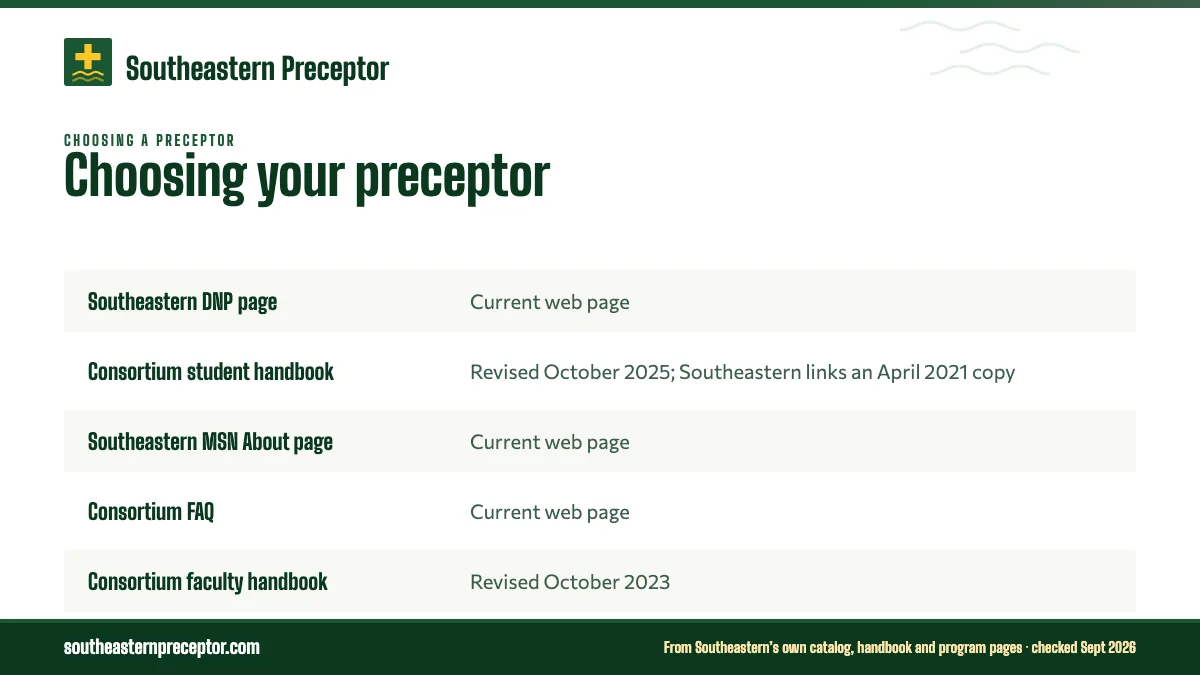
| Source | Date | What it says | What it means for you |
|---|---|---|---|
| Southeastern DNP page | Current web page | Students choose preceptors and facilities | You propose the preceptor and site |
| Consortium student handbook | Revised October 2025; Southeastern links an April 2021 copy | Pick the practice area, discuss the preceptor with course faculty, confirm willingness; faculty approve, the graduate coordinator reviews | Bring a candidate and a reason; no hours before both sign-offs |
| Southeastern MSN About page | Current web page | Clinical practicum experiences are faculty facilitated | Faculty plan with you every clinical term |
| Consortium FAQ | Current web page | A list of current and past preceptors across south Louisiana to recommend | Ask your course faculty member about it early |
| Consortium faculty handbook | Revised October 2023 | Faculty assist in identifying potential preceptors | Ask faculty for leads as well as approval |
| Southeastern DNP handbook | 2018-19 | The student selects the residency mentor with faculty input | The same model carries into the residency |
What a strong choice looks like for a Southeastern course
Faculty approve fit, so choose for fit. A candidate worth proposing clears every point below.
- Their patients match the course: pediatric and maternal patients for
NURS 6820, an adult panel forNURS 6830, adults with plenty of older patients forNURS 6840, or for PMHNP students the youth focus ofNURS 6920and the older-adult focus ofNURS 6930. - They hold an active Louisiana license, and for most of your hours they are a nurse practitioner certified in your population focus; preceptor requirements lists every condition.
- Their practice can supply 200 to 275 hours in one semester without long gaps.
- Their facility already holds a current contract with the university or can sign one in time, which clinical contracts shows how to check.
- Your hours with them fall entirely outside any paid shift.
How our placement desk does the finding
Southeastern gives you the choice; we give you candidates worth choosing. Our placement desk starts from your course number, its population and your home parish, then works through practices across your part of Louisiana, from the Northshore and Baton Rouge out to Acadiana or the Shreveport area.
Each candidate is checked before you hear the name: Louisiana license and certification, patient mix against the exact course, realistic weekly hours, willingness in their own words, and whether the facility may need a new university contract. Hard rotations get extra effort. Pediatric hours for NURS 6820 are a good example: North Oaks, the Hammond hospital, states in an archived version of its student clinical request page that it offers no pediatric rotations, so we look to community pediatric and family practices instead.
You then walk into the faculty conversation with a name, a current CV, a description of the practice and a proposed schedule, which is exactly what the handbook's second step asks you to discuss. Weigh both routes in searching yourself versus using placement help, or start with the request form.
Questions Southeastern students ask
Does Southeastern assign preceptors to its NP students?
Southeastern's published pages describe students choosing, with faculty facilitating, collaborating and approving, and the consortium offering recommendations from its preceptor list. None of them describes the university assigning nurse practitioner preceptors. Bachelor's students are the exception to the pattern: Southeastern arranges their clinical sites within about 60 miles of campus.
Can a physician serve as my Southeastern preceptor?
Southeastern's graduate programs page lists physicians as possible preceptors next to advanced practice nurses, and state rules permit a blend of clinician types. Most of your hours, though, need to be with a nurse practitioner certified in your population focus. A physician usually works best as a second preceptor for part of a course; confirm the split with your course faculty member before you commit.
Which version of the consortium handbook should I follow?
The consortium's site carries the October 2025 revision, while Southeastern's MSN resources page still links the April 2021 copy. Their precepted-learning wording matches, so the steps quoted here hold either way. Where anything else differs, the newer revision and your course's Canvas materials are the safer guide, and your course faculty member settles any question.
When do I need to name my preceptor for the next course?
The handbook asks students to give the assigned faculty member their preceptor and agency by the deadline their university designates, and Southeastern does not publish that date. Ask your course faculty member or the graduate coordinator at registration, and aim to have a name well before it, since a missing facility contract can take weeks or months.
May I choose a preceptor at the hospital or clinic where I work?
Yes, the handbook allows a preceptor in an agency that employs you. The condition is that your clinical hours sit apart from your job duties and fall on time you are not paid for. Clinicals where you work covers how to set that up cleanly with your manager and your preceptor.
Related pages
Last checked 2026-09-27
We check these pages against Southeastern's own catalog, program pages and consortium handbook, and Louisiana rules. Your course faculty, the graduate coordinator and your advisor have the final word.
Southeastern asks you to choose your preceptor. We find one near you.
Tell us your Southeastern track, where in Louisiana you live and when your next clinical course starts. We find Louisiana-licensed preceptors who fit the course, confirm whether the facility is already under contract with the university, and hand you what your course faculty need to approve it before the semester.
- Pediatric and women's health preceptors for
NURS 6820, adult and older-adult primary care forNURS 6830andNURS 6840 - Psychiatric preceptors for
NURS 6910toNURS 6930, with the child and older-adult focus each course sets - Across Louisiana, from the Northshore to Shreveport
Start your placement plan
Program, city and start date is all we need to begin.