The Intercollegiate Consortium behind Southeastern's MSN
Southeastern Louisiana University's MSN is delivered through the Intercollegiate Consortium for a Master of Science in Nursing, a partnership with McNeese State University, Nicholls State University and the University of Louisiana at Lafayette. You choose a home school, which keeps your records and is the school you graduate from, and you take online courses with students and faculty of all four. For clinicals, the consortium handbook sets the steps and your home school's rules fill in the rest.
Get your placement plan
Tell us your Southeastern program and where you live. A placement advisor replies with preceptor and site options in your community that fit your Southeastern course.
Four universities, one master's program
Southeastern's catalog calls the consortium a cooperative venture among the nursing units of the four universities, and its graduate page describes the master's program as four schools working together on one advanced practice curriculum. Two role concentrations come out of it: nurse practitioner, in family or psychiatric-mental health practice, and nursing education.
The consortium is one of two graduate partnerships at Southeastern, and it helps to keep them apart.
| Program | Partnership | What to know |
|---|---|---|
| MSN: FNP, PMHNP, Nursing Education | Consortium of Southeastern, McNeese, Nicholls and UL Lafayette | You graduate from the home school you pick |
| Post-master's FNP and PMHNP certificates | Offered through an affiliation with the consortium | Uses the consortium's clinical courses and preceptor steps |
| BSN to DNP and post-master's DNP | Academic partnership of Southeastern and UL Lafayette | Residency hours and NURS 8090 stay at your home institution |
CCNE accredits the master's program under the consortium's name; accreditation has the dates.
Your home school
Every consortium student picks a home university. Southeastern's graduate page says you select the school of your home designation, which maintains your academic records and is the university you graduate from. If Southeastern is your home school, Southeastern's rules govern everything the consortium hands back to each member.
That handoff happens more often than students expect, and much of it lands on clinicals. On these points, the consortium handbook defers to your home institution:
- The procedure for setting up NP and nurse educator clinical experiences
- Clinical health requirements and the drug screening policy
- The clinical tracking system you subscribe to and log hours in
- The deadline for telling faculty which preceptor and agency you plan to use
- Retaking a course after a C or below, which the October 2025 revision places at the home university when it offers the course
Home-school rules are also why Southeastern students follow Southeastern's Louisiana-only footnote and license requirement. Southeastern additionally requires at least one-third of a collaborative program's credit hours to come through its own instruction.
Taking courses across the four schools
Consortium courses are online, and any of the four universities may teach them, so your classmates and instructors may log in from Lake Charles, Thibodaux or Lafayette. Registration therefore has a step beyond Southeastern's own systems.
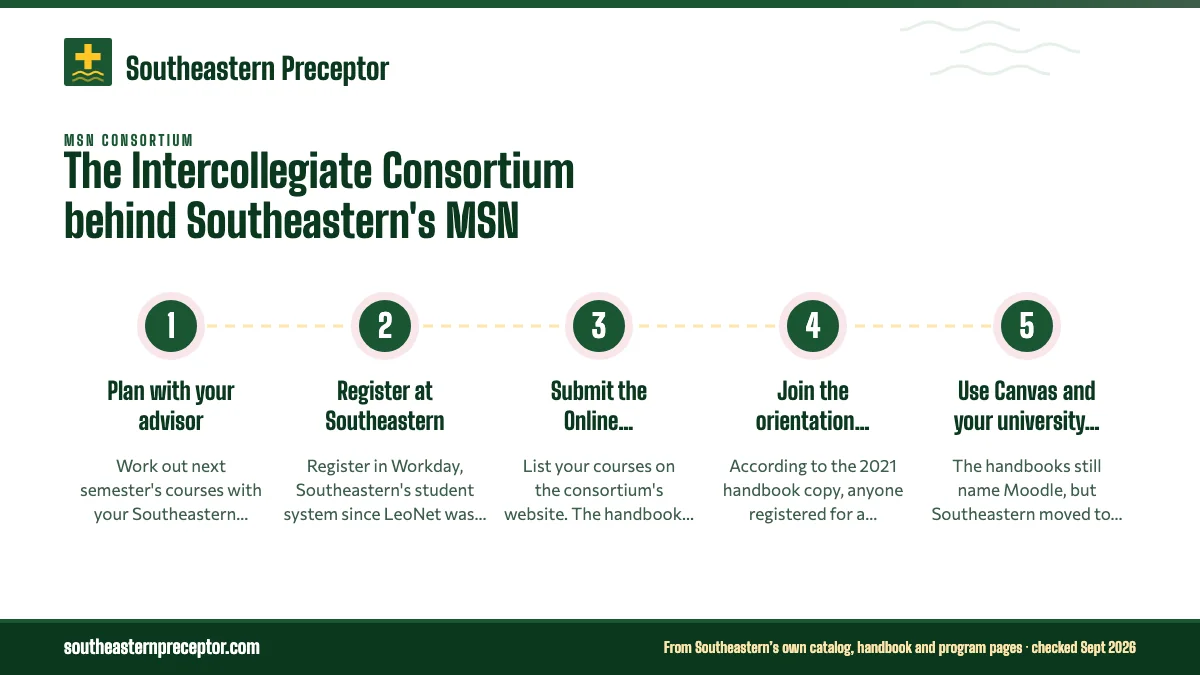
- Plan with your advisorWork out next semester's courses with your Southeastern advisor during advising.
- Register at SoutheasternRegister in Workday, Southeastern's student system since LeoNet was retired on July 1, 2026.
- Submit the Online Enrollment FormList your courses on the consortium's website. The handbook warns that skipping the form during advising puts your seat in the course at risk.
- Join the orientation courseAccording to the 2021 handbook copy, anyone registered for a consortium course also joins its online orientation course that term.
- Use Canvas and your university emailThe handbooks still name Moodle, but Southeastern moved to Canvas in spring 2024. Faculty and preceptor messages go through your university email account.
Before you enroll in any MSN course at a school outside the four, get the graduate coordinator's permission. Online student tools covers Workday and Canvas.
The consortium handbook: which copy to read
The student handbook is the consortium's main rulebook, maintained by a committee on which each member school's graduate coordinator sits. Two copies circulate, and they are not the same age.
| Document | Revised | Where it lives | What differs |
|---|---|---|---|
| Student handbook, current | October 6, 2025 | The consortium's own website | Adds the rule that a course failed at C or below is retaken at the home university when offered |
| Student handbook, older copy | April 28, 2021 | Linked from Southeastern's MSN Helpful Resources page | Same preceptor and tracking-system text; pages run one later |
| Faculty handbook | October 16, 2023 | The consortium's own website | Preceptor qualifications worded a little differently, plus a behavioral health licensing line |
The section on precepted learning, the heart of clinical planning, reads the same in both student copies, so either gives you the right steps. Where they differ, follow the October 2025 revision, and treat every mention of Moodle as out of date.
The consortium's preceptor list
The consortium's FAQ answers the preceptor question head on: students pick their own preceptors, working closely with instructors to choose sites, and the consortium can point you to names from a long roster of preceptors, past and present, who have taught its students in south Louisiana. The faculty handbook backs this up by asking faculty to help students identify potential preceptors and to evaluate clinical sites.
The list is a real asset, and the way to use it is early. Ask course faculty about recommended names at least a semester ahead, because a name from the list still has to be willing that term, see your course's population, sit under Louisiana's two-student cap and practice at a facility with a current university agreement. The FAQ describes the list as south Louisiana, so students in Monroe, Alexandria or Shreveport should ask how far it reaches.
The list itself is not public; it sits with faculty. The full wording of the placement statements is on choosing your preceptor.
What the consortium means for your clinicals
For clinical courses, the consortium makes the process the same at all four schools while leaving the files with each one. Its six steps apply everywhere: choose a practice area that fits the course, raise your preceptor choice with course faculty, check the facility agreement, meet the preceptor, submit the letter of agreement, and start only when the file is complete. The placement process walks through them for Southeastern students.
Two details are easy to miss. The agreement that counts is between the facility and your own university, so a clinic that hosts UL Lafayette or McNeese students may still lack one with Southeastern; check it in the clinical tracking system. And the consortium's grading rule reaches every clinical course: an unsatisfactory end-of-course rating from either the preceptor or the faculty member turns the grade into an F.
How we work inside the consortium's process
Our placement desk builds every search around the consortium's steps and Southeastern's home-school rules. We match the preceptor to the course you are entering, confirm the Louisiana license and population focus, and check whether the facility's agreement is with Southeastern itself, not only with another member school.
You take a complete proposal to course faculty, with the CV and facility details the file needs and time left for a new agreement if one is required. When faculty suggest a name from the consortium's list, we can help you reach out, confirm the dates and gather the paperwork. If a preceptor withdraws mid-semester, your placement advisor finds a replacement and prepares it for faculty review. Start a request.
Questions Southeastern students ask
Is Southeastern's MSN the same program as McNeese's or Nicholls'?
The curriculum is shared: all four universities deliver the same consortium MSN, and online courses may be taught by faculty from any member school. What differs is your home school, which keeps your records, is the school you graduate from and sets the rules the consortium defers to, such as clinical health requirements and the clinical tracking system.
Does the consortium assign preceptors?
No. The consortium's FAQ says students choose preceptors and sites in close collaboration with instructors, and it can recommend names from its roster of south Louisiana preceptors. Your course faculty sign off on each choice and the graduate coordinator looks it over, so the choice starts with you and ends with them.
Where do I find the consortium student handbook?
The consortium's website hosts the current revision, dated October 6, 2025. Southeastern's MSN Helpful Resources page links a copy revised April 28, 2021. The clinical planning text matches, but the newer copy adds a rule on retaking courses, so use it wherever the two differ.
Do I have to take courses from the other universities?
You may, because consortium courses are offered online by all four member schools and you sign up for them through the consortium's Online Enrollment Form. You still register at Southeastern, graduate from your home school and use Southeastern's Canvas and email. Taking one at a school outside the four requires the graduate coordinator's go-ahead in advance.
Is the DNP part of the consortium?
Not as a program. The consortium covers the MSN, and the post-master's certificates run through an affiliation with it. Southeastern's DNP is a separate academic partnership with UL Lafayette. The BSN to DNP's NP clinical courses are the same Family Health and Psychiatric/Mental Health courses, though, so the consortium's preceptor steps reach them. The DNP residency guide covers residency hours.
Related pages
Last checked 2026-09-27
We check these pages against Southeastern's own catalog, program pages and consortium handbook, and Louisiana rules. Your course faculty, the graduate coordinator and your advisor have the final word.
Southeastern asks you to choose your preceptor. We find one near you.
Tell us your Southeastern track, where in Louisiana you live and when your next clinical course starts. We find Louisiana-licensed preceptors who fit the course, confirm whether the facility is already under contract with the university, and hand you what your course faculty need to approve it before the semester.
- Pediatric and women's health preceptors for
NURS 6820, adult and older-adult primary care forNURS 6830andNURS 6840 - Psychiatric preceptors for
NURS 6910toNURS 6930, with the child and older-adult focus each course sets - Across Louisiana, from the Northshore to Shreveport
Start your placement plan
Program, city and start date is all we need to begin.