Why Southeastern clinical hours stay in Louisiana, and where the rule blurs
Southeastern Louisiana University states on its MSN page that every clinical hour happens in Louisiana, and its PMHNP certificate page says the same of practicum work. The reason sits in state rules that require each preceptor to hold a Louisiana license. The DNP has no matching sentence, its license wording differs from page to page, and a consortium handbook uses looser language, so this guide lays each source side by side.
Get your placement plan
Tell us your Southeastern program and where you live. A placement advisor replies with preceptor and site options in your community that fit your Southeastern course.
What Southeastern says
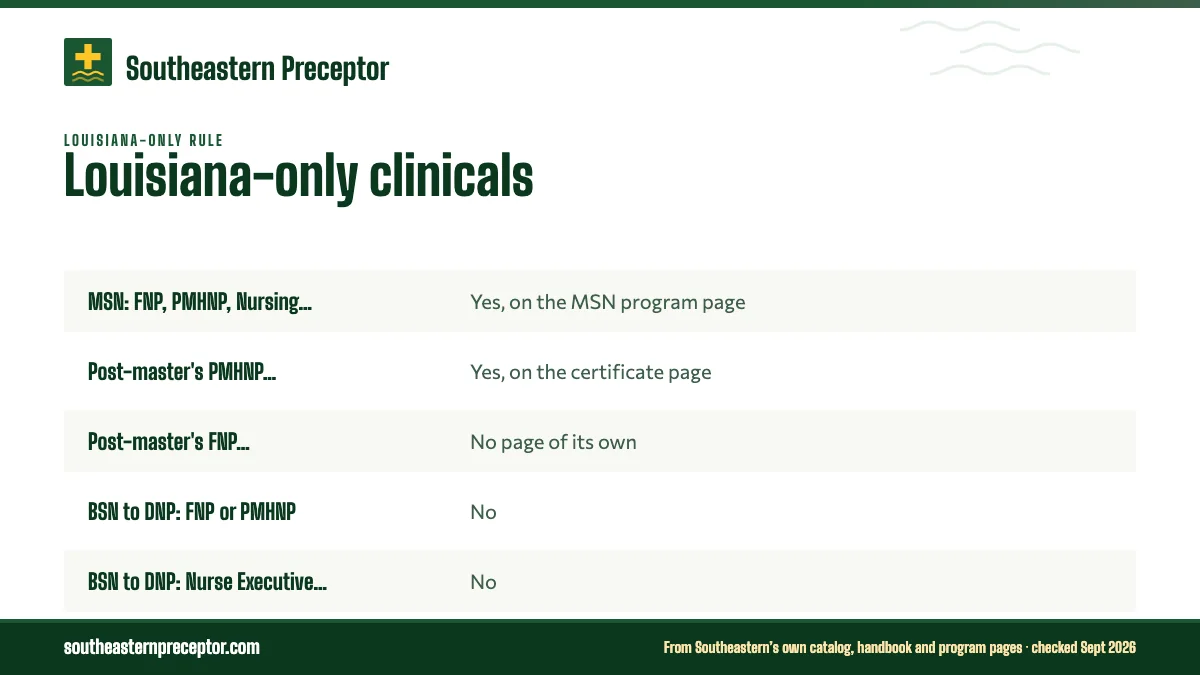
Two Southeastern pages put the rule in plain words. The MSN program page ends its note on online study with a footnote: "All clinical hours must be completed in Louisiana." The page for the post-master's certificate that moves practicing NPs into psychiatric-mental health care is just as direct: "All practicum experiences must be completed in the state of Louisiana."
The MSN footnote covers all three consortium concentrations: Family Nurse Practitioner, Psychiatric/Mental Health Nurse Practitioner and Nursing Education. The FNP certificate appears in the catalog without a web page of its own, but it runs on the same Family Health courses, NURS 6820 to NURS 6840, and asks for a Louisiana RN license.
| Program | Written Louisiana-only line | License the entry asks for |
|---|---|---|
| MSN: FNP, PMHNP, Nursing Education | Yes, on the MSN program page | Louisiana RN |
| Post-master's PMHNP certificate | Yes, on the certificate page | Louisiana RN, plus APRN for nurse practitioners |
| Post-master's FNP certificate | No page of its own | Louisiana RN |
| BSN to DNP: FNP or PMHNP | No | Louisiana RN |
| BSN to DNP: Nurse Executive Leadership | No | U.S. RN |
| Post-master's DNP | No | Louisiana RN in the catalog; U.S. licensure on the admission page |
The reason: a Louisiana license on every preceptor
The Louisiana State Board of Nursing regulates the programs it approves, and its preceptorship rule says anyone who precepts a student must hold an active Louisiana RN or APRN license with no encumbrance. A nurse practitioner in Gulfport or Beaumont, however skilled, falls outside that line unless they also carry Louisiana licensure, and Louisiana has not enacted the APRN Compact that might otherwise stretch a license across the border.
The board's facility rules point the same way. Hospitals used for student clinical experience must be licensed by Louisiana, a program needs the board's approval of a clinical facility at least four weeks before students use it, and faculty must confer with each preceptor and student every week. A program built on those rules keeps its students where the rules reach.
Your own license is tied in too. The consortium handbook requires an unencumbered Louisiana RN license for as long as you are enrolled in the MSN, and says the graduate coordinator must hear about any change to that license right away. Preceptor requirements covers the rest of the preceptor rule.
The DNP: no Louisiana sentence, mixed license wording
Southeastern's DNP pages, its DNP catalog entries and the 2018-19 DNP handbook contain no sentence limiting clinical or residency hours to Louisiana. What they do contain is license wording that points to Louisiana in most places and not in others.
- In the catalog, a Louisiana RN license in good standing is the entry requirement for the FNP and PMHNP routes of the BSN to DNP and for the post-master's DNP, which also asks for an APRN license where one applies.
- The catalog entry for the Nurse Executive Leadership concentration asks for a U.S. RN license instead.
- The DNP admission information page, in its post-master's section, asks for current, unencumbered U.S. nursing licensure.
Two facts narrow the question. The NP clinical courses inside the BSN to DNP FNP and PMHNP plans are the same consortium courses the MSN footnote covers, so those hours fall under the Louisiana line. And when the catalog keeps residency hours and NURS 8090 at the home institution, it is naming a university, not a state.
For residency courses NURS 8210, NURS 8220 and NURS 8230, Southeastern has published no answer either way. Plan on a Louisiana site unless the Graduate Nursing Office tells you otherwise in writing.
The consortium's looser wording
Two consortium documents read as if clinicals could happen outside Louisiana, and students sometimes find them first. The consortium faculty handbook, revised in October 2023, tells students to follow the nurse practice act of whichever state they do clinicals in. The consortium's FAQ page says that students taking online courses from the four member schools meet classmates from across Louisiana and east Texas.
Neither sentence overrides Southeastern. The consortium writes for four universities at once, the FAQ line describes classmates rather than clinical sites, and the consortium's mission statement speaks of the health needs of south Louisiana. For a Southeastern student, the program page's footnote is the specific rule and the one to follow.
When a consortium document and a Southeastern page disagree, raise it with your course faculty rather than picking the reading you prefer. The MSN consortium explains how the four schools share the program.
Living near the Mississippi or Texas line
Southeastern publishes no rule on where graduate students must live. What it asks for is a Louisiana RN license, Louisiana clinical hours and a few trips: DNP students travel to Hammond twice, once to start the program and once to defend the project, certificate students attend an onsite orientation, and course faculty visit each student's clinical site.
For a student across the Pearl River in Mississippi, the Northshore parishes are the natural Louisiana side; for east Texas, it is the southwest and northwest of the state. Lake Charles is roughly 174 road miles from Southeastern's campus and Shreveport roughly 290, estimates worth checking on a map, which matters for campus trips more than for a clinical site near home. The Northshore and Southwest Louisiana guides list systems and clinics on the Louisiana side.
A move out of state partway through is a separate issue. Southeastern cautions that relocating can put your enrollment, licensure path and aid in question, and wants to hear from you before you go; state authorization covers that page.
What to confirm before you plan
- DNP students: whether residency hours must be in Louisiana, and which license wording applies to your track.
- Students holding a multistate RN license from another compact state: whether it meets the graduate programs' requirement, which names a Louisiana license and says nothing about the compact.
- Anyone thinking of moving: how a move affects enrollment, licensure and aid, before you sign a lease.
- Anyone near a border: whether the Louisiana site closest to home already has a current agreement with the university.
Take placement questions to your course faculty and license or enrollment questions to the Graduate Nursing Office or the graduate coordinator. Keep their answers from your university email account, which the consortium handbook requires for all faculty and preceptor communication.
How we keep every placement inside Louisiana
Every preceptor our placement desk proposes to a Southeastern student practices in Louisiana and holds the Louisiana license the board requires. We search the whole state, from the Northshore to Lake Charles, Shreveport and Monroe, so a student living near a state line gets a site on the Louisiana side that is realistic to reach for three clinical semesters.
We check the license and the population focus, confirm whether the facility already has an agreement with the university, and hand you what course faculty need to approve the placement. For DNP students, we plan residency sites in Louisiana too, so an unanswered question about the rule never becomes a lost semester. Request a Louisiana preceptor.
Questions Southeastern students ask
Can I do Southeastern clinical hours in Mississippi if I live there?
Not for the MSN or the PMHNP certificate. Southeastern requires those hours in Louisiana, and Louisiana's rules require a Louisiana-licensed preceptor. No published rule stops you living in Mississippi, so you can keep your home and train at a Louisiana site. Plan the drive for three clinical semesters, not one, and pick a site you can reach on your days off.
Does a multistate compact RN license meet Southeastern's graduate requirement?
The graduate program pages name a Louisiana RN license and are silent on the Nurse Licensure Compact, whereas the RN to BSN page expressly accepts a compact license. Ask the Graduate Nursing Office before relying on a multistate license issued by another state. RN license requirements sets out each program's wording.
Must my DNP residency be done in Louisiana?
Southeastern has not said. No DNP page or catalog entry limits residency hours to Louisiana, yet most DNP tracks require a Louisiana RN license and the NP courses inside the BSN to DNP fall under the MSN's Louisiana line. Until the Graduate Nursing Office answers in writing, a Louisiana residency site is the safe plan.
Why does the consortium mention students in east Texas?
The consortium's FAQ describes the classmates you meet in online courses taught by its four member universities, who come from across Louisiana and east Texas. That is about who shares your courses, not where clinicals happen. Southeastern's MSN page is the rule for Southeastern students, and it keeps clinical hours in Louisiana.
Can my preceptor live in Texas but work in Louisiana?
Where a preceptor lives is not part of any rule. What counts is an active, unencumbered Louisiana RN or APRN license, a practice site in Louisiana that course faculty approve, and a current agreement between that facility and the university. A Texas resident practicing at a Lake Charles clinic under a Louisiana license can qualify.
Related pages
Last checked 2026-09-27
We check these pages against Southeastern's own catalog, program pages and consortium handbook, and Louisiana rules. Your course faculty, the graduate coordinator and your advisor have the final word.
Southeastern asks you to choose your preceptor. We find one near you.
Tell us your Southeastern track, where in Louisiana you live and when your next clinical course starts. We find Louisiana-licensed preceptors who fit the course, confirm whether the facility is already under contract with the university, and hand you what your course faculty need to approve it before the semester.
- Pediatric and women's health preceptors for
NURS 6820, adult and older-adult primary care forNURS 6830andNURS 6840 - Psychiatric preceptors for
NURS 6910toNURS 6930, with the child and older-adult focus each course sets - Across Louisiana, from the Northshore to Shreveport
Start your placement plan
Program, city and start date is all we need to begin.