Who can precept you at Southeastern, and what Louisiana asks of them
A preceptor for a Southeastern Louisiana University nurse practitioner student needs a Louisiana RN or APRN license that is active and carries no encumbrance, and the larger share of your clinical hours belongs with an APRN holding national certification in your own population focus. A physician can cover part of it. The consortium handbook adds five qualifications, and course faculty approve every preceptor before a single hour counts.
Get your placement plan
Tell us your Southeastern program and where you live. A placement advisor replies with preceptor and site options in your community that fit your Southeastern course.
The requirements at a glance
Three layers decide whether a clinician can precept you. Louisiana sets the floor through the Louisiana State Board of Nursing's rules for nursing programs. The Intercollegiate Consortium for a Master of Science in Nursing adds its own qualifications. Then your course faculty judge whether this person, in this practice, fits the course in front of you.
| Requirement | Where it comes from | What it means for you |
|---|---|---|
| Active, unencumbered Louisiana RN and/or APRN license | Board rule, LAC 46:XLVII.3543 | A clinician licensed only in Mississippi or Texas cannot precept you |
| Most hours with an APRN certified in your population focus | Same board rule | FNP students spend most hours with a family NP; PMHNP students with a psychiatric-mental health NP |
| Physicians (and dentists) may serve as graduate preceptors | Board definition, LAC 46:XLVII.3503 | A physician can carry part of a course, not the majority |
| Graduate education, current license, certification, one year of experience | Consortium student handbook | Checked by course faculty before approval |
The sections below take each layer in turn, then the paperwork, the evaluations and the pieces Southeastern keeps inside the course.
Louisiana's rules for a graduate preceptor
Louisiana puts its preceptor rules in the Administrative Code chapter on nursing education programs, and Southeastern works inside them. The license rule comes first: whoever precepts you needs a Louisiana RN license, a Louisiana APRN license, or both, active and with no encumbrance on it.
The board then shapes who you spend your time with. The bulk of your clinical experience belongs with an APRN who holds an active license and national certification in the population focus your program prepares you for. Around that core, programs may use a mix of clinicians to widen the range of experience, which is where a physician or a specialist fits.
Other parts of the same rule that touch your preceptor
- Preceptors are picked by written criteria that faculty and the facility's nursing leadership develop together.
- One preceptor may take no more than two graduate APRN students during any given clinical experience.
- Faculty keep responsibility for your learning and evaluation, using the preceptor's input, and confer with you and your preceptor at least weekly.
For the full set of board rules on APRN students, read Louisiana Board of Nursing rules. The collaborative practice agreement your NP preceptor works under is explained in Louisiana NP practice; as a student, you do not sign one.
What the consortium handbook asks of a preceptor
The consortium's student handbook has a short preceptor policy, worded the same in the October 2025 revision and the 2021 copy Southeastern links. It names five qualifications: graduate preparation, at the master's or doctoral level, in a field suited to precepting; a current, unencumbered license in their own discipline; APRN certification that fits the area; a practice setting where your skills can grow; and a year or more of clinical experience.
The consortium's faculty handbook, revised in October 2023, words the list a little differently.
| Point | Student handbook (2025) | Faculty handbook (2023) |
|---|---|---|
| Clinical experience | At least one year, written as a requirement | A minimum of one year, written as preferred |
| License | Current and unencumbered, in the discipline | Current state licensure in the discipline |
| Certification | APRN certification in the appropriate area | Certification in the appropriate area |
| Behavioral health clinicians | Not addressed | Must hold an independent license and not practice under supervision |
Treat the one-year line as a requirement unless your course faculty say otherwise. The behavioral health line matters to PMHNP students hoping to spend some hours with a therapist: that person needs a license that stands on its own.
Matching the preceptor to your course
Population focus is where a willing clinician most often turns out to be the wrong fit. Each Southeastern clinical course names the patients it centers on, and your preceptor's practice has to supply them. The table uses the 2026-27 catalog descriptions.
| Course | Hours | Patients the course centers on | Preceptor for most hours |
|---|---|---|---|
NURS 6820 Family Health I | 200 | Pediatrics and child-bearing women | Family NP whose patients include children and child-bearing women |
NURS 6830 Family Health II | 275 | Adults | Family NP in adult primary care |
NURS 6840 Family Health III | 275 | Adults and older adults | Family NP with a solid geriatric panel |
NURS 6910 Psychiatric/Mental Health I | 200 | Diagnostic assessment and common disorders | Psychiatric-mental health NP |
NURS 6920 Psychiatric/Mental Health II | 275 | Emphasis on children and adolescents | PMHNP who sees young patients |
NURS 6930 / NURS 6970 Psychiatric/Mental Health III | 275 / 120 | Emphasis on older adults | PMHNP with older adult patients |
Nursing Education students work in precepted class, lab and clinical settings in NURS 6440 and NURS 6570. DNP students choose a residency mentor; the 2018-19 DNP handbook looks for a master's at minimum, or the standing to get you into the population, data or system your project depends on. Hour totals are in the clinical hours guide.
The paperwork a preceptor provides
Preceptor paperwork is short, but none of your hours can start until it is on file in Southeastern's Graduate Nursing Office. The consortium handbook lists what has to be there before the first clinical day.
- A current vita or resume, dated within the last two years, or a completed professional profile.
- A three-way letter of agreement, with signatures from you, your course faculty member and the preceptor, which faculty review and may revise before approving.
- A current contract or letter of agreement between the university and the facility, a separate document handled at the institutional level.
- Your own clinical health, OSHA and HIPAA documentation.
The facility contract is often the slow piece, and the handbook cautions that a new one may need several weeks or even months. Clinical contracts shows how to check for one, and preceptor approval covers the faculty and graduate coordinator sign-off.
Some pieces are not posted anywhere public: Southeastern's MSN letter, profile and evaluation forms, any preceptor orientation packet, and the semester deadline for naming a preceptor, which the handbook leaves to your university without a date. Course faculty and the graduate coordinator hold all three, and the clinical tracking system shows which facilities already have a contract.
During the semester: duties and evaluations
The handbook gives preceptors four jobs: orient you to the role and the practice, make expectations clear, settle a schedule with you, and keep your course faculty informed. Faculty visit each student's site, on top of the weekly contact Louisiana requires.
Evaluation runs in three directions. Your preceptor gives input throughout, fills out the end-of-semester clinical evaluation and alerts faculty at once if your performance is in question. You evaluate the preceptor and the site each semester. Course faculty weigh the preceptor's input and assign your grade.
Progression, repeats and Incompletes are covered in grades and time limits.
A poor final evaluation from a preceptor is more than a bad review. Under the consortium handbook, if either your preceptor or your faculty member rates your final clinical performance unsatisfactory, the course grade is an F, and the catalog ends a graduate nursing student's place in the program after any D or F. The 2018-19 DNP handbook says only that it may result in an F.
How we check a preceptor before faculty see it
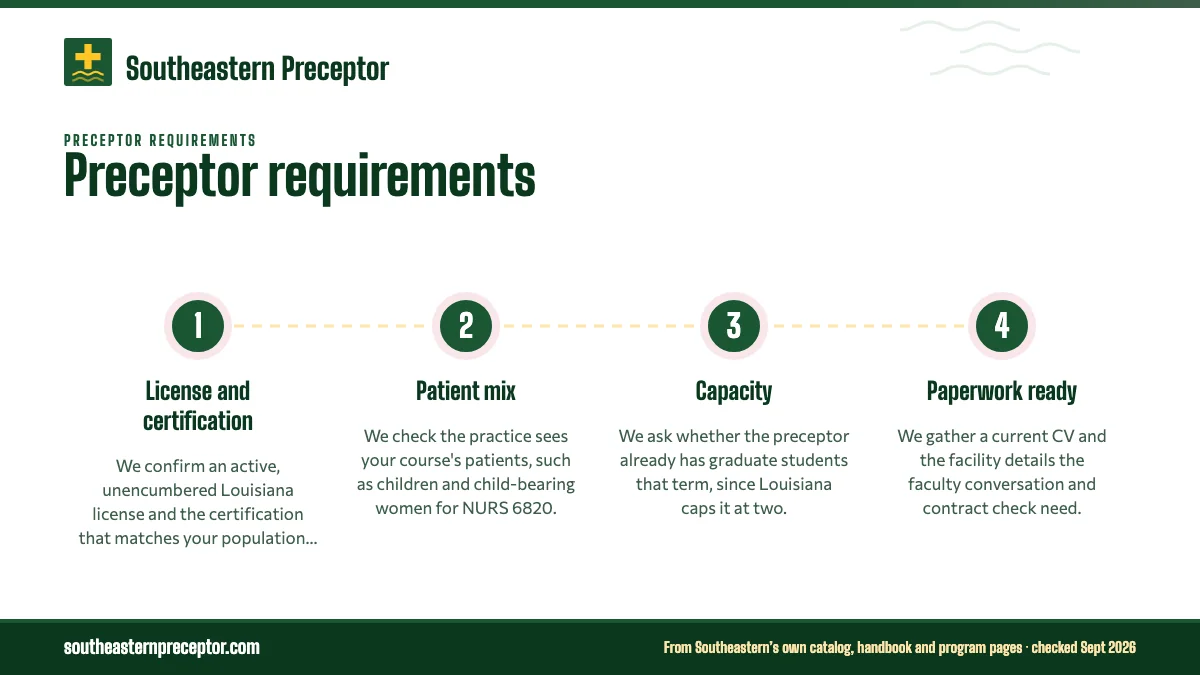
Our placement desk starts where Southeastern's process starts: with the course. We identify the exact course you are entering, then find a preceptor in your part of Louisiana whose license, certification and patient mix meet the board's rules and the consortium's list.
- License and certificationWe confirm an active, unencumbered Louisiana license and the certification that matches your population focus.
- Patient mixWe check the practice sees your course's patients, such as children and child-bearing women for
NURS 6820. - CapacityWe ask whether the preceptor already has graduate students that term, since Louisiana caps it at two.
- Paperwork readyWe gather a current CV and the facility details the faculty conversation and contract check need.
You bring a complete, well-matched proposal to course faculty, and your placement advisor stays on call through the semester. Send your course details to get started.
Questions Southeastern students ask
Can a physician precept a Southeastern NP student?
Yes, for part of the hours. Louisiana's definition of a graduate preceptor includes physicians, and Southeastern's graduate page describes clinical arrangements with advanced practice nurses and physician preceptors. The limit is proportion: most of your clinical experience has to be with an APRN certified in your population focus, so a physician usually fills a share of a course. Course faculty decide the balance.
Can my preceptor be licensed in another state?
Only if they also carry Louisiana licensure as an RN or APRN. The board's rule is written around a Louisiana license, and with no APRN Compact in force here, an NP licensed solely in Mississippi or Texas falls short of it. Southeastern also keeps MSN clinical hours inside the state, as Louisiana-only clinicals explains.
How many students can one Louisiana preceptor take?
The board's preceptorship rule limits a single preceptor to two graduate APRN students in any one clinical experience. A busy nurse practitioner may already be teaching students from other programs, so ask about the semester's commitments before you propose them to faculty. A preceptor already at the limit for your dates cannot add you, however willing.
Can a nurse practitioner with less than a year of experience precept me?
The consortium student handbook asks for at least one year of clinical experience, while the faculty handbook calls a year preferred. Because the two differ, treat one year as the working rule and raise any exception with your course faculty before asking the preceptor to commit. Faculty weigh experience alongside certification and the practice setting.
Do preceptors get training or orientation from Southeastern?
Southeastern posts no preceptor orientation or training material. The consortium's faculty handbook has faculty provide the materials needed to evaluate you in the preceptor's setting, and faculty stay in weekly contact during the experience. Ask your course faculty what your preceptor will receive, and share it when you first approach them.
Related pages
Last checked 2026-09-27
We check these pages against Southeastern's own catalog, program pages and consortium handbook, and Louisiana rules. Your course faculty, the graduate coordinator and your advisor have the final word.
Southeastern asks you to choose your preceptor. We find one near you.
Tell us your Southeastern track, where in Louisiana you live and when your next clinical course starts. We find Louisiana-licensed preceptors who fit the course, confirm whether the facility is already under contract with the university, and hand you what your course faculty need to approve it before the semester.
- Pediatric and women's health preceptors for
NURS 6820, adult and older-adult primary care forNURS 6830andNURS 6840 - Psychiatric preceptors for
NURS 6910toNURS 6930, with the child and older-adult focus each course sets - Across Louisiana, from the Northshore to Shreveport
Start your placement plan
Program, city and start date is all we need to begin.