Grades, Incompletes and time limits in Southeastern's graduate nursing programs
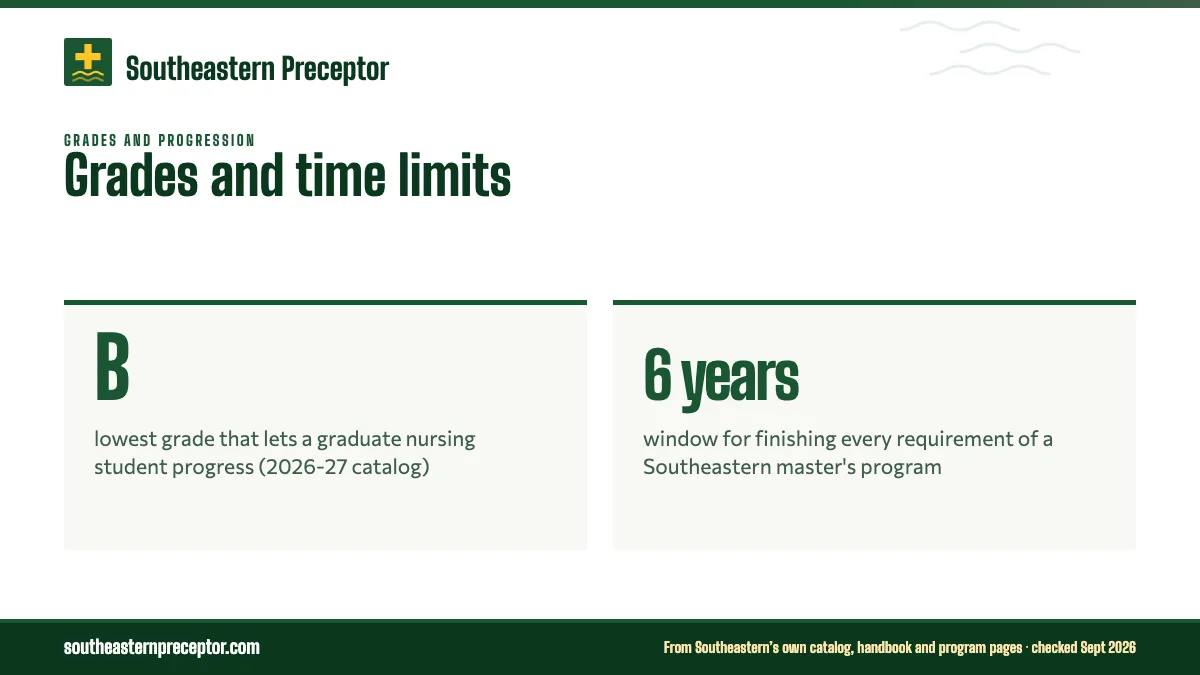
Southeastern Louisiana University's graduate nursing programs ask for a B in every course, and the consortium handbook turns an unsatisfactory final clinical evaluation into an F. An Incomplete has to be cleared by the end of the next semester, master's work has to be finished within six years, and transfer credit tops out at one-third of the program. Here is each rule in plain words, with its source and date.
Get your placement plan
Tell us your Southeastern program and where you live. A placement advisor replies with preceptor and site options in your community that fit your Southeastern course.
The grading scale nursing uses
Southeastern's graduate catalog uses standard letters: A earns 4 quality points per semester hour, B earns 3, C 2, D 1 and F none, alongside P, W, I for Incomplete, and IP for thesis courses only. The consortium student handbook, which governs MSN and certificate courses, converts course percentages to letters this way:
| Letter | Percentage | Quality points per hour |
|---|---|---|
| A | 92.5 to 100 | 4 |
| B | 84.5 to 92.49 | 3 |
| C | 76.5 to 84.49 | 2 |
| D | 69.5 to 76.49 | 1 |
| F | 0 to 69.49 | 0 |
The Graduate School's general rule lets up to six hours of C grades count toward graduation. Nursing sets a higher bar: the catalog says a graduate nursing student must earn a B in each course to be eligible to progress, so for nursing the six-hour allowance does not help.
The B rule, probation and dismissal
Earn below a B in a graduate nursing course and you are placed on probation. You then have two regular semesters to repeat the course and earn at least a B, and a second grade below B in the repeat ends your place in the program. The consortium's October 2025 handbook adds that when a C or lower forces a repeat, you retake the course at your home university if it offers the course.
A separate catalog sentence dismisses any graduate nursing student who earns a D or an F in a course taken for graduate credit. The two rules overlap, because D and F are also below B, but the dismissal sentence names them directly and offers no repeat. If you ever face one of those grades, ask the graduate coordinator how the two rules apply to your case before you plan anything else.
Because each clinical course is a prerequisite for the next (NURS 6830 needs NURS 6820, NURS 6920 needs NURS 6910), a repeat in the clinical sequence moves every later clinical course back by at least a semester. The clinical hours planner shows the full chain for each program.
When a clinical evaluation becomes an F
For courses with a clinical component, the consortium handbook states that an unsatisfactory final evaluation by a preceptor or a faculty member will result in an F. The 2018-19 DNP handbook words its practicum rule more softly: an unsatisfactory final evaluation may result in an F. Set beside the catalog's dismissal rule for D and F grades, the final clinical evaluation is the highest-stakes grade in an MSN clinical course.
Preceptors shape that evaluation but do not own it. Under the consortium's faculty handbook, the preceptor completes a clinical evaluation form at the end of the semester and notifies faculty immediately if a student's performance is in question. Louisiana's board rule keeps the evaluation itself with nursing faculty, with input from preceptors, and requires faculty to confer with each preceptor and student at least weekly during the precepted experience.
One more gate can end a clinical semester early: a student who does not provide the required evidence of clinical health requirements cannot remain enrolled in any clinical nursing course. The compliance guide lists those records.
The surest protection against a failed clinical evaluation is a preceptor whose practice matches the course. A site with few children for NURS 6820, or an adult-only practice for NURS 6920 with its child and adolescent emphasis, makes the course objectives harder to meet however hard you work.
Incompletes and what becomes of them
Southeastern gives an I only when circumstances beyond your control keep you from finishing a course in the semester you took it. The I has to be removed by the end of the next semester, summers included, unless your academic dean extends it. An I that is not removed turns into an F automatically, and an F in a graduate nursing course falls under the dismissal rule above.
For the DNP, the 2018-19 handbook says that when extenuating circumstances delay the project during planning or residency, the student receives an Incomplete and either finishes the work the next semester under the catalog's policy or completes the hours through Advanced Directed Studies, today's NURS 8090, which carries 135 residency hours per enrollment.
Southeastern publishes no rule linking an Incomplete, a delay or a withdrawal to a missing preceptor. If a preceptor falls through, talk with course faculty that week and read what to do without a preceptor. Withdrawal dates for each term sit on the academic calendar.
Time limits and staying enrolled
A master's student must complete every requirement within the six years immediately before the date the requirements are finished, and the dean of the program can grant an extension for extenuating circumstances. Southeastern's graduate nursing page states the same limit as six years from initial course enrollment.
The 2018-19 DNP handbook gives DNP students six calendar years from admission and lets them sit out, taking no courses, for up to two consecutive semesters. The current catalog reads more strictly: a student who does not enroll in graduate nursing courses for two consecutive regular semesters must reapply to the program. Follow the catalog, and talk with your advisor before planning any break.
Clinical delays are where these limits start to bite. Each semester lost to a missing preceptor pushes the rest of the clinical sequence back, and on the MSN PMHNP plan, where each psychiatric course is marked fall only or spring only, a missed term can mean a year's wait for the course to come around again. The placement desk exists for that risk: your placement advisor starts on the next course's preceptor while you are still in the current one, so the sequence keeps moving.
Transfer credit and courses outside the consortium
After earning at least 12 hours of graduate credit at Southeastern, you can appeal to the graduate coordinator or your graduate faculty advisor for approval to transfer credit from another university. Each transferred course needs a grade of B or better, and no more than one-third of the hours required for graduation may transfer in. For the consortium MSN and the DNP partnership with UL Lafayette, Southeastern adds that at least one-third of the required hours must come from Southeastern instruction.
Courses taught inside the consortium by McNeese, Nicholls or UL Lafayette faculty are part of your program, not transfers. A course from a university outside the consortium needs the nursing graduate coordinator's permission before you enroll. In the DNP, core courses from either partner school apply, but NURS 8090 and the residency hours in NURS 8210, NURS 8220 and NURS 8230 can be taken only at your home institution.
Post-master's certificate applicants go through a transcript review of advanced health assessment, pharmacotherapeutics and pathophysiology, and any missing course becomes a requirement before the certificate starts. Post-master's DNP applicants verify their earlier clinical hours on Southeastern's form so they count toward the 1,000-hour total.
Academic integrity reaches clinical records
The catalog makes upholding academic integrity the student's responsibility and names unauthorized material, communicating with classmates during an exam and trying to benefit from another student's work as violations; egregious or repeated cases can bring judicial sanctions. The consortium adopts a zero-tolerance policy covering cheating, plagiarism, self-plagiarism and fabrication, and it names clinical and practicum experiences among the places those rules apply. Students also sign an honor pledge that they have neither given nor received unauthorized aid.
That brings clinical hour records under the same standard as exams. Hours must be recorded as they happened, and time you are paid to work never counts as clinical time, even at your own employer. The guide to clinicals where you work explains that rule.
If you disagree with a grade or an evaluation, the consortium handbook sets out a five-step formal complaint procedure, and its first step has to be taken within five working days of the situation.
Questions Southeastern students ask
Does a C count in Southeastern's graduate nursing program?
Not toward progression. The Graduate School allows up to six hours of C grades toward graduation, but nursing requires a B in every course to progress. A C places you on probation, and you have two regular semesters to repeat the course and earn at least a B, at your home university if it offers the course.
Does a spring Incomplete have to be finished by summer?
Yes, unless your academic dean grants an extension. The catalog requires an I to be removed by the end of the next semester and counts summers, so an I from spring 2027 has to be cleared by the end of the summer 2027 semester. If it is not, the grade converts to an F automatically.
Can I take one semester off from Southeastern's nursing program?
The catalog's reapplication rule is triggered by two consecutive regular semesters without graduate nursing courses, so a single term off does not trigger it on its own. It can still cost more than a term if it breaks the clinical sequence, especially for PMHNP courses offered in only one season. Plan any break with your advisor first.
Do courses from McNeese or Nicholls count as transfer credit?
No. Courses taught through the consortium by McNeese, Nicholls or UL Lafayette are part of Southeastern's MSN, not transfers. The transfer limits apply to universities outside the consortium, and those courses need the nursing graduate coordinator's permission before you enroll.
Who decides whether I pass a clinical course?
Course faculty. Your preceptor completes an end-of-semester evaluation and flags concerns early, and Louisiana's rules have faculty evaluate students with preceptor input. Under the consortium handbook, an unsatisfactory final evaluation from either the preceptor or faculty results in an F, so keep in regular contact with both.
Related pages
Last checked 2026-09-27
We check these pages against Southeastern's own catalog, program pages and consortium handbook, and Louisiana rules. Your course faculty, the graduate coordinator and your advisor have the final word.
- Southeastern 2026-27 Catalog: Graduate Studies (grades, Incompletes, time limits, transfer)
- Southeastern 2026-27 Catalog: MSN, Family Nurse Practitioner (progression rules)
- Southeastern 2026-27 Catalog: academic integrity
- Consortium (ICMSN) student handbook, revised October 2025
- Southeastern: Graduate nursing programs (transfer limits)
Southeastern asks you to choose your preceptor. We find one near you.
Tell us your Southeastern track, where in Louisiana you live and when your next clinical course starts. We find Louisiana-licensed preceptors who fit the course, confirm whether the facility is already under contract with the university, and hand you what your course faculty need to approve it before the semester.
- Pediatric and women's health preceptors for
NURS 6820, adult and older-adult primary care forNURS 6830andNURS 6840 - Psychiatric preceptors for
NURS 6910toNURS 6930, with the child and older-adult focus each course sets - Across Louisiana, from the Northshore to Shreveport
Start your placement plan
Program, city and start date is all we need to begin.