The Louisiana State Board of Nursing's rules for APRN students and preceptors, in plain words
The Louisiana State Board of Nursing writes the rules every Southeastern Louisiana University nurse practitioner clinical runs under: who may precept, how much of your time must be with an APRN in your population focus, how closely faculty stay involved, and which programs and facilities may host students. Here they are in everyday language, with section numbers so you can read the text yourself.
Get your placement plan
Tell us your Southeastern program and where you live. A placement advisor replies with preceptor and site options in your community that fit your Southeastern course.
Three roles the Board plays in your education
The Board, often shortened to LSBN, reaches a Southeastern NP student in three ways. It licenses you, first as an RN and later as an APRN. It approves nursing programs, which is why Southeastern's post-master's certificates describe themselves as fully approved by the Board. And it writes the education rules in Title 46, Part XLVII of the Louisiana Administrative Code that govern clinical facilities, preceptorships and student eligibility.
Accreditation is a separate track: CCNE is the national accreditor for Southeastern's graduate nursing programs, while Board approval is a state authority, and accreditation covers both. The sections below restate the rules and cite each section number. The text itself is in the Louisiana Administrative Code, and the Board's site is where changes and forms appear.
Rules that apply to you as the student
An APRN student may carry out advanced practice nursing functions only under the guidance of a qualified instructor or preceptor, as part of the program of study (section 3529.G). The Board defines that guidance in section 4505: a licensed APRN, physician, dentist or person the Board approves, in the same or a related specialty or role, who must be accessible to you. The definition stops short of requiring physical presence at every moment; your course faculty, the site and your letter of agreement set the supervision you actually work under.
Eligibility is the second student rule. Section 3517.I bars a student from clinical nursing courses if there is evidence of conduct that would be grounds to refuse a license under R.S. 37:921. The consortium handbook spells out the Board's authority to limit, restrict, delay or deny a student's entry into or continuation in the clinical phase, citing the statute as 11:921, while Southeastern's DNP handbook cites 37:921. Southeastern stacks its own requirements on top, a Louisiana RN license and a year of specialty experience, covered in RN license rules.
Rules about who precepts you
| Rule | What it means for you | Section |
|---|---|---|
| Who counts | A graduate preceptor is an APRN, physician or dentist who guides you, models the role and teaches | 3503 |
| License | Every preceptor holds an active, unencumbered Louisiana RN or APRN license | 3543.G.1 |
| Population focus | Most of your clinical experience is with an APRN licensed and certified in your population focus, primary or acute care as the course requires | 3543.G.3 |
| Other clinicians | A mix of clinicians may teach part of the experience to broaden it | 3543.G.3 |
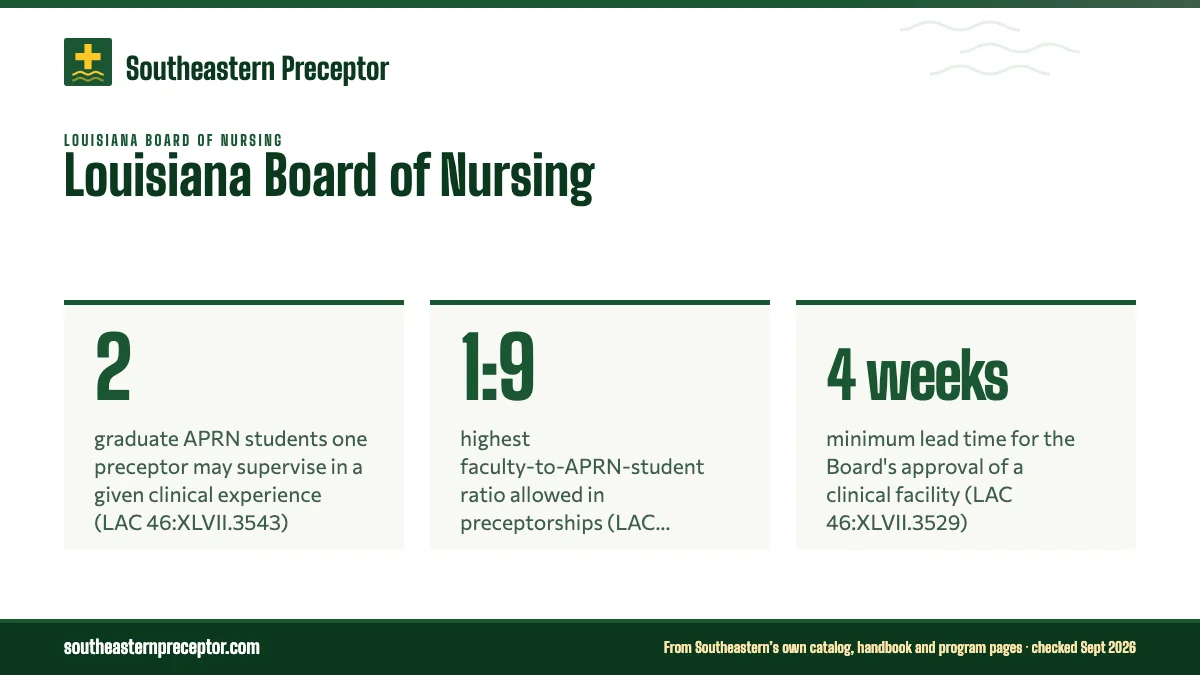
| Caseload | One preceptor supervises no more than two graduate APRN students in a given clinical experience | 3543.F.2 |
| Selection | Preceptors are picked using written criteria drawn up jointly by faculty and the facility's nursing administration, following Board guidelines | 3543.B |
The population focus rule shapes most searches. It says a majority, meaning more than half of your time, and sets no exact percentage; Southeastern's course faculty decide how the remainder may be shared with other clinicians. For an FNP student in NURS 6820, that points most hours toward an APRN whose certification fits the course's population. A pediatrician can support that course but should not carry the bulk of it, and course faculty settle any gray areas. The practical checklist is in preceptor requirements.
Rules about faculty oversight
The Board keeps nursing faculty in charge. Faculty hold responsibility for selecting and guiding every learning experience and for evaluating your performance, drawing on preceptor input (3543.A). They must be reachable by preceptors during any preceptorship (3543.C), check in with each preceptor and each student every week at a minimum (3543.D), and remain responsible for every APRN student in the clinical area whether supervision is direct or indirect (3543.E). A graduate program may assign no more than nine APRN students to one faculty member in preceptorships (3543.F).
At Southeastern this oversight shows up in the consortium's process: course faculty approve your preceptor and the letter of agreement, the graduate coordinator reviews, faculty visit the site, and your grade comes from faculty with the preceptor's evaluation as input. The rules address approval and supervision and say nothing about who locates a preceptor; at Southeastern you choose one in collaboration with course faculty, as preceptor approval describes.
Rules about programs and clinical facilities
Several rules work at the program level, out of your view, yet they can move your start date.
- Hospitals used for clinical experiences must hold a Louisiana license (3529.A).
- The program obtains the Board's approval of a clinical facility, using the Board's clinical facility survey form, at least four weeks before students use that agency (3529.B).
- The program and the agency sign a written agreement that sets out what each party is responsible for, liability insurance included, and how either side can end it (3529.D).
- Programs based in other states must meet Louisiana's standards and file for approval at least six months before offering clinical experiences here (3539.B). Both Ochsner systems, on their own student pages, also want a program's Board approval before hosting its graduate nursing students.
For you, the four-week facility window sits inside a longer contract timeline, since the consortium handbook cautions that securing a brand-new agency contract may stretch from weeks into months. Facility contracts explains how to start that clock early.
The Board and your APRN license after graduation
When you finish, the Board becomes your licensing agency again. Its APRN licensure rule (4507) calls for completion of a graduate or post-graduate program that prepares you for the role and current national certification in the matching role and population, and a gap of more than two years between finishing and applying triggers additional review. From the school's side, Southeastern's DNP page states that certification is a prerequisite for APRN licensure in Louisiana.
Prescriptive authority is a further step with its own rule (4513), including the collaborative practice agreement, covered in Louisiana NP practice. Application steps and forms change more often than the rules, so take them from the Board's own site when you apply.
How we build every match around the Board's rules
Your placement advisor checks each proposed preceptor against these rules before anything reaches Southeastern: an active, unencumbered Louisiana license, APRN certification in your population, and a schedule that keeps most of your hours with that APRN. We ask how many graduate APRN students the preceptor already has in the same experience, confirm the site is in Louisiana, and flag facilities that may need a new agreement so the contract and the Board's four-week approval window have room to run.
That way the faculty conversation is about fit and schedule, not about whether the preceptor qualifies. Start a request with your course and region, and we match within the rules from the first call.
Questions Southeastern students ask
Does my preceptor have to be in the room for every patient?
The Board's definition of guidance asks for a licensed APRN, physician, dentist or Board-approved person who is accessible, and it does not demand physical presence at every moment. What your faculty, the clinical site and your signed agreement specify for each course is the supervision you actually follow.
Can a physician assistant precept me in Louisiana?
The Board's definition of a graduate preceptor names APRNs, physicians and dentists, and physician assistants are not on that list. The rules do allow a mix of clinicians for part of your experience, so a PA might contribute some teaching. Ask your course faculty before you count any hours spent with a PA.
Is there a limit on how many students a Louisiana preceptor supervises?
Yes. Section 3543.F.2 caps a preceptor at two graduate APRN students during any one clinical experience, and faculty carry their own cap of nine APRN students each in preceptorships. If a preceptor already teaches students from other schools, ask how their schedule handles that limit before you commit to the site.
Does the Board approve my individual preceptor?
Not directly. The Board sets guidelines, and preceptors are chosen by written criteria that faculty and the facility's nursing leaders develop together. At Southeastern, course faculty sign off on each preceptor, with a review by the graduate coordinator. The Board's direct approvals are of programs and clinical facilities.
Where can I read the Board's rules myself?
They are in Title 46, Part XLVII of the Louisiana Administrative Code. The sections that matter most for NP students are 3503 (definitions), 3517 (student eligibility), 3529 (facilities), 3543 (preceptorships), 4505 (guidance), 4507 (APRN licensure) and 4513 (prescribing). Cornell's Legal Information Institute hosts a readable copy.
Related pages
Last checked 2026-09-27
We check these pages against Southeastern's own catalog, program pages and consortium handbook, and Louisiana rules. Your course faculty, the graduate coordinator and your advisor have the final word.
- Louisiana Administrative Code 46:XLVII.3543, preceptorships (Cornell LII)
- Louisiana Administrative Code 46:XLVII.3529, clinical facilities (Cornell LII)
- Louisiana Administrative Code 46:XLVII.4507, APRN licensure (Cornell LII)
- Louisiana Administrative Code 46:XLVII.4505, definitions (Cornell LII)
- Southeastern: NP to PMHNP post-master's certificate
Southeastern asks you to choose your preceptor. We find one near you.
Tell us your Southeastern track, where in Louisiana you live and when your next clinical course starts. We find Louisiana-licensed preceptors who fit the course, confirm whether the facility is already under contract with the university, and hand you what your course faculty need to approve it before the semester.
- Pediatric and women's health preceptors for
NURS 6820, adult and older-adult primary care forNURS 6830andNURS 6840 - Psychiatric preceptors for
NURS 6910toNURS 6930, with the child and older-adult focus each course sets - Across Louisiana, from the Northshore to Shreveport
Start your placement plan
Program, city and start date is all we need to begin.