Your Louisiana RN license and a year in the specialty: Southeastern's two gates before clinicals
Southeastern Louisiana University asks graduate nursing students for a valid, unencumbered Louisiana RN license and, before the first clinical or practicum course, twelve months of RN work in a setting that suits the specialty. Two DNP documents accept a U.S. license where the catalog asks for Louisiana, and the graduate pages say nothing about the Nurse Licensure Compact, so settle both questions with the Graduate Nursing Office before you rely on them.
Get your placement plan
Tell us your Southeastern program and where you live. A placement advisor replies with preceptor and site options in your community that fit your Southeastern course.
The license wording, program by program
Every Southeastern graduate program names a license at admission, and all but two documents name Louisiana. The table leads with the 2026-27 catalog and adds Southeastern's program pages where they differ.
| Program | License asked for | Where it says so |
|---|---|---|
| MSN: FNP, PMHNP, Nursing Education | Valid, unencumbered Louisiana RN license | Catalog and MSN admission page |
| Post-master's FNP certificate | Louisiana RN license | Catalog |
| Post-master's PMHNP certificate | Louisiana RN license, plus an APRN license for nurse practitioners | Certificate page and post-master's admission page |
| BSN to DNP, FNP and PMHNP | Louisiana RN license | Catalog and DNP admission page |
| BSN to DNP, Nurse Executive Leadership | U.S. RN license | Catalog |
| Post-master's DNP | Louisiana RN license, plus an APRN license if applicable | Catalog |
| Post-master's DNP | Current, unencumbered U.S. nursing license | DNP admission page |
| RN to BSN, for contrast | RN license through the Louisiana State Board of Nursing or the Nurse Licensure Compact | RN to BSN page |
For the MSN and both certificates the answer is simple: a Louisiana RN license, held from admission through graduation. The DNP rows are where Southeastern's documents part ways, covered further down.
Keeping the license clean while you are enrolled
Holding the license at admission is only the start. The consortium handbook requires MSN students to keep an unencumbered Louisiana RN license for the entire program and to report any change in license status to the graduate coordinator right away. Failing to report an encumbrance or a disciplinary proceeding is grounds for immediate dismissal. The 2018-19 DNP handbook asked for proof of current RN and APRN licenses at admission and again every year.
The Louisiana State Board of Nursing runs a check of its own: a record serious enough to affect licensure can also affect whether you may start a clinical course. The Board's rules walks through how that eligibility rule and the Board's authority over students work.
A useful habit: check your own record on the Board's online license verification, which Southeastern's DNP admission page links, before each clinical semester, and renew well ahead of any expiration that falls inside a course.
One year of RN practice in the specialty, before clinicals
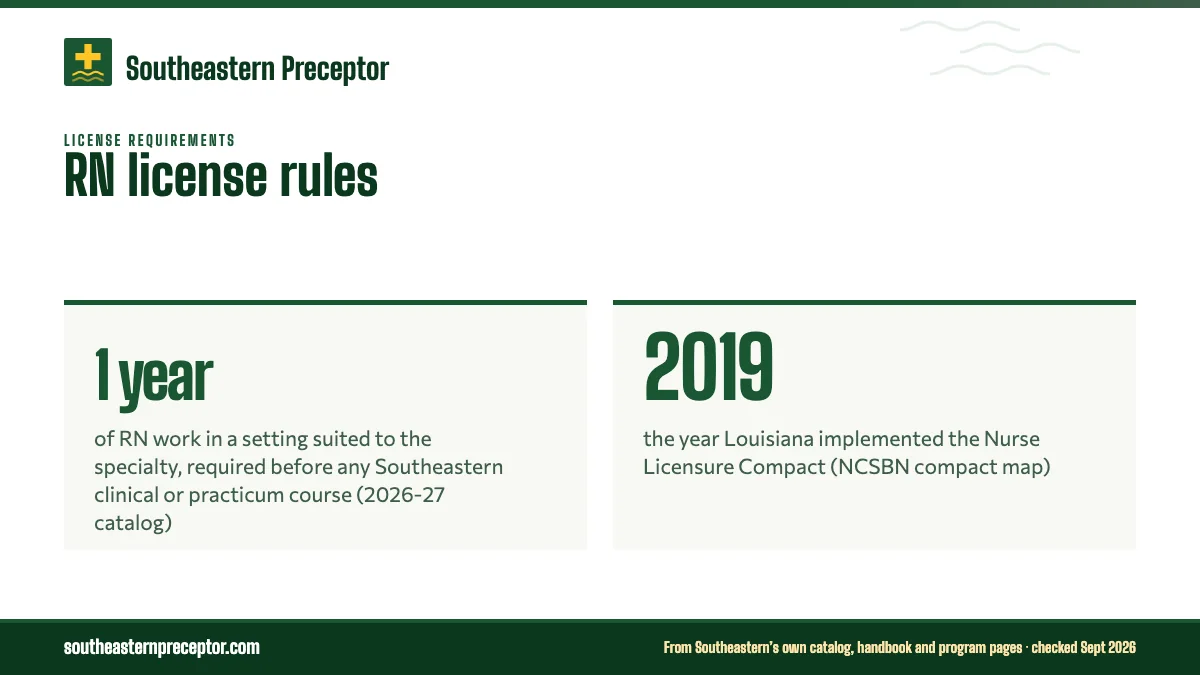
Each Southeastern graduate catalog entry carries the same condition: before any clinical or practicum course begins, you need documented proof of a full year working as an RN somewhere that suits your specialty concentration. The gate sits on the clinical course rather than on admission, so a newer nurse can take the early theory courses while finishing that year.
Timing is the part to plan. In the MSN FNP plan the first clinical course, NURS 6820 Family Health I, arrives in the third semester. The MSN PMHNP sequence opens with NURS 6900, which carries 60 observation hours, before the 200-hour NURS 6910; ask whether your year must be complete before the observation course or only before NURS 6910. Our reading of the rule: have the year finished and documented by the time you register for your first clinical course.
Southeastern does not define on any public page which RN roles count as appropriate to FNP or PMHNP study. If your experience comes from a setting that does not line up neatly with your concentration, ask the graduate coordinator in writing before you register.
The DNP license conflict
Southeastern's DNP documents disagree with each other. The catalog wants Louisiana RN licensure for two BSN to DNP concentrations, FNP and PMHNP, and for the post-master's DNP. The Nurse Executive Leadership catalog entry accepts a U.S. RN license, and the DNP admission page asks post-master's applicants for a current U.S. nursing license.
Three facts point toward Louisiana for any DNP student headed into NP clinical courses. The FNP and PMHNP clinical courses inside the BSN to DNP are the same consortium courses the MSN's all-in-Louisiana rule covers. State rules tie every preceptor to Louisiana licensure. And no DNP page says residency hours may happen in another state. Louisiana-only clinicals covers the rule and its limits; for a residency outside the NP courses, ask the Graduate Nursing Office and keep its reply on file.
The Nurse Licensure Compact and what it leaves open
Louisiana belongs to the Nurse Licensure Compact for RN licenses, with implementation on July 1, 2019 according to NCSBN's compact map. Southeastern's RN to BSN page accepts either a Louisiana-issued license or one held under the compact. The graduate catalog entries ask for a Louisiana RN license and never mention the compact, and no public page says whether a multistate license issued by another compact state meets that wording. If that describes you, ask the graduate coordinator before you apply.
Some Louisiana hospitals give their own answer. The two Ochsner systems, on their graduate student pages, accept an active RN license for the state where the clinical happens or a compact license.
Advanced practice licenses sit outside that compact. Louisiana has not enacted the separate APRN Compact, which only Delaware, North Dakota, South Dakota, Utah and Wyoming have adopted and which needs seven states to take effect; NCSBN said in May 2026 that it is working with boards to redesign it. After certification, the Louisiana State Board of Nursing issues your NP license, as certification exams explains.
Moving mid-program carries its own risk. Southeastern's licensure disclosure page warns that relocating to another state can affect whether you stay in the program, meet licensure requirements or keep financial aid, and asks you to contact the program first. See state authorization.
What your preceptor's license has to show
License rules run both ways. Louisiana's rule requires each preceptor to be licensed in Louisiana, as an RN, an APRN or both, with no encumbrance, and the bulk of your hours has to be spent with an APRN who holds certification in your own population focus. The consortium's own list asks for current licensure in the preceptor's discipline, the right APRN certification, graduate education at the master's or doctoral level in a related field, and a year or more in clinical practice, which its faculty handbook calls preferred.
Psychiatric settings add one more: a behavioral health clinician who precepts has to hold an independent license rather than practice under someone's supervision.
Preceptor requirements has the complete checklist. Before a preceptor's name reaches your course faculty, your placement advisor checks the Louisiana license on the Board's verification, confirms certification in the matching population and notes the years in practice, so the approval conversation starts with the facts in hand. Share your program, license status and next clinical course on the request form and we plan the search around your timeline.
Questions Southeastern students ask
Can I apply to Southeastern's MSN with a nursing license from another state?
The MSN asks for a valid, unencumbered Louisiana RN license at admission. If you hold a multistate license from another compact state, Southeastern's graduate pages do not say whether it satisfies that wording, even though the RN to BSN page accepts compact licenses. Ask the graduate coordinator before you apply, and plan on Louisiana clinical hours either way.
Does the year of RN experience have to be finished before admission?
The catalog ties it to your first clinical or practicum course, not to admission. You need evidence of a year of RN practice in an area suited to your concentration before that course begins. In the MSN FNP plan the first clinical course falls in the third semester, so time your application with that in mind.
What if my license receives a board action while I am enrolled?
Report it right away. The consortium handbook requires students to tell the graduate coordinator about any change in license status immediately, and it treats a failure to report encumbrances or disciplinary proceedings as grounds for immediate dismissal. The Board can also restrict or delay a student's clinical phase, so early, open contact is the safer course.
Do I need an APRN license for the post-master's PMHNP certificate?
Yes, if you are already a nurse practitioner, which this NP to PMHNP certificate assumes. Southeastern's post-master's admission page asks for current, unencumbered Louisiana licensure: an RN license plus an APRN license for nurse practitioners. The certificate's practicum experiences must also be completed in Louisiana.
Is there a multistate APRN license I could use in Louisiana?
Not at present. Louisiana has not enacted the APRN Compact, only five states have, and it needs seven before it operates. NCSBN said in 2026 that it is redesigning the compact. Nurse practitioner licensure in Louisiana runs through the state Board of Nursing, so a Louisiana APRN license is the route.
Related pages
Last checked 2026-09-27
We check these pages against Southeastern's own catalog, program pages and consortium handbook, and Louisiana rules. Your course faculty, the graduate coordinator and your advisor have the final word.
Southeastern asks you to choose your preceptor. We find one near you.
Tell us your Southeastern track, where in Louisiana you live and when your next clinical course starts. We find Louisiana-licensed preceptors who fit the course, confirm whether the facility is already under contract with the university, and hand you what your course faculty need to approve it before the semester.
- Pediatric and women's health preceptors for
NURS 6820, adult and older-adult primary care forNURS 6830andNURS 6840 - Psychiatric preceptors for
NURS 6910toNURS 6930, with the child and older-adult focus each course sets - Across Louisiana, from the Northshore to Shreveport
Start your placement plan
Program, city and start date is all we need to begin.