NURS 6820 Family Health I: 200 hours with children and child-bearing women
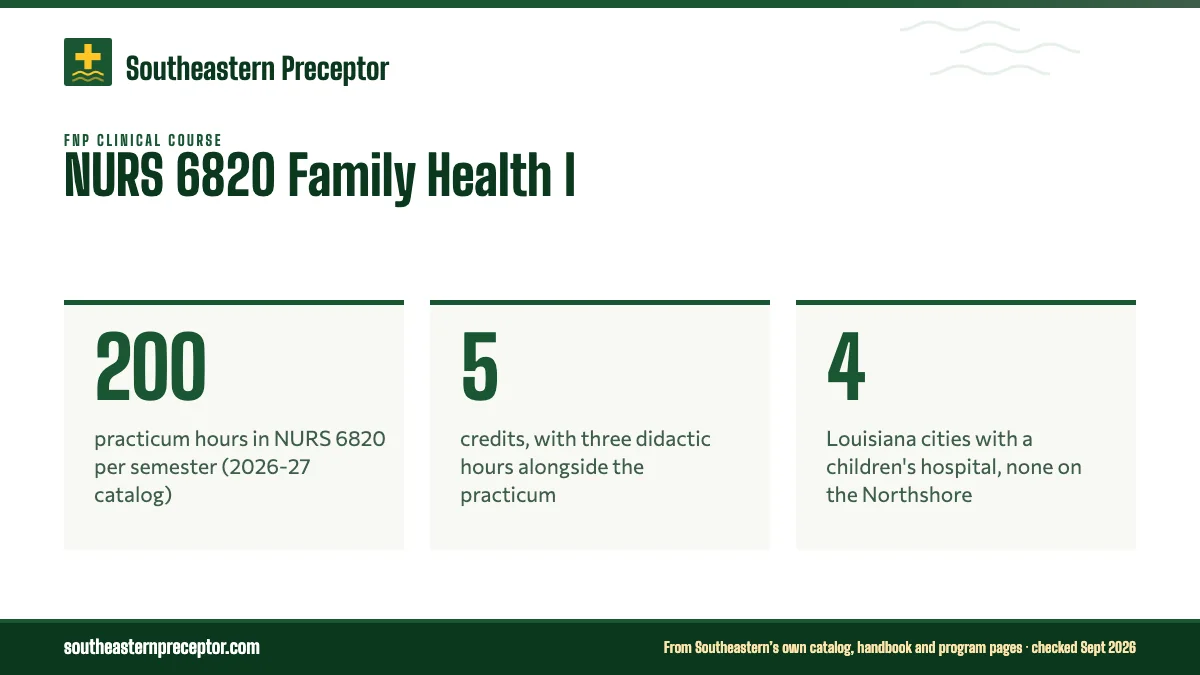
NURS 6820 Advanced Practice Nursing: Family Health I opens the clinical sequence in Southeastern Louisiana University's FNP track: five credits that pair didactic work with a 200-hour practicum focused on children and child-bearing women. It is also the hardest of the three FNP courses to place, because Louisiana's children's and women's hospitals cluster in four cities, none of them on the Northshore.
Get your placement plan
Tell us your Southeastern program and where you live. A placement advisor replies with preceptor and site options in your community that fit your Southeastern course.
What the catalog says about NURS 6820
The 2026-27 catalog lists NURS 6820 Advanced Practice Nursing: Family Health I at five credits: three didactic hours, plus 200 hours of practicum each semester. Its description sets the clinical focus in a single sentence: "Clinical experiences will focus on the care of individuals and families in the pediatrics and child-bearing women populations."
The course carries a laboratory fee, and the catalog does not say which terms it runs. It is the gate to the rest of the FNP sequence: NURS 6830 lists it as the prerequisite, and so does NURS 6810, the business, leadership and health policy course, for FNP students. FNP 750 hours shows how Family Health I fits with the two 275-hour courses that follow.
Prerequisites and when you reach it
Before Family Health I, the catalog requires a theory course (NURS 6000, or NURS 8000 or NURS 8300 for doctoral students) plus NURS 6020, NURS 6050, NURS 6070, NURS 6170 and NURS 6180: evidence, statistics, advanced health assessment, pharmacology and pathophysiology. Southeastern also expects a year of RN experience in a clinical area that fits the specialty before any clinical course, current CPR, a drug test and an unencumbered Louisiana RN license.
Where Family Health I falls
- MSN FNP: semester 3 of the catalog plan, alongside
NURS 6090Population Based Primary Care. - BSN to DNP, FNP concentration: semester 4, a summer term, with no other course beside it.
- Post-master's FNP certificate: the first semester, once the graduate coordinator has reviewed your earlier advanced assessment, pharmacology and pathophysiology coursework.
The doctoral placement deserves a second look. Southeastern's summer 2026 semester ran about eight weeks of classes, so 200 hours in a summer term works out to roughly 25 a week by our arithmetic, against about 13 in a fall term.
Two populations in one course
Family Health I asks for experience with children and with women in their child-bearing years, and the catalog says neither how the 200 hours divide between the two nor which settings count. You settle that split with your course faculty when you plan the semester, and it shapes the search. One practice that sees both populations keeps the paperwork to a single contract and letter of agreement; a pediatric preceptor plus a women's health preceptor doubles it.
Under the Louisiana State Board of Nursing's rules, the bulk of NP clinical time belongs with an APRN whose certification covers the same population, other clinicians may fill in the remainder, and every preceptor must hold an active Louisiana license. Louisiana counts physicians among graduate preceptors, and Southeastern's graduate page names physician preceptors alongside advanced practice nurses, so a pediatrician or an obstetrician can carry part of the teaching. Preceptor requirements covers the rest.
Where pediatric and women's health preceptors are in Louisiana
Specialty care for children and women is concentrated. Louisiana's children's hospitals are in New Orleans, Baton Rouge, Lafayette and Shreveport, and its dedicated women's hospitals sit in the same four cities. Few of them publish any route in for NP students.
| City | Hospitals | Published NP-student route |
|---|---|---|
| New Orleans, about 57 miles | Manning Family Children's (LCMC Health); Ochsner Children's; Ochsner Baptist Women's Pavilion | LCMC, per an archived copy: a school affiliation agreement first, and no preceptor matching. Ochsner: requests come only from schools through InPlace, and students are asked not to contact providers |
| Baton Rouge, about 44 miles | Our Lady of the Lake Children's Hospital; Woman's Hospital | None published |
| Lafayette, about 103 miles | Our Lady of Lourdes Women's & Children's | None published |
| Shreveport, about 290 miles | Willis Knighton South & the Center for Women's Health | None published |
| Hammond | North Oaks Medical Center | An online request form; per an archived copy, no pediatric rotations at this time |
Outside the hospitals, pediatric hours on the Northshore more often come from community settings. HRSA lists 91 health center sites in the region, and RKM Primary Care alone runs 60 across Livingston and Tangipahoa, 56 of them school-based. School-based clinics mostly follow the school year, which matters if your Family Health I falls in summer. Northshore Louisiana maps the region.
Start the Family Health I search earliest
Every clinical site needs a contract or letter of agreement between the facility and the university, and the consortium handbook cautions that securing a new one may run from several weeks to months. Family Health I stretches that further: fewer sites fit, two preceptors may mean two sets of paperwork, and some large systems take requests only from schools on fixed dates. Ochsner's clinical education page, for example, wants graduate nursing requests from schools by fixed dates (fall by June 15, spring by November 15, summer by March 15) and allows at least four months for a new school agreement.
Plan backward from those dates. If Family Health I falls in spring, a preceptor chosen in early fall leaves room for faculty approval and a contract; one chosen in December may not. Clinical contracts explains the university side of that timeline.
How we find your NURS 6820 preceptor
Your placement advisor starts with where you live and the semester Family Health I opens, then looks for Louisiana-licensed APRNs and physicians whose patients include children and child-bearing women: pediatric practices, family practices with a young patient mix, women's health clinics and community health centers. We check whether each facility already holds a contract with the university, collect the preceptor's current CV and what the letter of agreement needs, and bring it all to you in time for the faculty conversation.
When one practice cannot cover both populations, we pair two preceptors and keep both sets of paperwork on track. No preceptor yet helps if the semester is already close, and the form below is where your search begins.
Questions Southeastern students ask
Can I do NURS 6820 hours on a hospital pediatric unit?
The catalog describes Family Health I by population, children and child-bearing women, and names no setting. Whether an inpatient unit fits the course objectives is your course faculty's decision when you plan the semester, and Louisiana expects the larger share of hours under a population-matched APRN. Ask before you commit to any site.
Can a pediatrician or OB-GYN precept Family Health I?
Louisiana's rules count physicians as graduate preceptors, and Southeastern's graduate nursing page names physician preceptors alongside advanced practice nurses. The same rules reserve most NP clinical time for APRNs in the matching population, so plan on a physician covering part of the 200 hours rather than all of them unless your course faculty say otherwise.
Is NURS 6820 offered in the summer?
The catalog course description lists no offered terms. The plans show where it lands: semester 3 of the MSN FNP, whose season depends on when you started, and the summer of semester 4 in the BSN to DNP FNP plan. Your program plan and advisor give the actual term.
Can one family practice cover both pediatrics and women's health?
Possibly. The catalog asks for experience with both populations but does not require two sites or set the split. A family practice with enough children and pregnant patients may satisfy your course faculty, and it saves a second contract and letter of agreement. Ask faculty how they want the 200 hours divided before you choose.
What if I have no pediatric preceptor as the semester nears?
Southeastern publishes no written policy for a missing preceptor, so tell your course faculty early; the consortium says it can suggest names from the preceptors it has worked with across south Louisiana. Hours begin only once the file is complete, and a late start squeezes 200 hours into fewer weeks.
Related pages
Last checked 2026-09-27
We check these pages against Southeastern's own catalog, program pages and consortium handbook, and Louisiana rules. Your course faculty, the graduate coordinator and your advisor have the final word.
- Southeastern 2026-27 catalog: NURS 6820 Advanced Practice Nursing: Family Health I
- Southeastern 2026-27 catalog: MSN, Family Nurse Practitioner concentration
- Louisiana Administrative Code 46:XLVII.3543, preceptorships (Cornell LII)
- Ochsner Health: clinical education, graduate nursing requests
- North Oaks Health System: student clinical request
Southeastern asks you to choose your preceptor. We find one near you.
Tell us your Southeastern track, where in Louisiana you live and when your next clinical course starts. We find Louisiana-licensed preceptors who fit the course, confirm whether the facility is already under contract with the university, and hand you what your course faculty need to approve it before the semester.
- Pediatric and women's health preceptors for
NURS 6820, adult and older-adult primary care forNURS 6830andNURS 6840 - Psychiatric preceptors for
NURS 6910toNURS 6930, with the child and older-adult focus each course sets - Across Louisiana, from the Northshore to Shreveport
Start your placement plan
Program, city and start date is all we need to begin.