Southeastern's BSN to DNP, PMHNP concentration: psychiatric clinicals and the residency
The Psychiatric/Mental Health Nurse Practitioner concentration of Southeastern Louisiana University's BSN to DNP is 76 credits in a nine-semester catalog plan. It starts precepted work with 60 hours of psychotherapy observation, then three psychiatric clinical courses worth 750 hours, and ends with a residency that overlaps the last of them. You propose each preceptor and course faculty approve; we find Louisiana psychiatric preceptors who fit each course and prepare everything that approval needs.
Line up your psychiatric preceptors
Share your start term and parish, and your placement advisor will plan a search for each PMHNP course and the residency.
What the PMHNP concentration asks of you
Southeastern runs its doctorate jointly with UL Lafayette, and the 2026-27 catalog lists the psychiatric concentration at 76 credit hours, the largest of the three BSN to DNP options. Courses are taught in distance formats. Two campus visits remain: orientation ahead of your first term and the project defense near graduation.
Entry is possible in any term according to the catalog; the DNP admissions page sets April 15, July 15 and November 15 as the cutoffs for summer, fall and spring. You need an unencumbered Louisiana RN license, at least a 2.7 GPA across your undergraduate work and a phone interview with the DNP program coordinator. Because the catalog wants twelve months of RN work in a field that fits the specialty before any clinical course, psychiatric or behavioral health nursing time is worth building now.
Southeastern's majors page for this concentration lists 39 semester hours. The catalog's 76 is the number its course list supports.
The catalog's nine-semester plan
Psychopharmacology arrives early, in the second semester, and precepted time begins in the fourth. From there, something precepted is on your calendar every term until you graduate.
| Semester | Courses | Precepted hours |
|---|---|---|
| 1, summer | NURS 6050, NURS 6170 | None |
| 2, fall | NURS 8010, NURS 8300, NURS 6080 | None |
| 3, spring | NURS 6070, NURS 6180, NURS 6020 | Weekly lab in NURS 6070 |
| 4, summer | NURS 6900 Psychotherapy | 60 observation |
| 5, fall | NURS 6910 Psychiatric/Mental Health I, NURS 8040, NURS 8310 | 200 |
| 6, spring | NURS 6920 Psychiatric/Mental Health II, NURS 6810, NURS 8030 | 275, plus 90 in NURS 8030 |
| 7, summer | NURS 8210 Residency I, NURS 8080 | 90 |
| 8, fall | NURS 6930 Psychiatric/Mental Health III, NURS 8220 Residency II, NURS 8070 | 275 and 180 |
| 9, spring | NURS 8230 Residency III, NURS 8060 | 180 |
The catalog prints totals of 750 clinical hours and 540 residency hours for this concentration, and notes that you may graduate with an MSN along the way. How the residency courses add up, and why the course descriptions give 450 rather than 540, is covered in DNP residency hours.
Observation first, then three psychiatric courses
NURS 6900 Psychotherapy for Advanced Practice Psychiatric Nursing carries 60 practicum hours of observation. Those hours sit outside the catalog's 750, so by our count you will spend 810 precepted hours in psychiatric settings before the residency is added.
NURS 6910 Psychiatric/Mental Health I (200 hours) introduces initial diagnostic assessment and basic individual and family psychotherapy for common disorders. NURS 6920 Psychiatric/Mental Health II (275 hours) takes on common and complex disorders at every age, weighted toward children and teenagers. NURS 6930 Psychiatric/Mental Health III (275 hours) keeps the lifespan view but emphasizes older adults.
Each emphasis points to a different kind of site: for example, an outpatient or community mental health practice for the first course, a setting that sees young patients for the second, and one with a steady older adult caseload for the third. The course guides for Psychiatric/Mental Health II and the PMHNP's 750 hours go deeper.
Settle the course terms before you recruit
Southeastern's documents disagree on when the psychiatric courses run. The BSN to DNP plan, the MSN plan for the same courses and the catalog course descriptions each give a different pattern:
| Course | BSN to DNP plan | MSN plan | Course description |
|---|---|---|---|
NURS 6900 | Summer | Fall only | Fall, spring |
NURS 6910 | Fall | Spring only | Not stated |
NURS 6920 | Spring | Fall only | Not stated |
NURS 6930 | Fall | Spring only | Not stated |
A preceptor agrees to specific months, so the term matters before anyone is asked. Confirm the semester for each psychiatric course with your advisor or the DNP program coordinator as soon as you are admitted, and again before each search begins. Your registration in Workday is the final word for any given term.
Once the terms are fixed, work backward: allow time for course faculty approval, the graduate coordinator's review and, if the site is new to Southeastern, a facility contract that the consortium handbook warns can take weeks to months.
Semester eight carries 455 precepted hours
In the eighth semester, Psychiatric/Mental Health III (275 clinical hours) runs alongside Residency II (180 residency hours). Our arithmetic: that is 455 precepted hours in one fall. Fall 2026 ran from August 19 to December 11, about 16 weeks, which works out to roughly 28 hours a week for a student who also works as a nurse.
Two searches have to finish before that fall. Your psychiatric site must be approved for the older adult emphasis, and your residency site and mentor must already be in place from Residency I, where the course expects you to secure IRB approval. Under Southeastern's 2018-19 DNP handbook, which has not been replaced online, the project mentor is someone you recruit from beyond the university, with your faculty's input.
If your DNP project fits a psychiatric setting, ask faculty early whether one organization can host both the clinical and the project work. Southeastern publishes no rule either way, and the answer shapes both searches.
Who can precept psychiatric hours in Louisiana
Louisiana's nursing board requires every preceptor to hold an active Louisiana RN or APRN license and wants most graduate clinical experience under an APRN certified in the student's population focus. For you that means a psychiatric mental health nurse practitioner for most hours, with a psychiatrist able to cover part. The consortium's faculty handbook adds a mental health twist: a behavioral health clinician serving as preceptor has to hold an independent license, not one that requires supervision. Preceptor requirements has the full list.
Need is high close to campus. Federal shortage data list mental health shortage designations covering Tangipahoa, Livingston, Washington and St. Helena parishes, and several private behavioral hospitals operate on the Northshore, though none of them publishes a PMHNP student process. The Northshore guide maps the options.
Two rules travel with every placement: clinical time at your employer counts only when it is unpaid and separate from your job, and Southeastern's MSN page, whose psychiatric courses you share, keeps every clinical hour inside Louisiana. Louisiana-only clinicals explains how that reaches DNP students.
How we support Southeastern PMHNP doctoral students
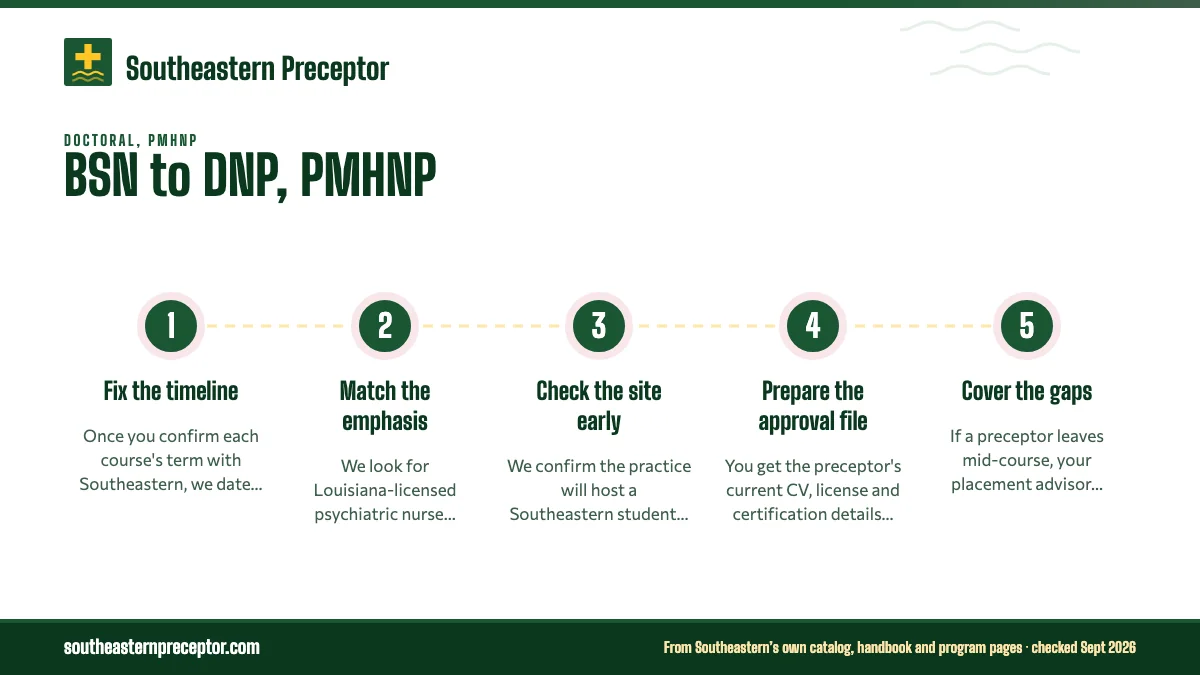
- Fix the timelineOnce you confirm each course's term with Southeastern, we date every search to begin a semester ahead, with extra lead time for the heavy eighth semester.
- Match the emphasisWe look for Louisiana-licensed psychiatric nurse practitioners, or psychiatrists for part of the hours, whose caseload fits the course: observation, then general adult work, then young patients, then older adults.
- Check the site earlyWe confirm the practice will host a Southeastern student and ask whether it already has an agreement with the university, so a new contract can start in time.
- Prepare the approval fileYou get the preceptor's current CV, license and certification details and the scheduling facts your course faculty and the letter of agreement ask for.
- Cover the gapsIf a preceptor leaves mid-course, your placement advisor begins the replacement search right away and keeps your faculty informed through you.
Ready to plan? Use the request form to tell us when you were admitted; the psychotherapy observation is the first search we open.
Questions Southeastern students ask
Why is Southeastern's BSN to DNP PMHNP 76 credits when the FNP is 70?
Our comparison of the two catalog plans: the psychiatric concentration adds NURS 6080 Diagnostic Considerations and Psychopharmacology for Psychiatric Disorders and NURS 6900 Psychotherapy, three credits each. The three psychiatric clinical courses carry the same five credits apiece as the three Family Health courses, and the DNP core and residency courses are shared.
Do the psychotherapy observation hours count toward the 750?
No. The catalog's 750 comes from the three clinical courses, 200 plus 275 plus 275. The 60 observation hours in NURS 6900 are listed separately, so you should plan on 810 precepted psychiatric hours in total by our arithmetic. Log every hour the way your course faculty direct.
Can I stop Southeastern's BSN to DNP PMHNP with an MSN?
An MSN exit exists for both NP concentrations once you have met the master's requirements, and the catalog's PMHNP plan flags it. Raise it with the graduate coordinator before you change anything, because it changes the courses you have left.
Should I wear a lab coat at a psychiatric clinical site?
Not always. The consortium student handbook normally expects a white lab coat but exempts settings where one would be out of place, and psychiatric mental health units are its first example. Name tags are required during any consortium lab or practicum experience, so wear yours whatever the dress code.
Are Southeastern's DNP classes online?
The catalog says every course in the DNP programs is delivered in distance accessible formats. What happens in person: a campus orientation before term one, the project defense in your last term, and the precepted hours at your clinical and residency sites.
Related pages
Last checked 2026-09-27
We check these pages against Southeastern's own catalog, program pages and consortium handbook, and Louisiana rules. Your course faculty, the graduate coordinator and your advisor have the final word.
Southeastern asks you to choose your preceptor. We find one near you.
Tell us your Southeastern track, where in Louisiana you live and when your next clinical course starts. We find Louisiana-licensed preceptors who fit the course, confirm whether the facility is already under contract with the university, and hand you what your course faculty need to approve it before the semester.
- Pediatric and women's health preceptors for
NURS 6820, adult and older-adult primary care forNURS 6830andNURS 6840 - Psychiatric preceptors for
NURS 6910toNURS 6930, with the child and older-adult focus each course sets - Across Louisiana, from the Northshore to Shreveport
Start your placement plan
Program, city and start date is all we need to begin.