Southeastern BSN clinicals: the tracks, the clinical labs and who arranges your sites
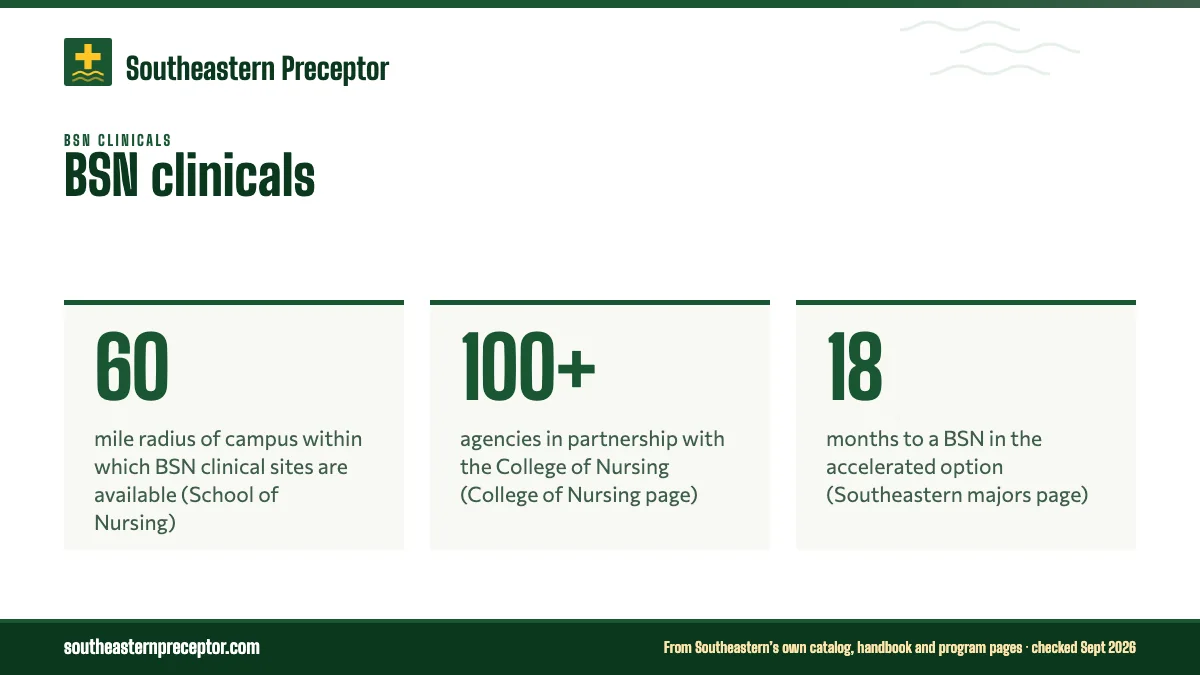
Southeastern Louisiana University arranges clinical sites for its pre-licensure BSN students, within about 60 miles of campus, through partnerships with more than 100 agencies. That holds for the traditional track, the accelerated option in Baton Rouge or on the Northshore, and LPN to BSN. Your job is to get there and learn; this guide explains the clinical lab sequence and what you can start now if you plan to become a nurse practitioner later.
Thinking about an NP program after your BSN?
Tell us your expected graduation and the NP track you are considering, and your placement advisor will outline the graduate clinical timeline.
Southeastern's BSN tracks
Southeastern's BSN is a 120-credit, on-campus program with several entry points. The traditional track is the generic baccalaureate route for students starting nursing from the beginning. The accelerated option serves students who already hold a bachelor's in another field and runs about 18 months, with a Baton Rouge version and a Northshore version based at the St. Tammany Academic Center in Covington. LPN to BSN serves licensed practical nurses (the School of Nursing's home page calls this route LPN to RN). The online RN to BSN is the fourth path, for nurses already licensed as RNs.
Applications for the nursing sequence close on September 1 for a spring entry and on February 1 for a summer start in the accelerated option or a fall start in the traditional track, according to the School of Nursing's about page.
Location shifts as you progress. The School of Nursing says the last three semesters of nursing classes and skills lab are taught at Southeastern's Baton Rouge Center on Essen Lane. The Northshore accelerated page says its classes and clinical experiences all take place on the Northshore.
Southeastern arranges your clinical sites
This is the biggest difference between the BSN and Southeastern's graduate programs. Once you are admitted to the nursing sequence, the School of Nursing states, clinical sites are available within a 60-mile radius of campus, and you are responsible for your own transportation. The College of Nursing reports partnerships with more than 100 agencies to support that range of practice experiences.
Those partnerships are visible in Southeastern's own news. In September 2026 Southeastern reported that North Oaks was hosting eight clinical groups for the College of Nursing that semester, with 18 preceptors and five adjunct faculty. In February 2026 it announced work with Our Lady of the Lake Regional Medical Center to give first-semester students hands-on practice in the Epic electronic record. For the Northshore accelerated cohort, St. Tammany Health System's own pages describe clinical training at St. Tammany Parish Hospital.
Louisiana's nursing board rules leave the selection and guidance of every student learning experience with nursing faculty, which in the BSN means the site is arranged for you rather than found by you. Expect a clean criminal background check through the Louisiana State Board of Nursing and drug testing once you enter nursing coursework.
The clinical lab sequence
Clinical work in the BSN runs through NLAB lab and clinical courses. The 2026-27 catalog lists the following, among others:
| Course | Focus | Credits |
|---|---|---|
NLAB 3730 | Foundations of Nursing Practice Lab | 3 |
NLAB 3820 | Adult and Gerontological Nursing Lab | 6 |
NLAB 4730 | Nursing Care of the Childbearing Family Lab | 3 |
NLAB 4770 | Nursing Care of Infants, Children, and Adolescents Lab | 3 |
NLAB 4880 | Promoting a Healthy Community Lab | 1 |
NLAB 4890 | Advanced Concepts in Nursing Lab | 5 |
By their catalog descriptions, NLAB 4890 runs fifteen hours of laboratory a week and NLAB 4880 runs three. Southeastern also runs computer and skills labs with human patient simulators at the Hammond campus and the Baton Rouge Center, where part of your skills practice happens.
Notice that the lab sequence already mirrors the populations graduate nurse practitioners train in: adults and older adults, childbearing families, and children and adolescents. The settings you see now are a preview of the ones FNP students later search for.
What you can do now for graduate clinicals later
If you might become a family or psychiatric nurse practitioner, the BSN years are a good time to prepare, because graduate clinicals work differently. In Southeastern's MSN and BSN to DNP, you choose each preceptor and site and course faculty approve them, and every MSN clinical hour is completed in Louisiana. A few habits now make that far easier.
- Keep a simple record of the nurse practitioners and physicians you meet in clinical groups, with the setting and population each serves. The consortium notes that most of its graduate students train with local physicians and NPs, often where they are later offered jobs.
- Pay close attention in
NLAB 4730andNLAB 4770. Pediatric and women's health placements are among the hardest for graduate students to find near Hammond; North Oaks' student request page (archived copy) says it offers no pediatric rotations. - Choose your first RN job with the specialty in mind. Before any graduate clinical course, Southeastern expects a year of RN practice in an area that fits the specialty, psychiatric nursing for a PMHNP, for example.
- Protect your GPA. The MSN and BSN to DNP look for at least a 2.7 across all undergraduate work, repeated courses included.
- Keep your Louisiana RN license unencumbered. Graduate NP admission asks for it, and the consortium requires students to report any change in licensure status right away.
The clinical placement process guide shows how a graduate NP student at Southeastern moves from choosing a preceptor to faculty approval.
Where we fit for BSN students
Your BSN clinicals are Southeastern's to arrange, and the School of Nursing does it through a wide network of partner agencies within reach of campus, so during the BSN your energy can go into learning.
We come in later. Southeastern graduate students propose their own preceptors for three clinical courses of 200 to 275 hours each, and that is where we do our work: finding Louisiana preceptors who fit the exact course, checking them against Southeastern's and Louisiana's rules, and preparing what course faculty need to approve them. If you are a BSN student with a graduate program in mind, a short planning conversation can map when your first graduate clinical course would fall. The MSN FNP and MSN PMHNP guides show the clinical sequence, and the request form is open when you are ready.
Questions Southeastern students ask
Can I pick my own clinical site in Southeastern's BSN?
Southeastern publishes no process for BSN students to propose their own sites. The School of Nursing makes clinical sites available within about 60 miles of campus and handles the arrangements. If you have a strong reason to ask about a particular agency, raise it with your clinical faculty, not with the agency.
Is Southeastern's BSN accredited?
Yes. The Commission on Collegiate Nursing Education accredits Southeastern's baccalaureate nursing program through December 31, 2032, with its next on-site review planned for spring 2032. Southeastern's master's, DNP and post-graduate certificate programs hold separate CCNE accreditation that runs through December 31, 2033, which matters if you plan to continue.
Can I get an RN license in another state after Southeastern's BSN?
Southeastern's BSN licensure table lists 47 entries, Louisiana included, where the program meets the state board's educational requirements. It lists no determination yet for California, Maryland, New York, Oregon, Washington and Wyoming. Check the current table and that state's board before you plan a move.
Does the Northshore accelerated BSN lead to a job at St. Tammany Health System?
St. Tammany Health System's pages say graduates of the Southeastern accelerated program it supports receive priority consideration for jobs, along with scholarships and clinical training at St. Tammany Parish Hospital. Priority consideration is not a promise of employment, so apply the way any new graduate would.
Do Southeastern BSN students need a car for clinicals?
In practice, yes. The School of Nursing says clinical sites can be anywhere within a 60-mile radius of campus and that students must provide their own transportation. Carpooling with your clinical group can help, but plan for regular drives across the Northshore and Baton Rouge area.
Related pages
Last checked 2026-09-27
We check these pages against Southeastern's own catalog, program pages and consortium handbook, and Louisiana rules. Your course faculty, the graduate coordinator and your advisor have the final word.
Southeastern asks you to choose your preceptor. We find one near you.
Tell us your Southeastern track, where in Louisiana you live and when your next clinical course starts. We find Louisiana-licensed preceptors who fit the course, confirm whether the facility is already under contract with the university, and hand you what your course faculty need to approve it before the semester.
- Pediatric and women's health preceptors for
NURS 6820, adult and older-adult primary care forNURS 6830andNURS 6840 - Psychiatric preceptors for
NURS 6910toNURS 6930, with the child and older-adult focus each course sets - Across Louisiana, from the Northshore to Shreveport
Start your placement plan
Program, city and start date is all we need to begin.